
Is SEO Worth It? Use This Flowchart to Decide

SEO & Marketing Educator at Ahrefs
69% of marketers actively invest in SEO (source). Why? SEO is worth the investment for so many marketers typically because of these five benefits:
- Targeted and compounding traffic. SEO can attract the right visitors who are likely to become customers. SEO content continues to draw traffic over time, leading to steady growth.
- Connects with buyers at every stage. SEO helps you reach people at different points in their buying process, from just browsing to making a purchase.
- Boosts your visibility, and lowers your competitors’. Improving your search rankings makes it harder for your competitors to be seen. Your success in SEO directly impacts their visibility, giving you a competitive edge.
- Lowers customer acquisition costs. Over time, SEO becomes cheaper than other marketing methods. You don’t pay for each visitor, as you do with ads. This means you get more value from your initial investment as your traffic and sales grow.
- Enhances trust in a brand. SEO boosts trust in brands by signaling credibility and expertise through higher search rankings, making users more likely to choose them over competitors.
And recently, another reason emerged: to gain more visibility in responses generated by AI, such as ChatGPT or Google AI Mode.
But how do you know if SEO is worth the investment for you? Well, if people are searching for what you do or sell OR searching for solutions to problems you help to solve, then SEO will probably be a good investment. And this is true no matter if you’re a small, local business or a global brand.
You can look at this problem as a flowchart:
However, if the answer to all of them is “no,” then you may be better off with a different type of marketing.
Not sure how to answer those questions? Read on to learn more.
Question 1. Are potential customers searching for what you sell or do?
If you run a local business, then the answer to this question is almost certainly “yes”—at least statistically:
In short, if you’re not showing up for relevant local queries, then you’re leaving money on the table. Local SEO helps with this, and we have a full guide on that.
But if you have an e-commerce, SaaS, or small online business, this may not be the case, especially if you’re doing something completely new or really niche.
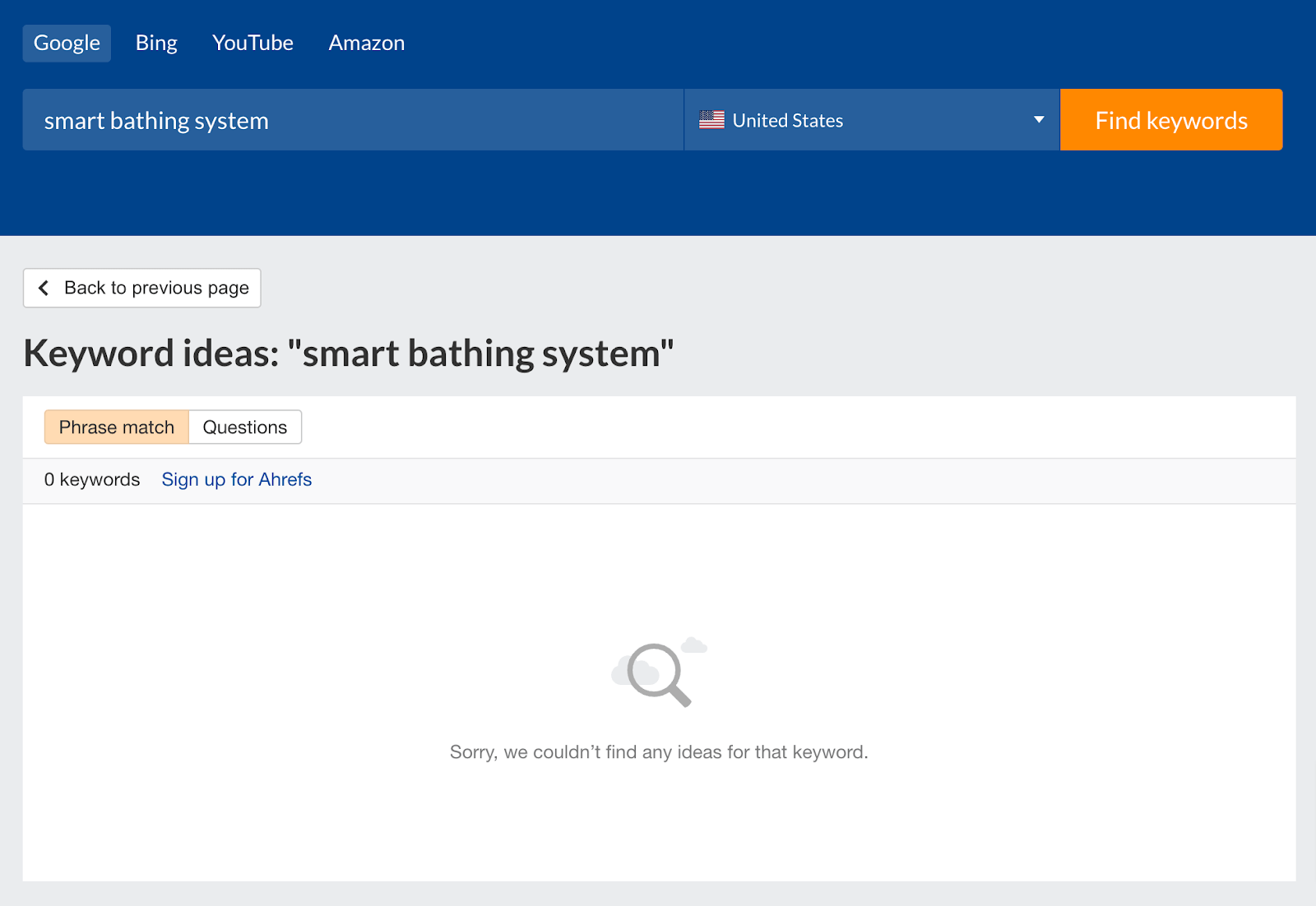
Companies producing smart bathing systems (or smart baths) like Kohler probably need to invest in other types of marketing before people really catch up with their technology. Right now, everyone is just taking a normal bath. Data via Ahrefs’ free keyword generator.
So the first step is to plug what you do or sell into a keyword research tool and see if there’s any search volume.
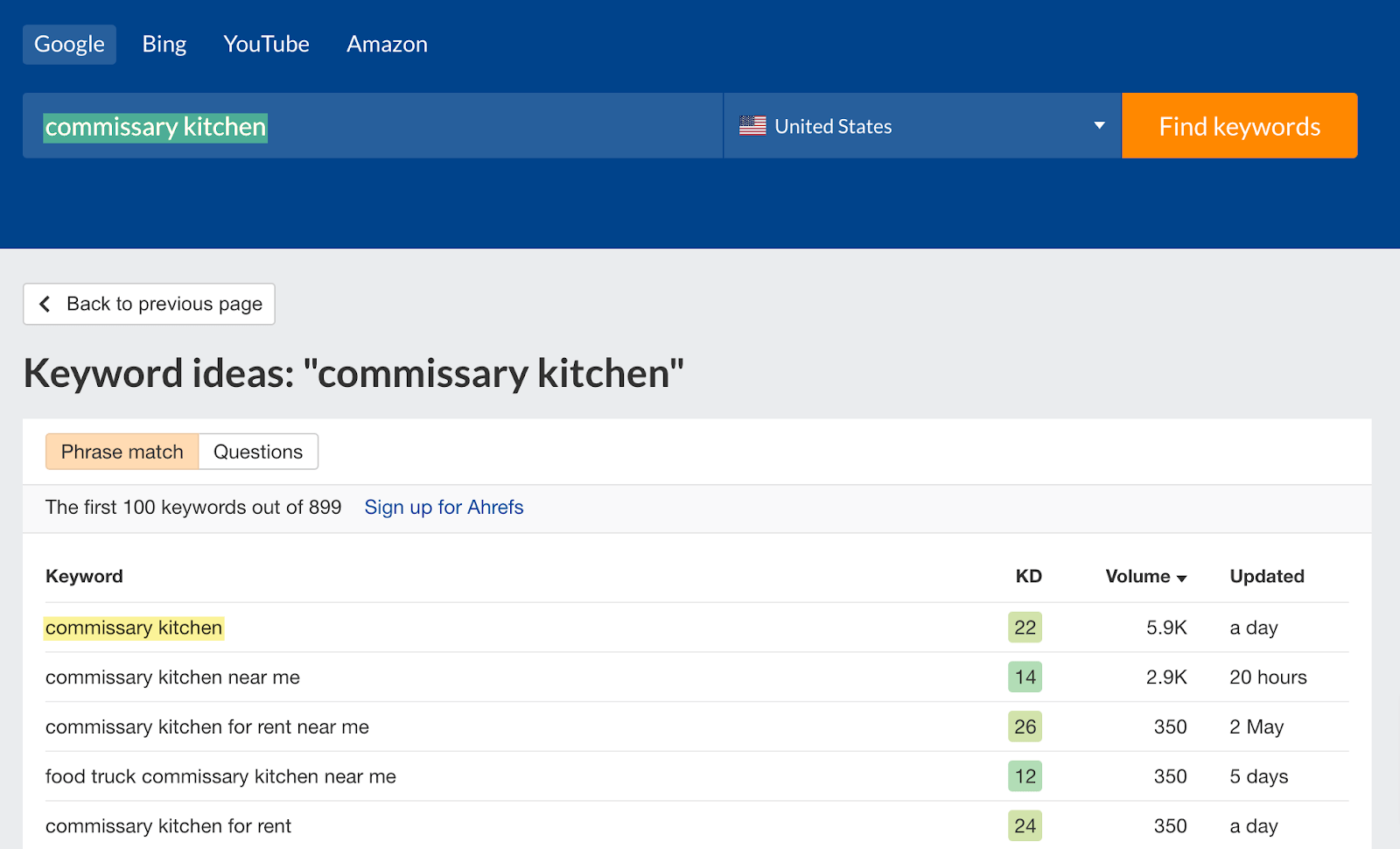
For example, if we plug “commissary kitchen” into Ahrefs’ free keyword generator, we see that it has an estimated monthly search volume of 5,900 in the U.S. alone. This answers our question: People are searching for what we do.
But even if this isn’t the case, people may be searching for individual products or services you offer. So it’s worth plugging some of these into a keyword tool as well to see if people are searching for them. If that’s not the case, don’t worry. SEO may still be worthwhile—and that brings us to question #2.
Question 2. Are potential customers searching for solutions to problems your business helps to solve?
Even if people aren’t searching directly for what you do or sell, they may be searching for problems to solutions you can help with. And there’s quite a high chance for this given that:
- 68% of online experiences begin with a search engine (BrightEdge).
- 71% of B2B researchers start their research with a generic search instead of queries containing a brand name or product (Google).
- 53% of shoppers say they always do research before a purchase to ensure they are making the best possible choice (Google).
For example, we have a tool called Content Explorer that’s basically a searchable database of billions of webpages. Virtually nobody is searching for it on Google. However, they’re searching for problems the tool helps to solve, such as link prospecting or finding content ideas.
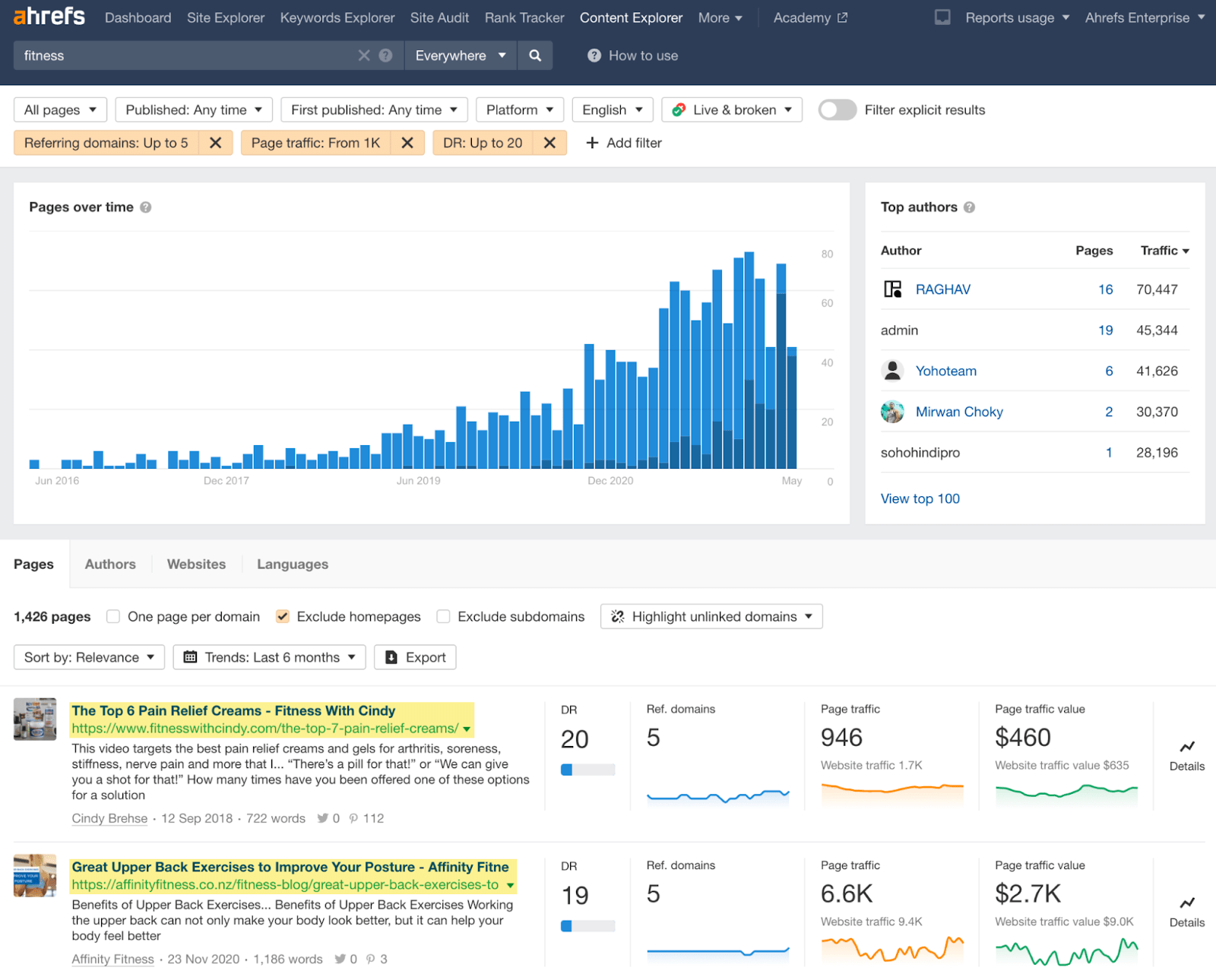
SEO is often worthwhile in this case because you can create content that teaches searchers how to solve their problems with the help of your product or service. This is precisely what we do at Ahrefs.
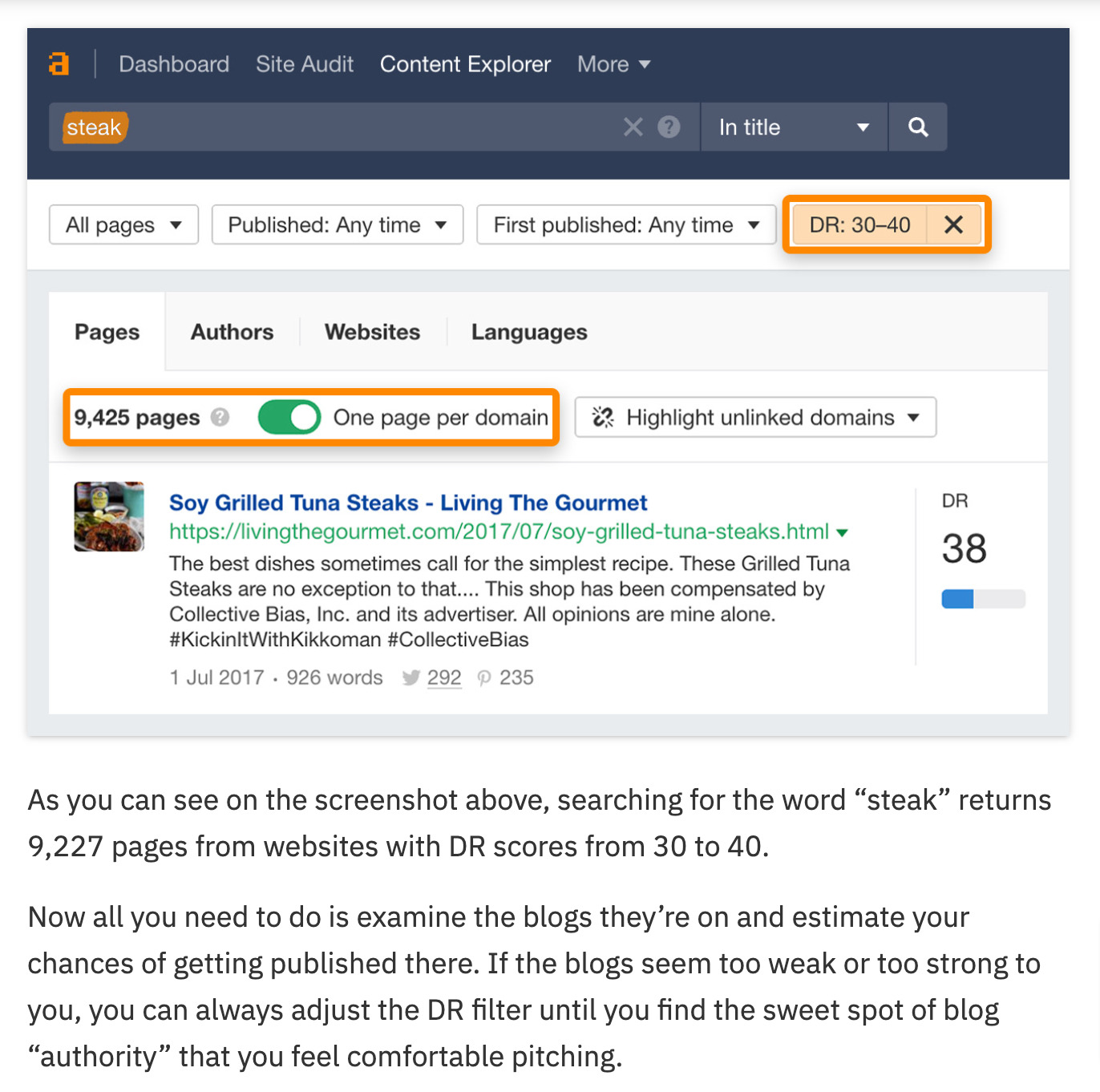
One of our blog posts explaining a solution with the use of Content Explorer. This article gets an estimated 1.3K monthly organic traffic.
To see if people are searching for problems you can help solve, just use a keyword research tool as we did in question #1. This time, insert the name of the problem your product or service can solve. Also, see the Questions tab to look for relevant questions.
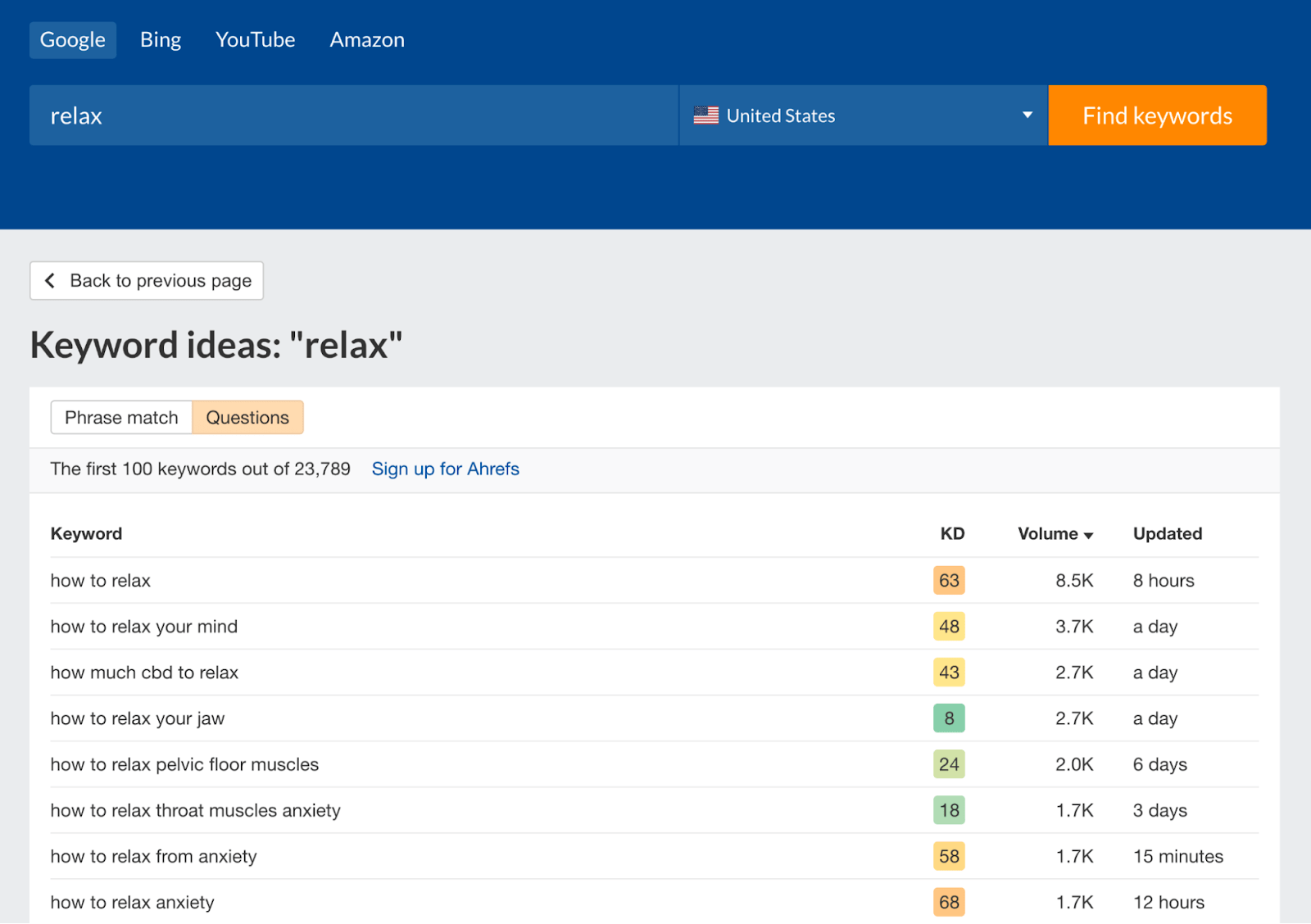
Let's say somebody invented a brilliant relaxation program/product and gives it a completely new name. That name surely won't have any search volume. But as you can see, the problem of not experiencing effective relaxation does. So that person can create content answering questions about relaxation and generate awareness about their relaxation program.
TIP
If you need more information for your research, you can take it to the next level with features offered by paid SEO tools. Not only can you look up more keywords in one run, but you also get more metrics, have access to advanced filters, and can even see your competitors' keywords.
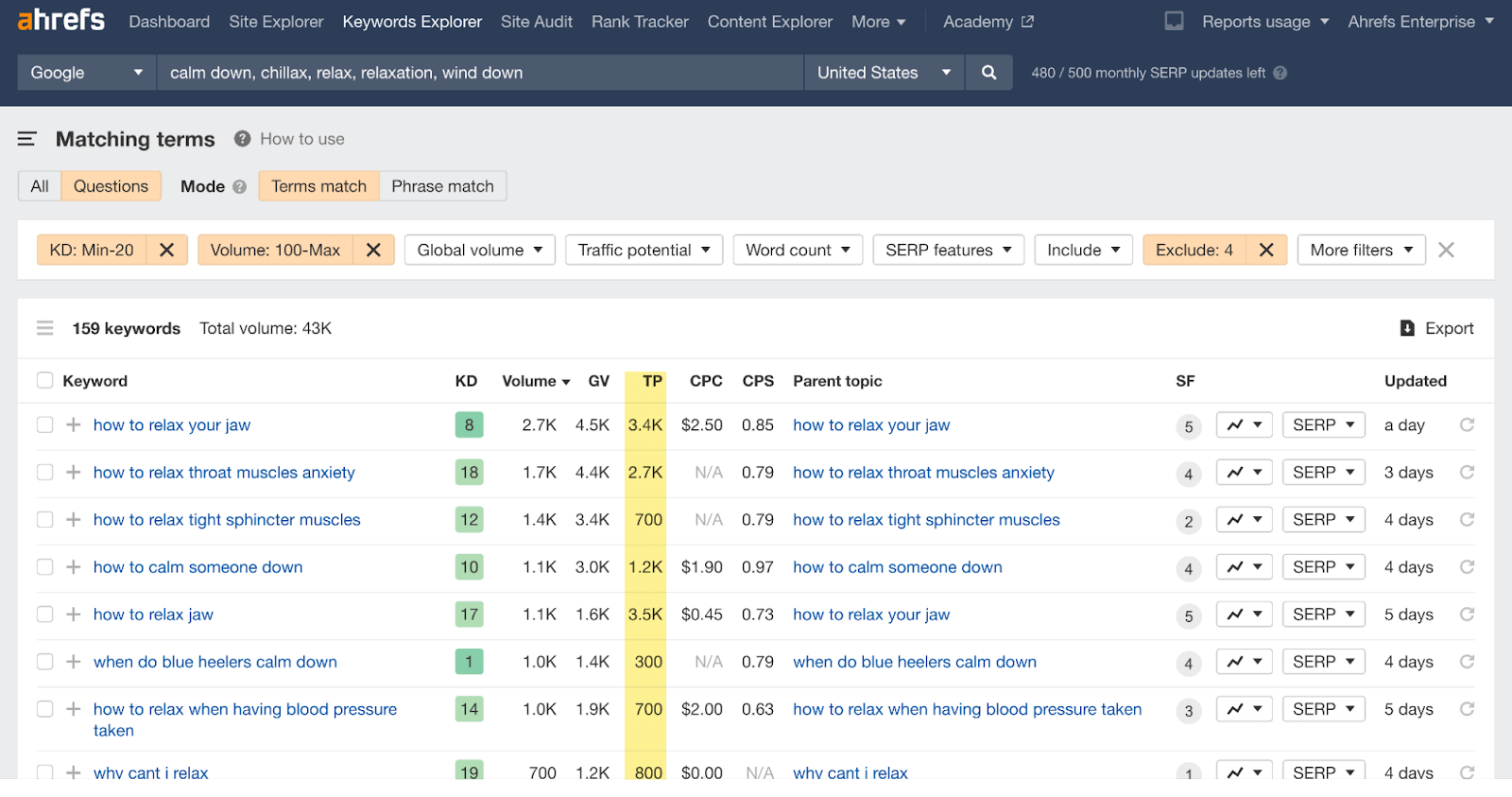
A small sample from our Keywords Explorer. Here, you can see similar research for relaxation-related questions, but we've also used more seed keywords and advanced filters to show low-competition keywords with considerable traffic. Also, you can see the Traffic Potential (TP) of those keywords—more search volume doesn't always translate to more traffic.
How SEO fuels your visibility in AI-generated answers
Tools like ChatGPT, Perplexity, and Google’s AI Mode are becoming the new way people find answers. That’s where GEO—Generative Engine Optimization—comes in. Think of it as SEO for AI search.
Here’s the great part: if you’re already doing solid SEO, you’re basically doing GEO too. They’re not separate things.
When AI tools need accurate, up-to-date information, they pull it from Google, Bing, and other search engines. So if your content ranks well there, you have a high chance of showing up in AI results.
Here's some more proof—Ahrefs’ articles have been cited thousands of times by AI platforms without doing any special “AI SEO.” Good old-fashioned SEO did the trick.
So, the rules are the same:
- Write helpful, well-organized content that answers real questions.
- Build trust with backlinks and mentions.
- Build authority by diving deep into specific topics and sharing well-researched, high-quality content from authors who truly know their stuff.
- Keep your site fast, mobile-friendly, and easy to crawl.
Bottom line: strong SEO doesn’t just help you rank on Google—it sets you up for AI visibility too. One effort, double the payoff.
FAQ
Frequently asked questions about starting with SEO.
How long does SEO take to show results?
Short answer: usually 3–6 months to see meaningful results, according to our study.
Here’s the typical timeline:
- Months 1–3: Set up and groundwork. Don’t expect much traffic yet.
- Months 3–6: Early signs — pages start ranking on Google, small traffic trickles in.
- Months 6–12: Real growth — steady traffic, leads, and sales.
- 12+ months: Compounding results — older content keeps performing, new content ranks faster.
What affects your timeline:
- New sites take longer.
- Competition. Broad keywords = slow, niche topics = faster.
- Resources. More time, content, and tools = quicker results.
- Consistency matters more than big bursts of activity.
Bottom line: if you can commit for the long haul, SEO is one of the best investments you can make.
Think of it like planting a tree — slow to start, but once it grows, it keeps producing for years.
How much does SEO really cost?
So if you answer “yes” to question #1 and/or question #2, then SEO is worth it in theory. But there’s one more thing to it: the cost/effort may outweigh the reward.
Basically, you have three options for investing in SEO:
- Hiring an agency/consultancy — Probably the most expensive option, costing from $99 (agencies) to $171/hour (consultancies). In many cases, you will also need to pay a monthly retainer. On the upside, you don't have to learn SEO, and you can start fast.
- Building a team or outsourcing to freelancers — Somewhat expensive. On average, SEO freelancers cost $71.59/hour, and an in-house SEO specialist costs $71K/year (in the U.S.). You need to know what you’re doing, and you need to invest time in the hiring and onboarding process.
- Doing it yourself — The cheapest option. But it takes time to learn the ropes.
There may be a fourth “hybrid” option: hiring an agency/freelancer for some time to see the results. Then you may want to build an in-house SEO team or even learn SEO yourself.
Sidenote
We surveyed members of the SEO industry to find out how much they charge for SEO services and what pricing models they use. Read the study here.
If you decide to hire an SEO agency or a consultant, ask them if they think SEO will be worthwhile for you. A good agency will give you an honest answer and explain why it’s the case one way or another.
And if you're interested in the do-it-yourself path, start from our introduction to SEO.
Final thoughts
SEO has always been one of the best marketing channels out there. Even with AI Overviews rolling out and millions of people turning to AI assistants for answers, SEO remains one of the most reliable, high-ROI strategies. It offers precise targeting through keyword research and still has a relatively low barrier to entry.But given all this, is there a time and place when you should focus on other strategies instead of SEO—or skip it entirely?I think it’s when:
- You need revenue fast (can’t wait 6+ months).
- You need to promote a time-sensitive offer.
- Your audience doesn’t use Google that much (like Gen Z on TikTok/Instagram). That said, you can still use SEO on alternative platforms to Google (for example, SEO for TikTok).
In such cases, channels like ads or influencer marketing will likely yield faster results. SEO is powerful, but only when the timing and context are right.
Mateusz Makosiewicz is a marketing researcher and educator at Ahrefs. He has been involved in marketing for over 15 years, specializing in growth marketing, content marketing, marketing strategy, and management.
Mateusz studied Advertising and Media Marketing at the University of Gdańsk. He gained his marketing experience in agencies, SaaS companies, and hardware companies where he worked in various roles, from managing advertising projects for clients to leading marketing departments.
On Ahrefs blog he writes about SEO and marketing based on experience drawn from testing probably every piece of marketing advice ever published, trial and error in startup marketing in the Silicon Valley, and tweaking growth engines like his life depended on it.
Keep learning





Your weekly marketing’s must-reads
Join 284K marketers for weekly news, useful reads, industry updates, and the memes you didn’t know you needed.
Explore what’s inside the newsletter →