
The Content Marketer’s Guide to Performance Reviews

SEO & Marketing Educator at Ahrefs
Employee performance reviews have been used in companies for decades. For employees, these reviews are an opportunity to get feedback on their work and even a raise. For managers, reviews are an important management and leadership tool.
The problem is nobody really likes performance reviews. They’re stressful, awkward, and ineffective (according to some). Yet it seems they are necessary.
So how should managers go about performance reviews in their content marketing teams? Read on to learn some basic theories and see the insights that some marketing managers shared with us.
We’re going to cover:
What is a performance review?
A performance review (also called performance evaluation or appraisal) is a process where managers assess an employee’s work performance to identify their strengths and weaknesses, offer feedback, and assist with goal setting.
Why are performance reviews important in marketing?
A common misconception about performance reviews is that they are meant to benefit only the businesses or managers and not the employees. However, properly conducted reviews (in any form) can offer an immediate lift for all “sides.”
For businesses (and managers conducting the reviews), performance reviews are a tool for optimizing the performance of staff, strengthening leadership, creating a better alignment with the strategy, and understanding the perspectives of employees.
For employees, reviews are a way to get an overview of their strengths and weaknesses and progress. During reviews, employees can also voice criticisms, discuss career opportunities with managers, or get a raise.
Types of performance reviews
A performance review, in general, is a multi-layered phenomenon, such as the obvious business performance side of things, different management theories, company policies, HR and, of course, the psychological aspect of giving and receiving a performance review in a modern workplace.
In the past, when businesses tried to prioritize some aspects over others or balance them, new types of performance reviews emerged. These days, it seems there is no consensus for a single, right way to do a performance review. Each way has its advantages and disadvantages.
If you’re interested in how performance reviews evolved, see this timeline.
Among all of the alternatives, here are the types of performance reviews that seem to be most relevant to evaluating the work of content marketers.
- Rating scale – Probably the most traditional type. The reviewer evaluates the reviewee by assigning ratings to variables (e.g., creativity, teamwork) arranged in a table.
- Self-assessment – As the name suggests, the employee performs a self-assessment based on goals, KPIs, or OKRs defined either by the manager or by the employee themself. Then the employee discusses the results with the manager; for example, both sides can compare results of the same appraisal form.
- 360 feedback – Practically, the entire professional surrounding of the employee takes part in the evaluation process: managers, co-workers, customers and, sometimes, even the employee themself. This method usually utilizes a questionnaire handed out to the participants.
- Management by objectives (MOB) – Performance is reviewed based on how well an employee meets their goals. In content marketing, the goals can be something like the number of articles written, traffic growth, generated leads, etc.
- Continuous, real-time feedback – In this method, the employee receives ongoing feedback by openly discussing how tasks and projects are progressing. Often used in agile management. Typically, it does not utilize any form of scorecards or formal appraisals set in longer intervals; it’s sort of an antithesis of the traditional way of doing performance reviews.
Within those types, with the exception of real-time feedback, there are three commonly used techniques for gathering and passing information: checklist (aka forced choice), scorecard, and free form (aka an essay). Let’s take a quick look at some simple examples.
Example 1. A scorecard technique used in the rating scale method. Here, the manager marks the score of an employee for a given period of time, e.g., the last three months. In the end, all of the points can be summed up to constitute a general score.
Performance level/ Work dimension | 1 - Poor | 2 - Fairly poor | 3 - Fairly good | 4 - Good | 5 - Excellent |
|---|---|---|---|---|---|
Creativity | X | ||||
Efficiency | X | ||||
Teamwork | X |
Example 2. A checklist technique used in the self-assessment method. The employee is handed a questionnaire with forced-choice questions. There is no scale here, only “black” and “white.”
Statement | Yes | No |
|---|---|---|
I am creative at work. | X | |
I fulfill the quota of written articles. | X | |
I help other team members achieve their goals when needed. | X |
Example 3. A free-form essay technique. This can be used as a standalone technique or as a supplement to the other techniques.

Employee XYZ is a skilled writer with a head full of ideas. She puts her full creative effort into each written article, resulting in great, original content. In addition to that, her articles are always on time.
However, XYZ could work on her teamwork skills. They’re not horrible, but neither are they great. Other team members could learn much from her. But she rarely shares her perspective, and I rarely see her offering assistance to co-workers.
With some basic theory out of the way, let’s look at the practical side of things. Let’s see how some of the marketers we asked conduct performance reviews for content marketers and how they feel about the idea in general.
Results of our survey
Some of the methods listed in the section above are decades-old, some have been transplanted from other fields (e.g., military), and some were designed for corporations.
This means that what we have just discussed may potentially be outdated and/or not suitable for startups and SMBs. After all, marketers may have adopted different methods over the years that work well, especially in the area of content marketing.
So in our search for the answer to doing performance reviews for content marketers, we decided to go further than just understanding the theories.
What’s more, we also wanted to learn what particular metrics are being used to assess the performance of content marketers.
So we asked marketing managers to answer these two questions in a quick survey on social media:
In some cases, we’ve added an additional question: How do you determine if a content marketer deserves a raise?
Two disclaimers to note here. First, marketing is a broad field with various specializations. Hence, we decided to limit the scope of the survey to just content marketing. Second, the survey was conducted on social media in an open forum. So we chose not to rule out the possibility of respondents being influenced by existing responses.
All in all, we’ve got 20 responses to questions #1 and #2 and 10 responses to the additional question #3, plus some comments. Here’s what we found:
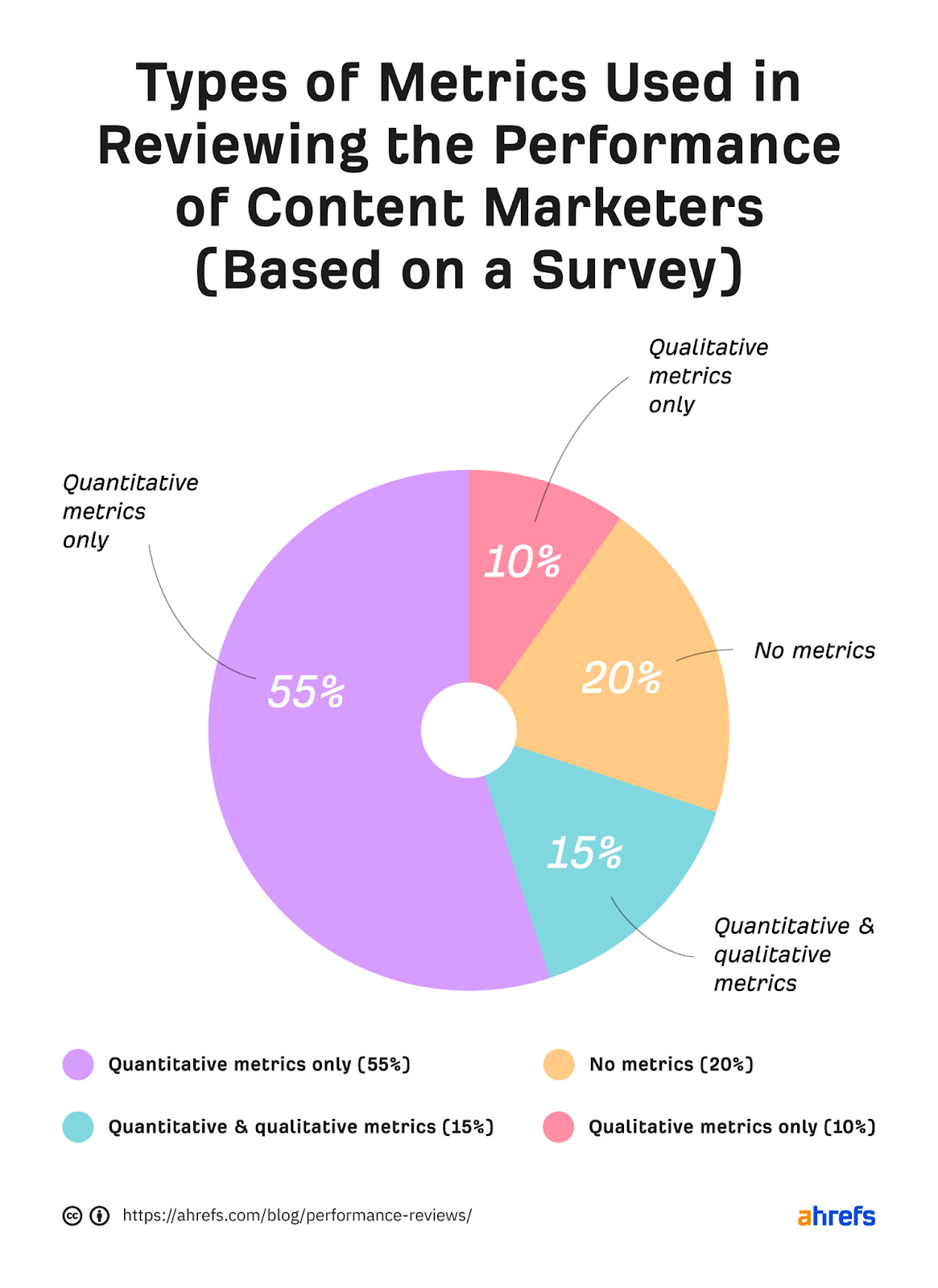
- Marketers use different types of metrics to measure the performance of content marketers:
- 55% use only quantitative metrics.
- 20% don’t use any metrics.
- 15% use both qualitative and quantitative metrics.
- 10% use only qualitative metrics.
- Among the quantitative metrics, the most popular are traffic and MQLs. Some others mentioned are social media shares, influence on MRR, keyword rankings, engagement rate, referrals to shop, and dwell time.
- Among qualitative metrics, marketers mentioned feedback from readers, quality of product placement, internal feedback, managers’ personal opinions.
- Half of the surveyed managers (50%) use a quarterly interval for conducting performance reviews. However, managers often mix those with monthly, weekly, and even real-time feedback.
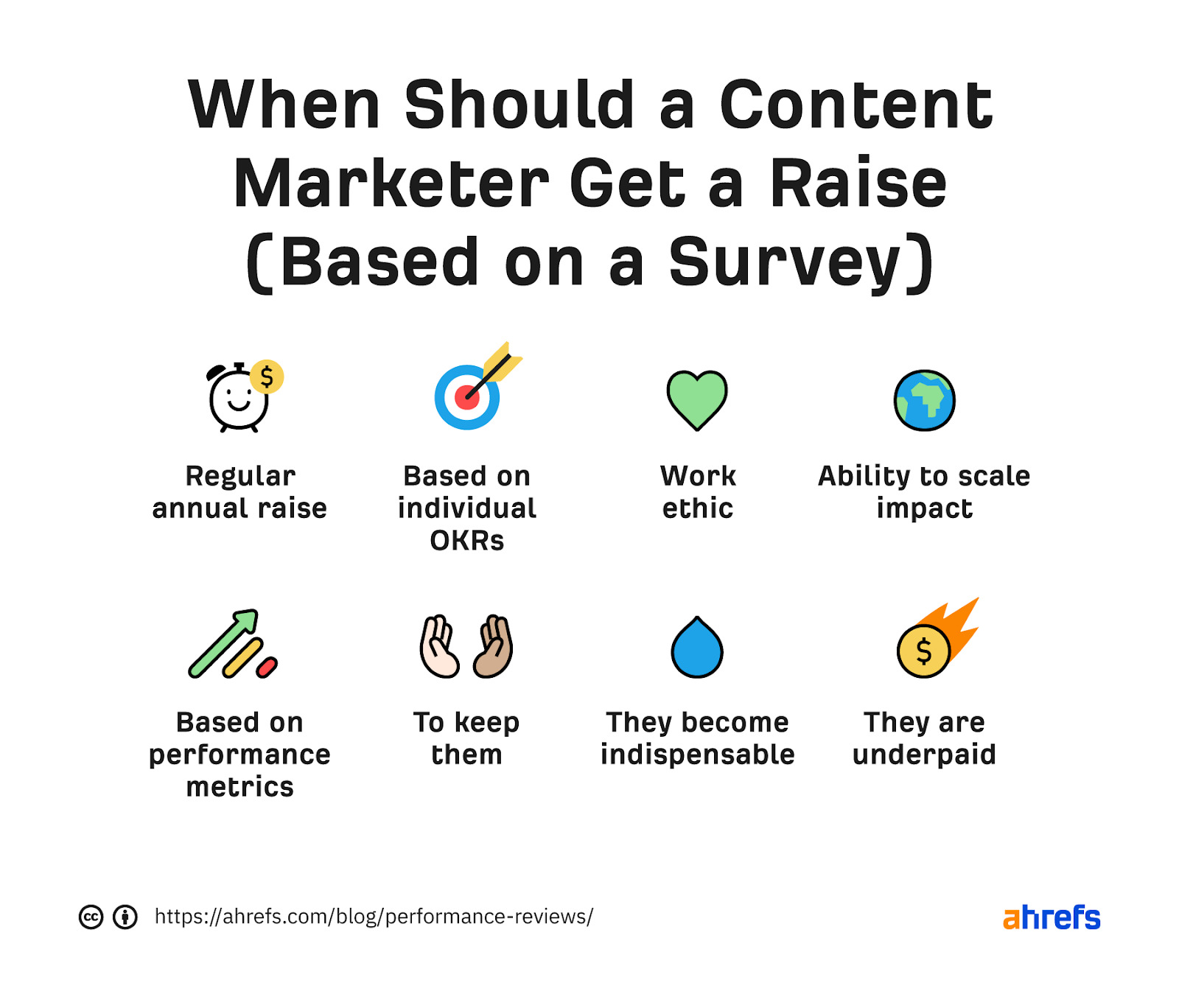
- For reasons to give a raise, the clearest pattern among the responses is that managers utilize the same metrics used for measuring performance. However, some managers mentioned they consider additional factors like work ethic, a regular annual raise, employee being underpaid, or wanting to keep the employee.
- A minority of marketers don’t perform performance reviews. Notably, most answers came from Twitter. Here are a couple of those answers that explain the reasons for this approach:
I think every reader will make their own conclusions after studying the survey results. Some will treat it as a sign that the “traditional way” of doing performance reviews is still the way to go.
Others may flinch at the mere sight of any kind of scorecard, and they may treat the small but significant percentage of managers who don’t use any metrics or do performance reviews as the most important group.
Here’s my take on the subject. It’s based on the data from the survey, the research I did for this article, and my personal experience as a marketing manager a couple of years back. I tried to distill them, and this brings us to the following tips…
Five tips to ensure effective performance reviews in the context of content marketing
Finding one definitive answer to the problem of performance reviews seems impossible until you try it out on your own turf. Whatever you do, you may want to consider these tips.
1. Try different methods and techniques to find what works
One undeniable conclusion from our survey is that managers assess the performance of content marketers differently. There sure are patterns and commonalities but no unanimity.
Reason? Very prosaic: People are different, and organizations are different. What could work in a 500+ corporation may fail miserably in a startup. While some content marketers like to have strict guidelines and follow exactly what is expected of them, others perform best if they are left with a lot of room to move.
Then we have different styles, strategies, and types of content marketing. One team may focus on writing SEO content; another may focus on social media, sales enablement, or video marketing. They won’t have the same process, challenges, and objectives.
In all of those differences and complexities, I think nailing the right performance review method boils down to one thing: How can you as a manager help your team members achieve their goals?
In other words, nobody needs (and trusts) a manager who only judges people. Your performance reviews should be constructive and ideally benefit both “sides.”
So don’t just blindly copy what someone else is doing. Instead, take any advice for a “test drive” and see what happens. Observe your team, get feedback, and look at the impact of your decisions on the performance and quality of content.
2. Be careful with the “carrot and stick”
What often concludes a performance review is the possibility of a raise for the reviewee.
If you want to reward employees by giving them a raise, you probably can’t go wrong with the answers our respondents gave. But if raises are a part of an incentive plan in a creative field like content marketing, things become a bit tricky.
Incentive plans are essentially “carrot and stick” systems: rewards and punishments used to induce a certain behavior or a certain level of work performance. Using direct punishments (pay decrease, demotions, etc.) is probably rare. But in a workplace, a lack of reward practically equals punishment.
A number of studies (e.g., here and here) have shown that incentive plans may do more harm than good. Here’s why:
- Any pay-for-performance system tends to make people less enthusiastic about their work. They become less committed to excellence and less creative. This isn't great for content marketing, an area that requires more open-ended thinking and, thus, is more cognitively demanding.
- If people are forced to compete for rewards—especially if they are ranked against each other—it’s the end of teamwide cooperation.
- When people work for a reward, they may be more tempted to conceal problems, take on easier tasks, and minimize the challenge (i.e., avoid risk-taking and innovation).
- If you’re looking to induce a long-term change in an employee's behavior, don’t bother. Rewards result in temporary compliance only.
Let’s make things clear here. Rewarding content marketers with raises and bonuses for great work is nothing short of doing justice to their inputs.
But it doesn’t work the other way around. Introducing a reward system to improve the quantity and quality of content is probably a bad idea for the reasons mentioned above.
You may want to do this instead: provide training, give useful feedback, and leave room for self-determination. Other than that, you may want to review your recruitment process, which brings us to the next tip.
3. Performance reviews won’t fix a broken recruitment process
From my experience, if you hire the right people, all you need to do in terms of performance reviews is to regularly talk to them. No awkward pressure, no formalities, no scores. In fact, casual chats work best.
The reason for this is the right person for the job will have the intrinsic motivation to excel at their role. They will want to do the job as best as possible. They may even be more concerned about their performance than the manager.
So if they understand that you, as a manager, are there to help them achieve their goals, remove roadblocks when needed, remove yourself from a given process when needed, or even step in when needed, you will gain their trust.
Otherwise, you will become another dark cloud in their blue sky. Another problem to solve and obstacle to avoid. You won’t earn their trust. And without trust, you won’t see their true potential.
If your recruitment process is broken and you end up hiring people who don’t really fit the role or the company culture, you will likely struggle with performance reviews as a result. This means you will have to devise some complex system of assessment instead of simply having regular chats.
4. Let your employees track their own performance
A good idea may be to ask your employees to prepare their own performance reports. Here’s why:
- Makes assessment standards more transparent
- Leaves less room for unfair assessments from managers
- Gives employees an increased sense of ownership of their work
- Makes it easier for managers to collect information (especially in bigger organizations)
For example, if your strategy is based on content designed to rank on search engines, content marketers on your team can use an SEO tool like Ahrefs to track things such as keyword rankings, search visibility, backlinks, or organic traffic growth. This data can then be aggregated for any period of time and discussed with a manager.
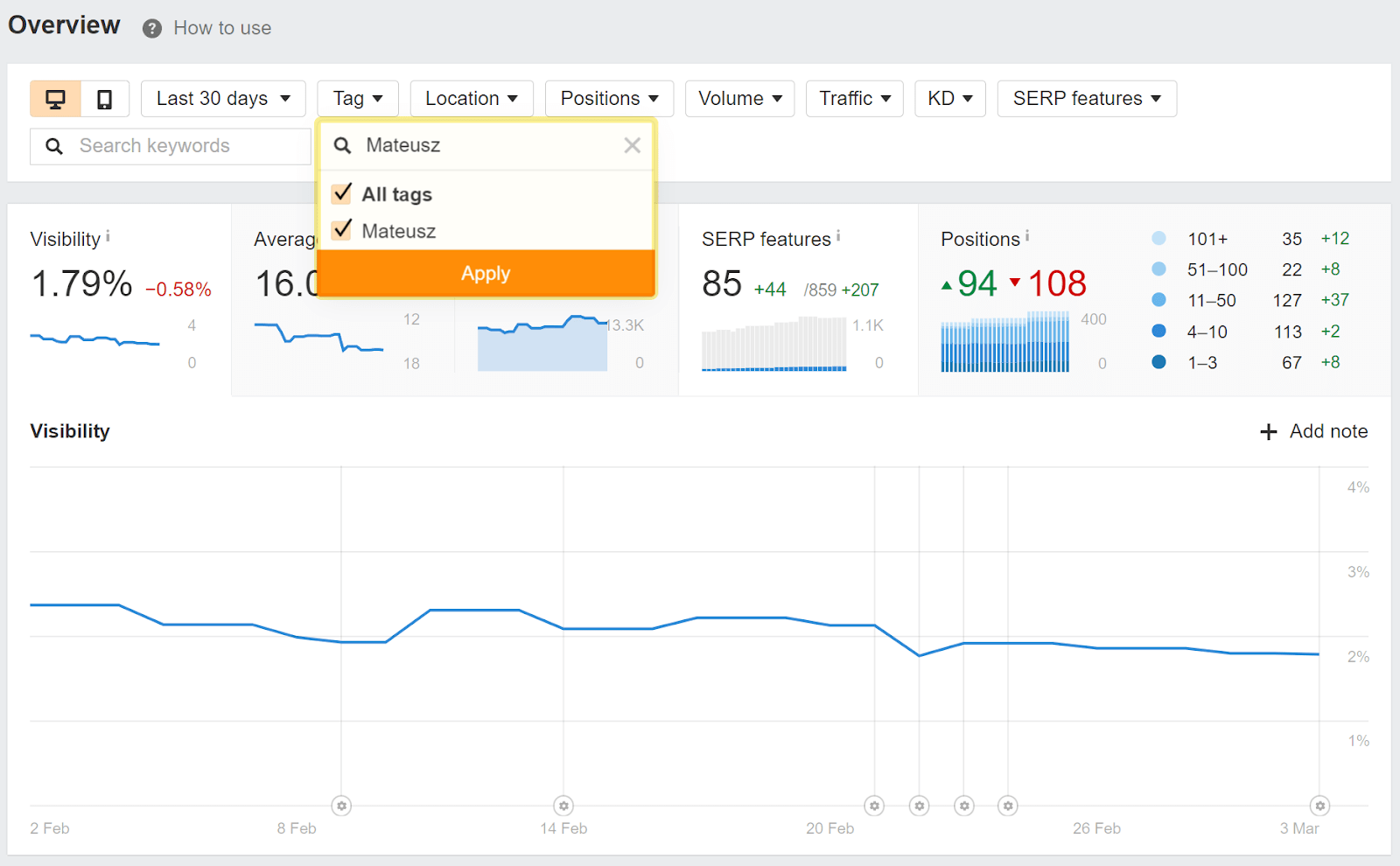
In Ahrefs’ Rank Tracker, tags can help to filter articles by author. This way, all writers can easily monitor the performance of their work.
5. Don’t forget the small things
Last but not least, let’s take note of the small details that can make or break your performance reviews. Without further ado, here’s a short list of things worth remembering:
- Make performance standards clear – Don’t make your team members guess what effects you’re after. Also, don’t make it a weird psychological game of “impress me.”
- Find the right time and place – A room full of people at 7 a.m. won’t be a time and place where thoughts and words will flow. Reviews are a sensitive matter. Try to keep it private and non-intimidating. Typically, the best time is close to the end of the day but leave enough time for discussions. If you’re doing the review remotely, don’t sit in a place where the whole company can hear you (or the reviewee).
- Give your employee a copy of the review – If you’re using some kind of a scorecard or checklist, it’s a good idea to share it with your employee. Otherwise, your performance standards are not clear.
- Prepare notes and agenda – Don’t come to the performance review meeting unprepared. Take time to gather your thoughts and write them down. You can even send the meeting agenda to your employee beforehand.
- Ensure a two-way conversation – This is true for all review methods. If you don’t let the reviewee express their opinions, you’ll make them frustrated. Nothing good can come out of that.
Final thoughts
Our initial plan for this article was to include a template for performance reviews. A one-size-fits-all solution all content marketing managers and heads of content departments can use to measure the performance of content marketers.
I’m glad we didn’t go in that direction.
If we did, we would lose all that diversity in opinions on the topic and different practices of conducting performance reviews.
So to reiterate the question from the introduction: How should managers conduct performance reviews of their content marketing teams? Well, it seems that they should find their own way because no one will answer this question for them.
Sure, there are methods and techniques, but they don’t come with any promises. Furthermore, asking other managers won’t result in a simple answer either.
When it comes to performance reviews, you need to consider the consequences of choosing one method over the other. They should be tested within one’s specific work environment, as they can enhance just as many things as they can undermine.
Got questions or comments? Ping me on Twitter.
Mateusz Makosiewicz is a marketing researcher and educator at Ahrefs. He has been involved in marketing for over 15 years, specializing in growth marketing, content marketing, marketing strategy, and management.
Mateusz studied Advertising and Media Marketing at the University of Gdańsk. He gained his marketing experience in agencies, SaaS companies, and hardware companies where he worked in various roles, from managing advertising projects for clients to leading marketing departments.
On Ahrefs blog he writes about SEO and marketing based on experience drawn from testing probably every piece of marketing advice ever published, trial and error in startup marketing in the Silicon Valley, and tweaking growth engines like his life depended on it.


Keep learning




Your weekly marketing’s must-reads
Join 284K marketers for weekly news, useful reads, industry updates, and the memes you didn’t know you needed.
Explore what’s inside the newsletter →