


Local SEO: The Complete Guide

Former Head of Content at Ahrefs

What is local SEO?
Local SEO is a strategy that helps Google understand where your business is, what you offer, and how trustworthy you are. This improves your ranking in local search results, benefiting any business with a physical location or that serves a local area.
For example, this pizzeria ranks #1 in the local pack and “blue link” organic results:
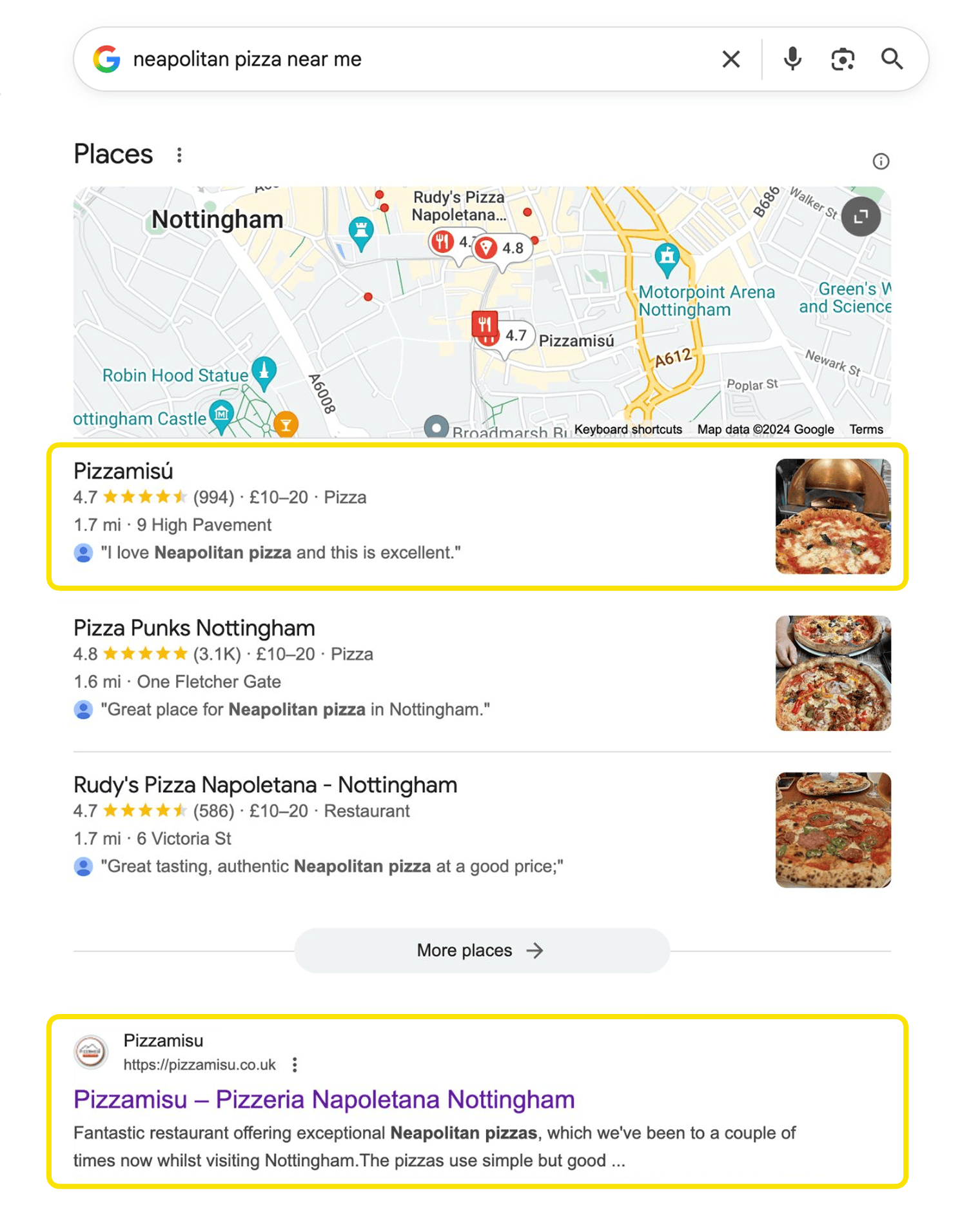
This is because it’s close to me, has exactly what I need, and has a great reputation (4.7/5 from 994 reviews).
Why is local SEO important?
Local SEO is important because many people use search engines to find local businesses.
In fact, according to Google:
30% of all mobile searches are related to location.
78% of people who search for something nearby on their phones visit the business within a day.
28% of searches for something nearby result in a purchase.
In short, customers are searching for your business. If you’re not there, you’re leaving money on the table.
How does local SEO work?
Local SEO is a game of two halves because Google shows two types of search results for local searches. These are local pack results and organic “blue link” results. You can rank on both of them.
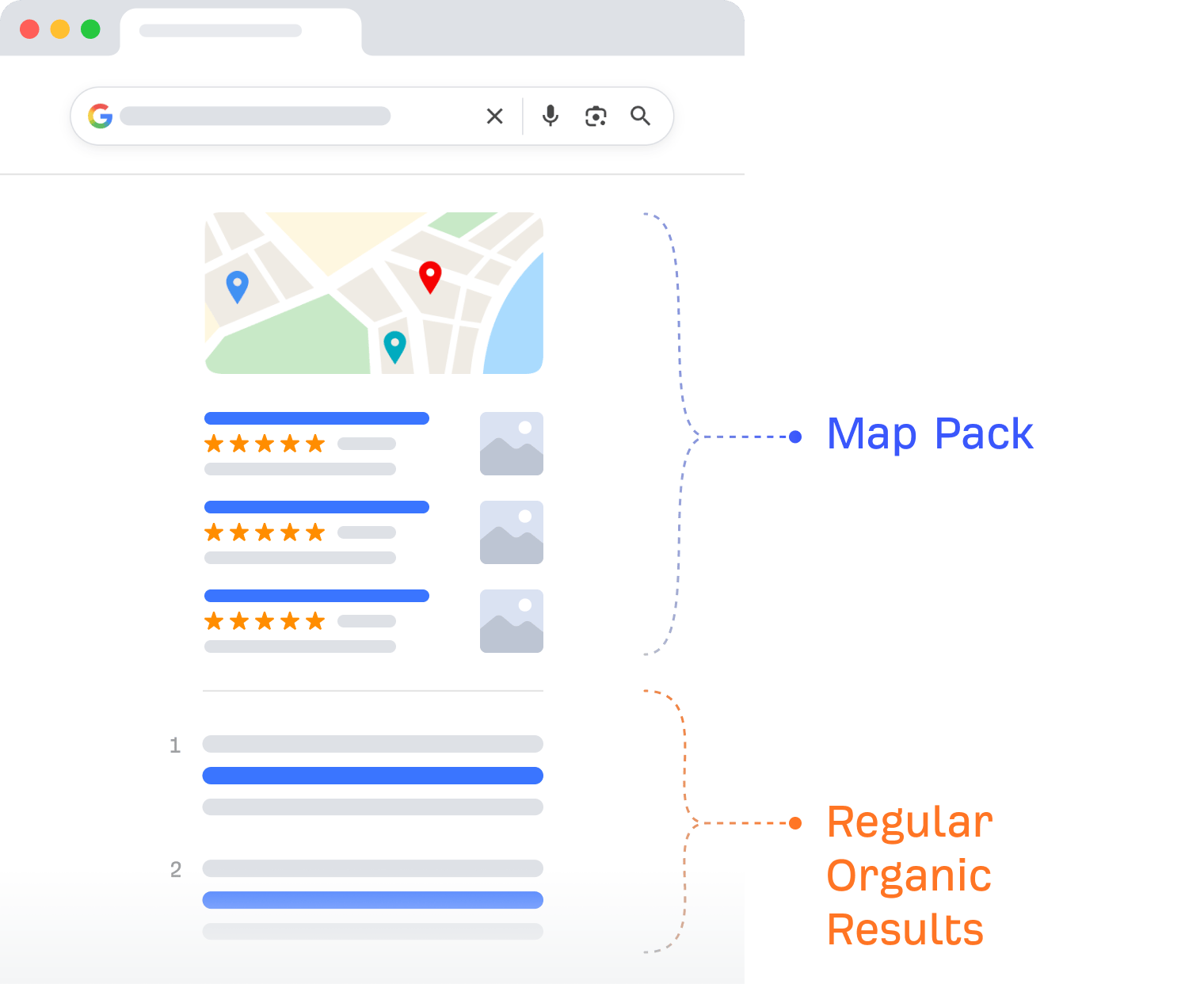
Map pack results
The map pack (aka local pack) is a Google SERP feature that shows the top local business listings and a map. It often appears at the very top of Google’s search results for local searches.
Organic search results
The “regular” organic search results are the “ten blue links” that we’re all familiar with. They usually appear below the map pack results.
What is a good local SEO strategy?
Lay a strong foundation with initial optimizations, then put systems in place to automate as much as you can going forward.
For example, reviews are important but getting more of them doesn’t have to be a chore. You can do simple things to encourage customers to leave them, such as placing cards like these on tables if you run a restaurant:

This is what I like to call passive local SEO. As long as you’re delighting your customers, your online reputation will grow on autopilot and rankings should improve.
Keep this idea in mind as you go through the rest of this guide.
How to do local SEO
Doing local SEO involves optimizing for the local pack and the regular “blue link” organic results. To do this, you optimize for local ranking factors.
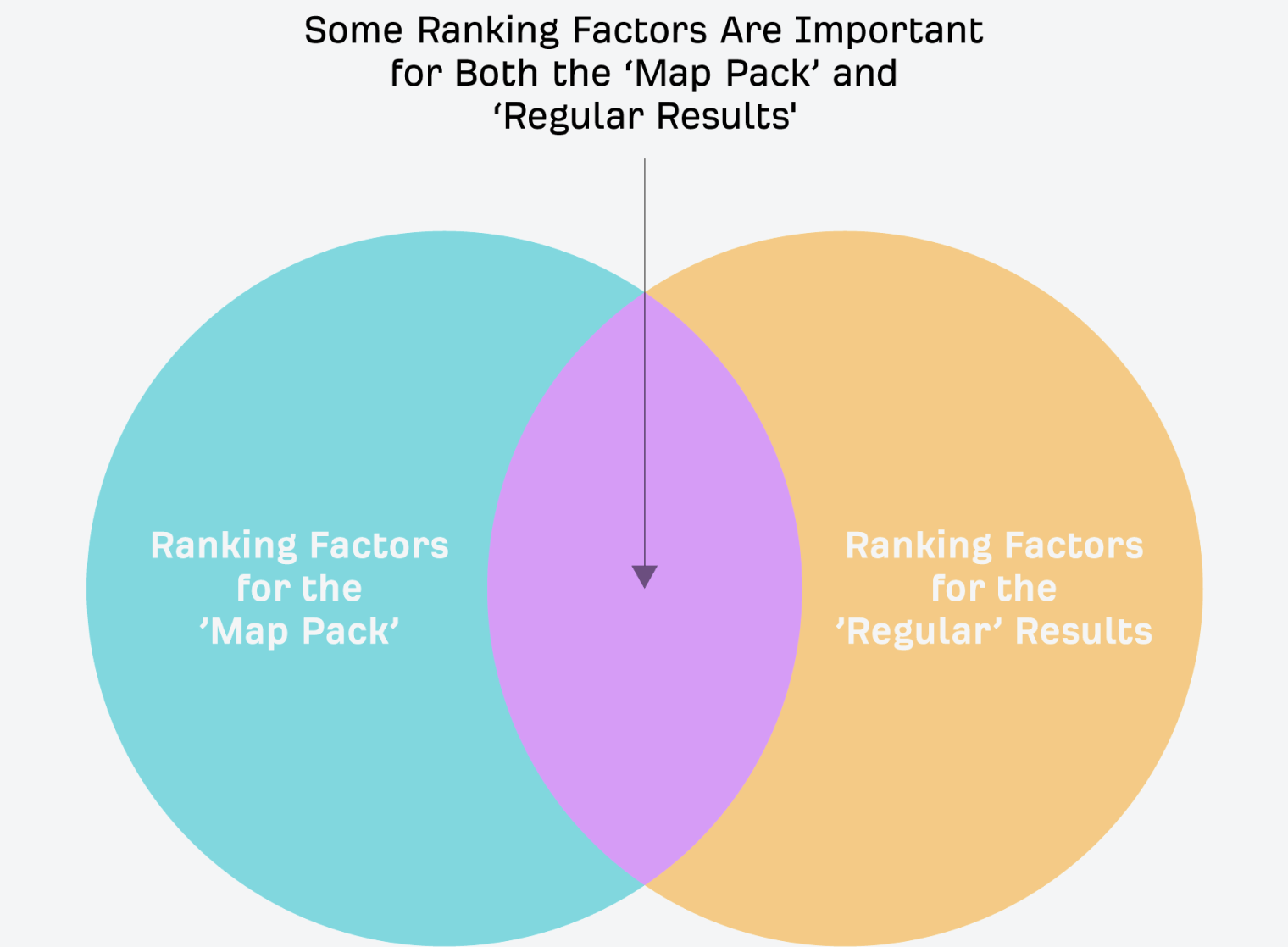
Some of these are important for both the local pack and regular results, whereas others are more important for just one of them.
Let’s go through the process of local SEO from start to finish.
Get a Google Business Profile (formerly Google My Business) and optimize it
A Google Business Profile is a local listing with information about your business. It’s free and allows your business to appear in the map pack and Google Maps.
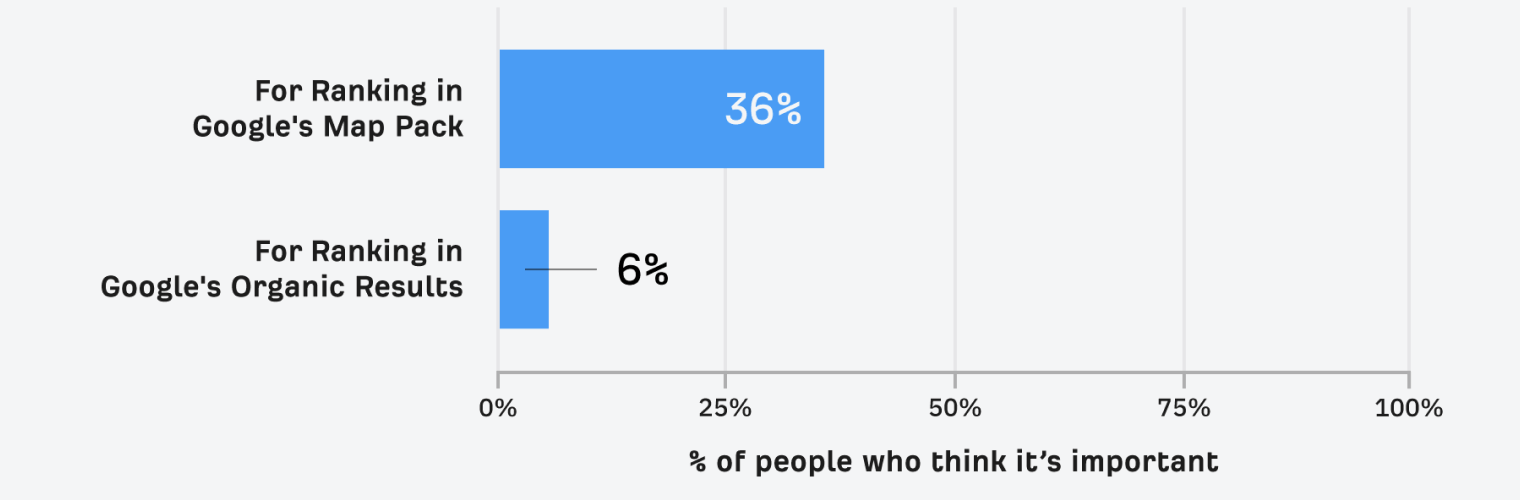
36% of SEOs think your Google Business Profile is the most important ranking factor for the map pack. And 6% believe that it’s important for the “regular” organic results. That’s according to BrightLocal’s survey.
How many SEOs think a Google Business Profile is the most important ranking factor?
This isn’t surprising, as you need a Google Business Profile to stand any chance of ranking on the map pack.
Business Profile signals are increasing in their perceived importance for the map pack over time too.
The perceived importance of Google Business Profile signals over time
| 2013 | 2014 | 2015 | 2017 | 2018 | 2020 | 2021 | |
|---|---|---|---|---|---|---|---|
Local Pack/Finder | 23% | 20% | 22% | 19% | 25% | 33% | 36% |
Localized Organic Results | 10% | 10% | 8% | 7% | 9% | 7% | 6% |
Source: BrightLocal
Beyond rankings, Google states that customers are 70% more likely to visit businesses with a complete Business Profile. They’re also 50% more likely to consider buying from them. So it’s clear that a complete and optimized Business Profile is essential if you want to attract more business.
Here are a few best practices from Google:
Be specific when setting your business category
Set your business hours (including holiday hours)
Add your address (if you have a storefront)
Set your service area (if you visit or deliver to customers and clients)
Add the products or services you offer
Add photos
Ask customers for reviews
Get more reviews
Reviews refer to the quantity and quality of reviews on your Google Business Profile and elsewhere online.
BrightLocal’s 2021 study shows that 17% of SEOs deem reviews the most important ranking factor for map pack rankings. But only 5% see them as most important for regular organic rankings.
How many SEOs think reviews are the most important ranking factor?
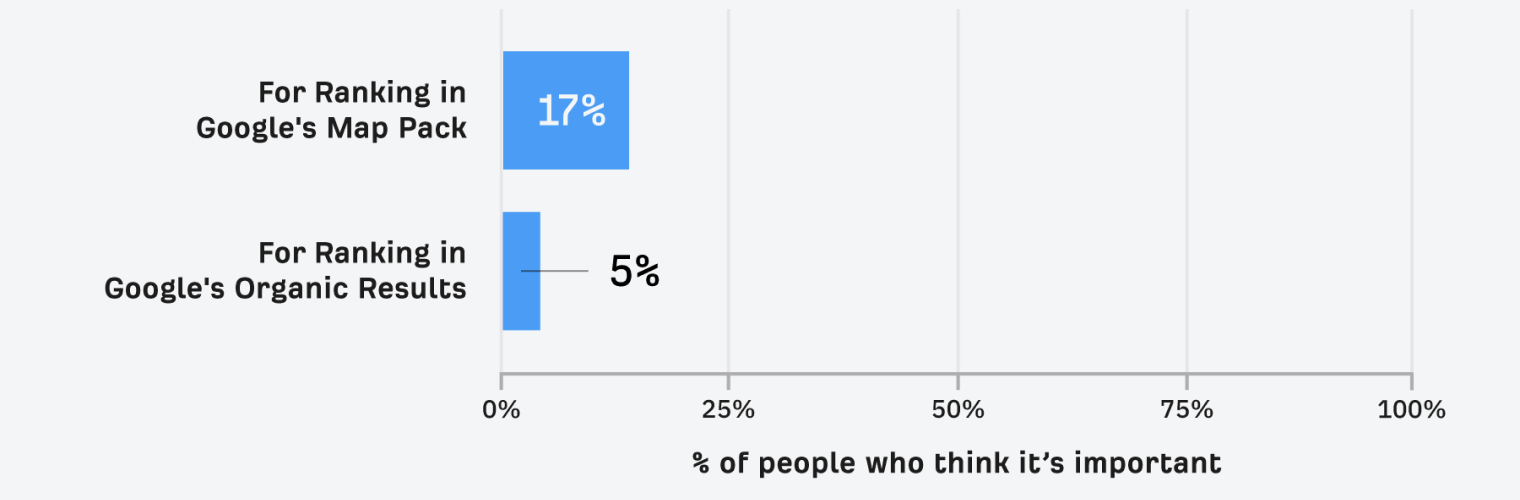
Reviews have also grown in their perceived importance for map pack rankings over the past few years.
The perceived importance of review signals over time
| 2013 | 2014 | 2015 | 2017 | 2018 | 2020 | 2021 | |
|---|---|---|---|---|---|---|---|
Local Pack/Finder | 12% | 12% | 11% | 13% | 15% | 16% | 17% |
Localized Organic Results | 6% | 7% | 6% | 7% | 6% | 6% | 5% |
Source: BrightLocal
But reviews aren’t only about rankings. Getting reviews on your Google Business Profile and elsewhere builds trust with Google and customers.
Here are a few best practices for getting more reviews from Google:
Remind customers to leave reviews (you can create and share a review link in Google Business Manager)
Focus on getting reviews on your Google Business Profile
Respond to reviews to build trust (you’ll need a verified Google Business Profile to do this)
- Don’t offer or accept money in exchange for reviews (it’s against Google’s terms)
Don’t discourage bad reviews or request good reviews from customers (it’s against Google’s terms)
Get listed in directories (for more NAP citations)
A NAP citation mentions your business’s name, address, and phone number online. They usually appear on business directories and social media profiles.
There are also NAPW citations that mention your website.
BrightLocal’s 2021 study shows that 7% of SEOs think citations are the most important ranking factor. That’s true for both the map pack and regular results.
How many SEOs think citations are the most important ranking factor?
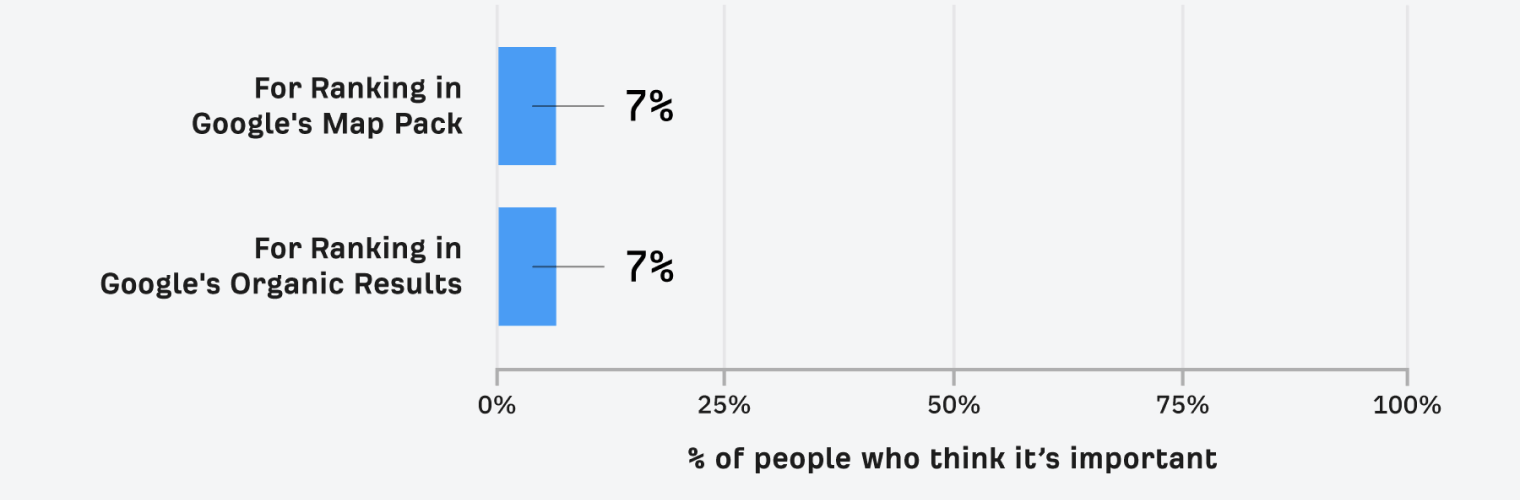
In other words, they’re somewhat important—but not as important as they used to be.
The perceived importance of citations among SEOs has been declining since 2014.
The perceived importance of citation signals over time
| 2013 | 2014 | 2015 | 2017 | 2018 | 2020 | 2021 | |
|---|---|---|---|---|---|---|---|
Local Pack/Finder | 18% | 20% | 17% | 13% | 11% | 7% | 7% |
Localized Organic Results | 11% | 11% | 10% | 8% | 9% | 6% | 7% |
Source: BrightLocal
That said, citations can still help searchers discover your business online. This is because directories often rank on the search results for local queries. So if you’re in those directories, the people who click on them in the search results may find your business.
Here are a few best practices:
Submit to other big players (in the U.S., these include Apple Maps, Yelp, Yellow Pages, Bing Places, and Facebook)
Submit to other popular directories in your local area and industry
Keep your citations consistent (same name, address, phone number) everywhere
Further reading
Tip
Here’s a quick way to find industry and local directories:
This will show you sites linking to one or more of your competitors, but not you.
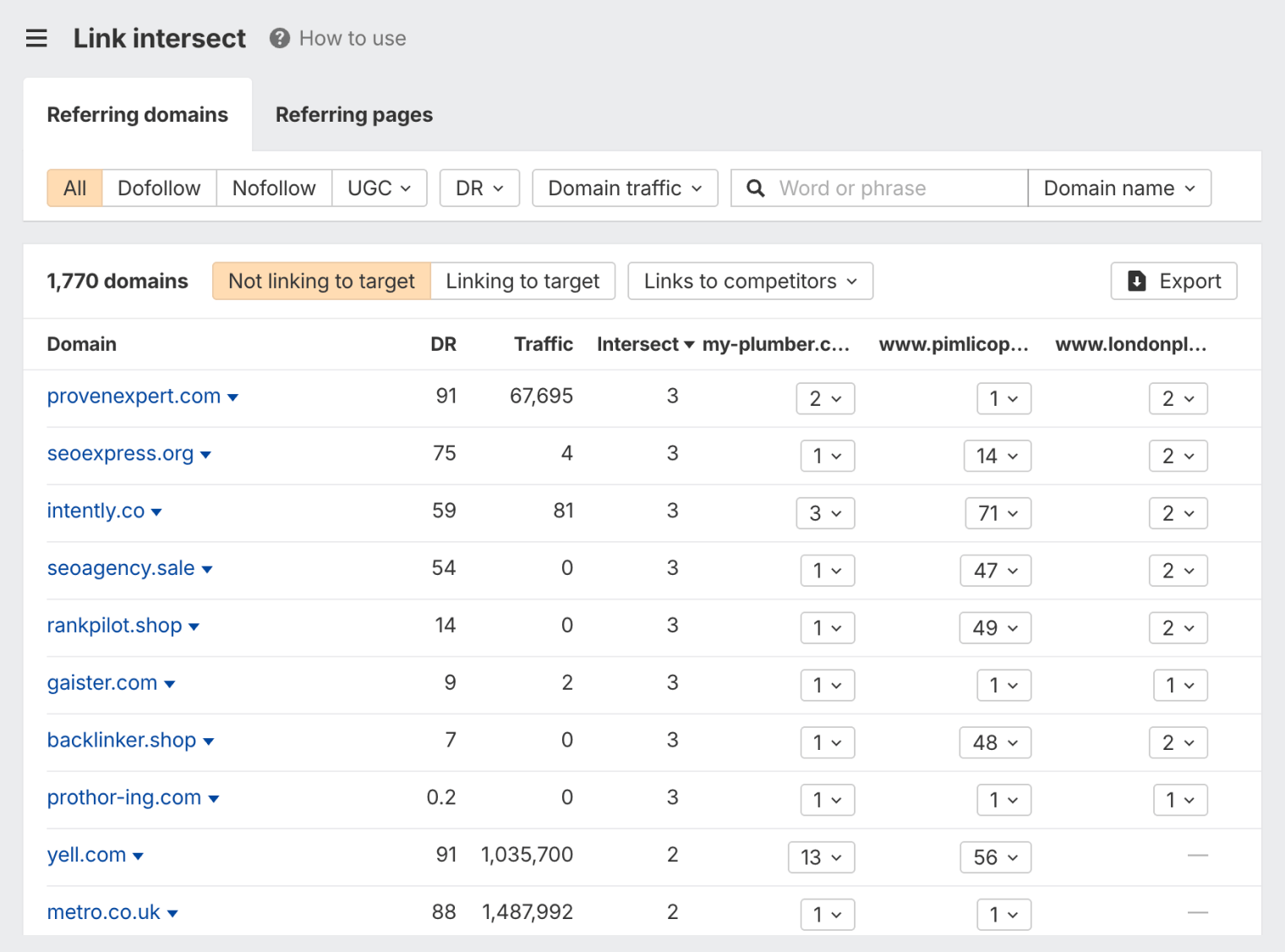
If a website links to many competitors, it’s probably a directory where you can also add a listing.
Do local keyword research
Local keyword research is the process of understanding how people search for the local services you offer.
It’s important because you want to optimize for what people search for.
Let’s go through how to do this.
Find service-based keywords
Most people don’t think about the different ways that others may search for what they do.
For example, if you’re a plumber, some customers will find you by typing “plumber” into Google. But others will search for queries relating to specific services like “drain unblocking.”
For that reason, you should begin by brainstorming and listing the services you offer. This will help you maximize your presence for queries your customers are searching for.
Here’s what that can look like for a plumber:
Drain unblocking
Boiler repair
Boiler installation
Boiler servicing
Radiator installation
Burst pipe repair
To expand this list, use the service keywords as “seeds” to find more services people are searching for.
For example, if we plug the services above into Ahrefs’ Keywords Explorer and check the Matching terms report, we see keywords like:
gas boiler installation
combi boiler installation
electric boiler installation
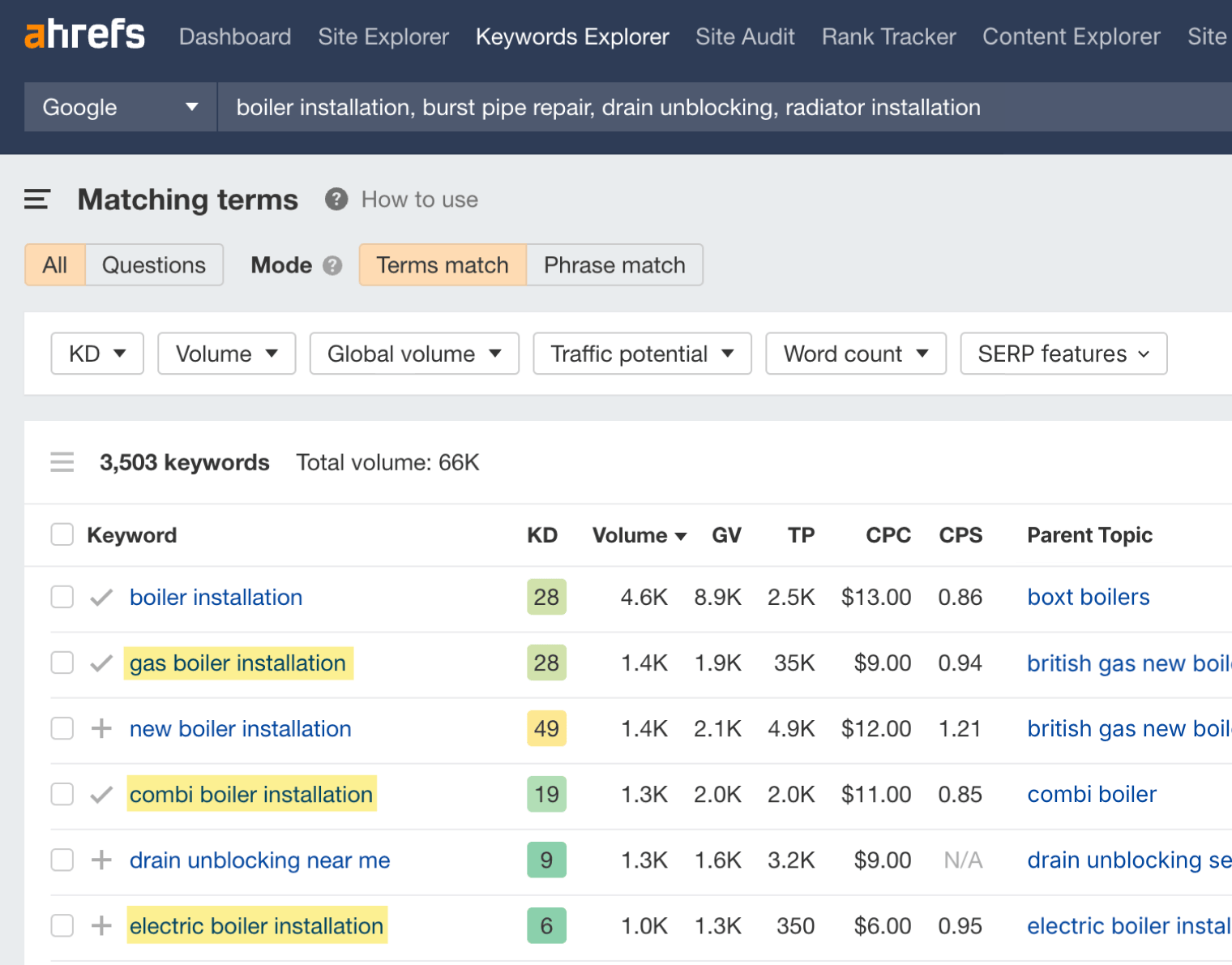
If you offer those services, you may also want to consider targeting these keywords.
Here’s another way to find “missed” keywords:
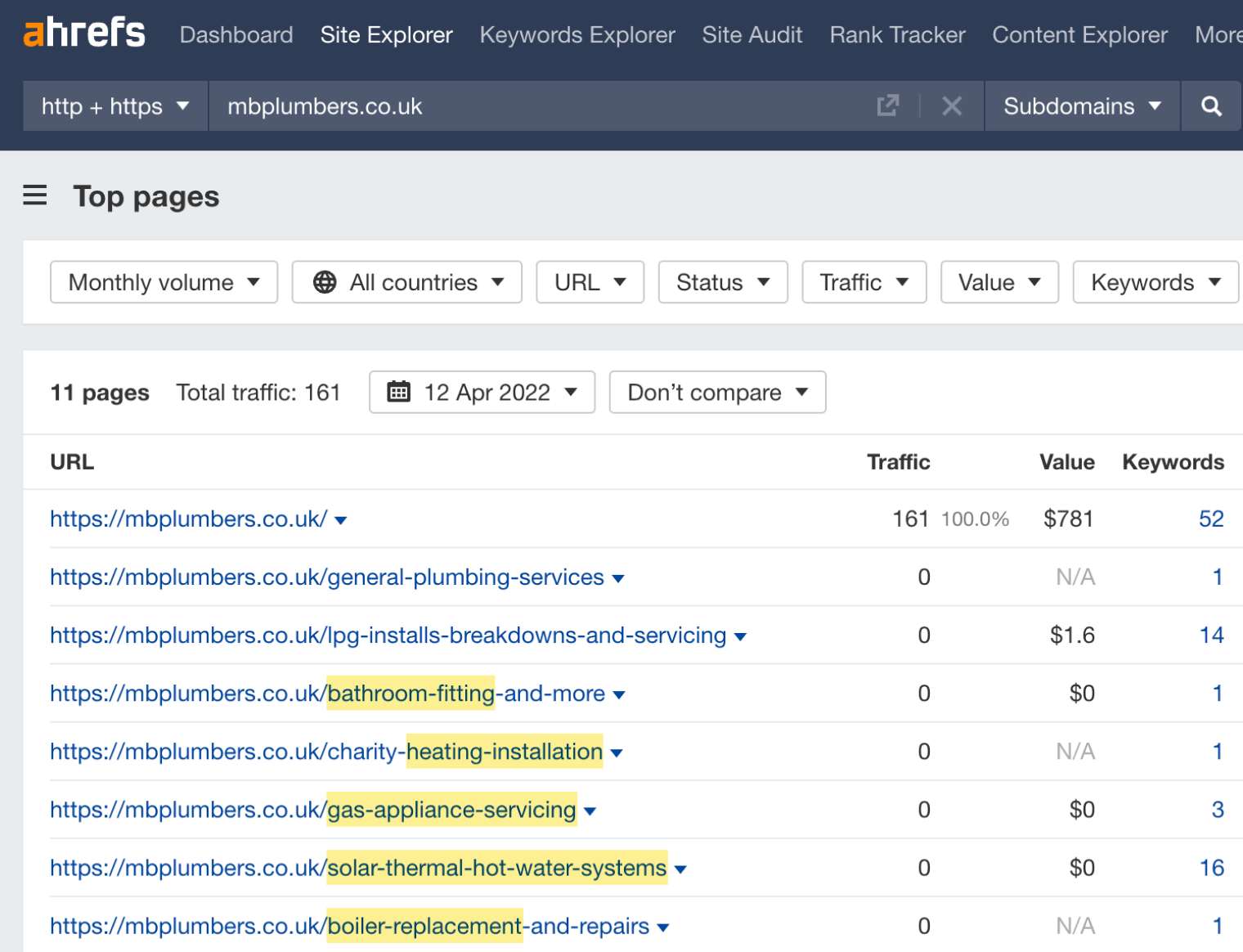
Plug a competing business into Ahrefs’ Site Explorer, go to the Top pages report, and look for URLs that map to services.
Check search volumes
Keyword research tools show you national search volumes. If you want search volumes for your state, city, or town, you’ll have to use Google Keyword Planner.
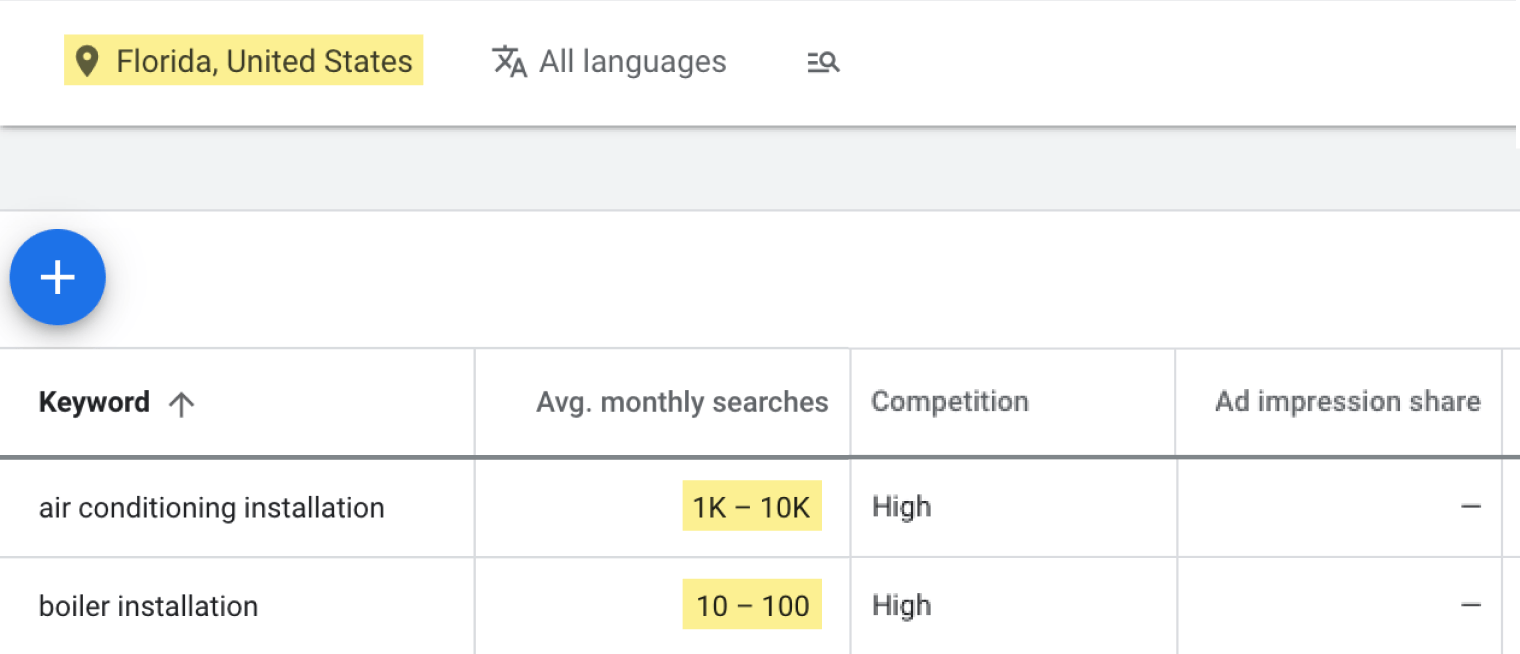
Unfortunately, Keyword Planner has its issues:
It shows broad search volume ranges (e.g., 1K–10K), not absolute numbers.
It groups keywords and shows a combined rounded search volume.
For that reason, checking the relative popularity of keywords at the national level tends to be more productive. This is because what happens in one city is likely to be similar in the next.
You can do this with a keyword research tool like Ahrefs’ Keywords Explorer.
For example, the tool tells us that more people search for “boiler repair” than “boiler installation” in the U.K.:

This is probably the case whichever city we’re in, so it’s an excellent way to prioritize keywords.
Check for local intent
Local intent means that searchers want to shop nearby. If that isn’t the case for your services, it’s not a local SEO opportunity.
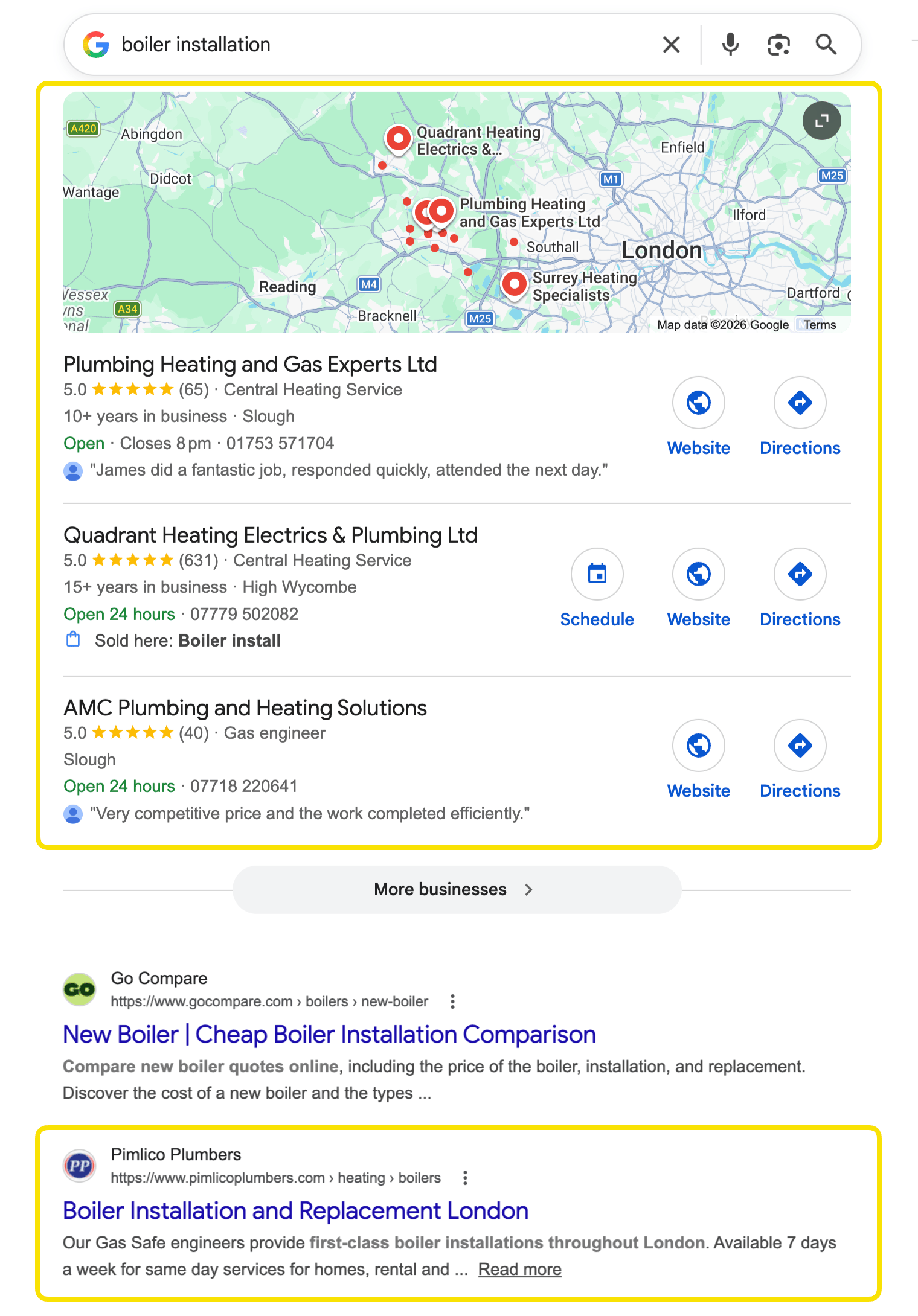
To check a query for local intent, Google it and check the results.
If there’s a map pack and/or some local “blue link” results, it has local intent.
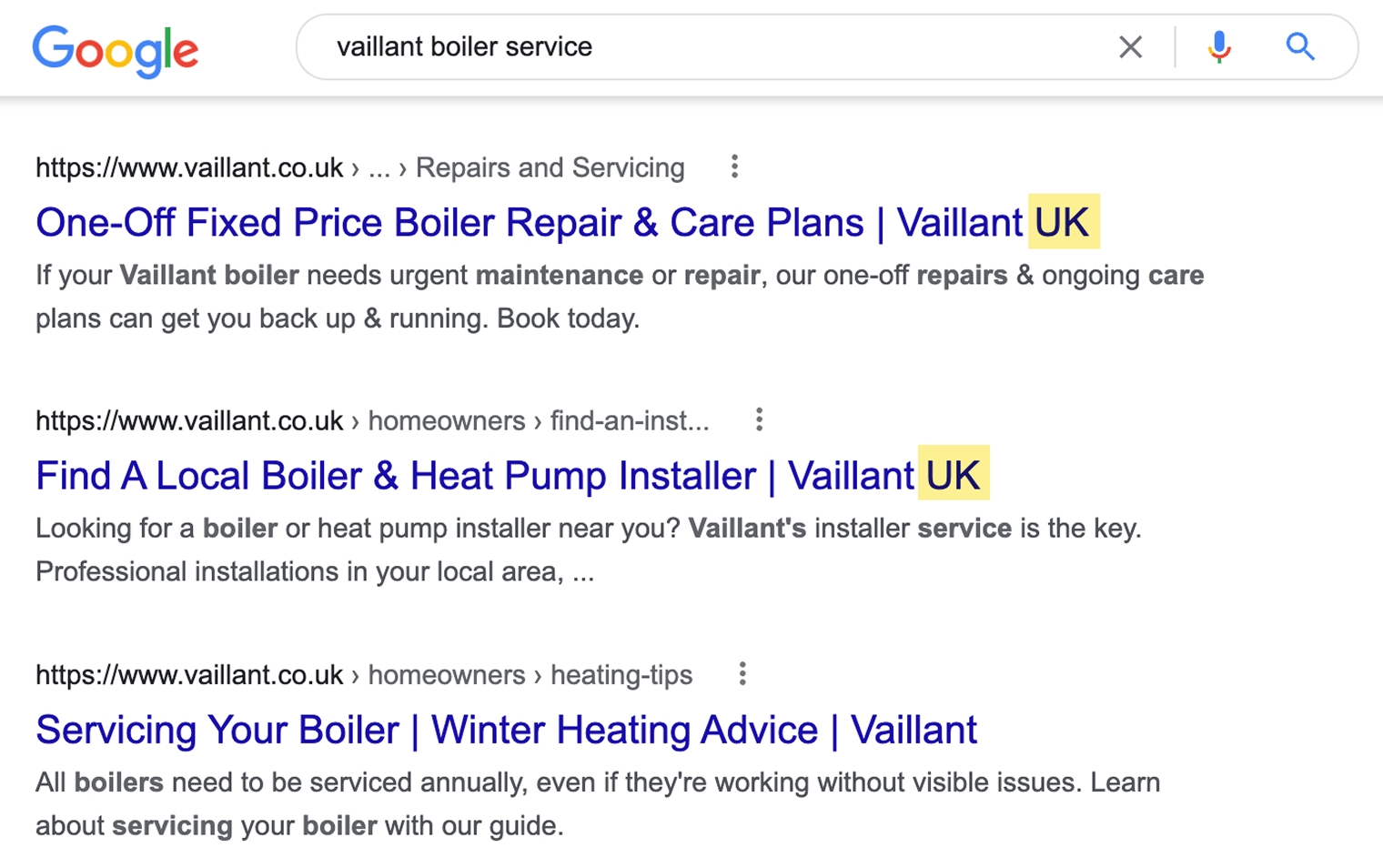
If there are no map pack and local “blue link” results, it doesn’t have local intent.
You can still target keywords without local intent, but it’s not a job for local SEO.
Assign keywords to pages
Your homepage is unlikely to rank for all your service keywords. So you’ll need to target some with separate pages.
To assign keywords to URLs, think about which services they map to.
If they map to very different services, such as “boiler installation” and “burst pipe repair,” assign them to separate pages.
If they map to the same service, such as “drain unblocking” and “drain unclogging,” assign them to the same page.
You can learn more about this process in our local keyword research guide below.
Further reading
Get more backlinks
Links act like votes for your site from other websites.
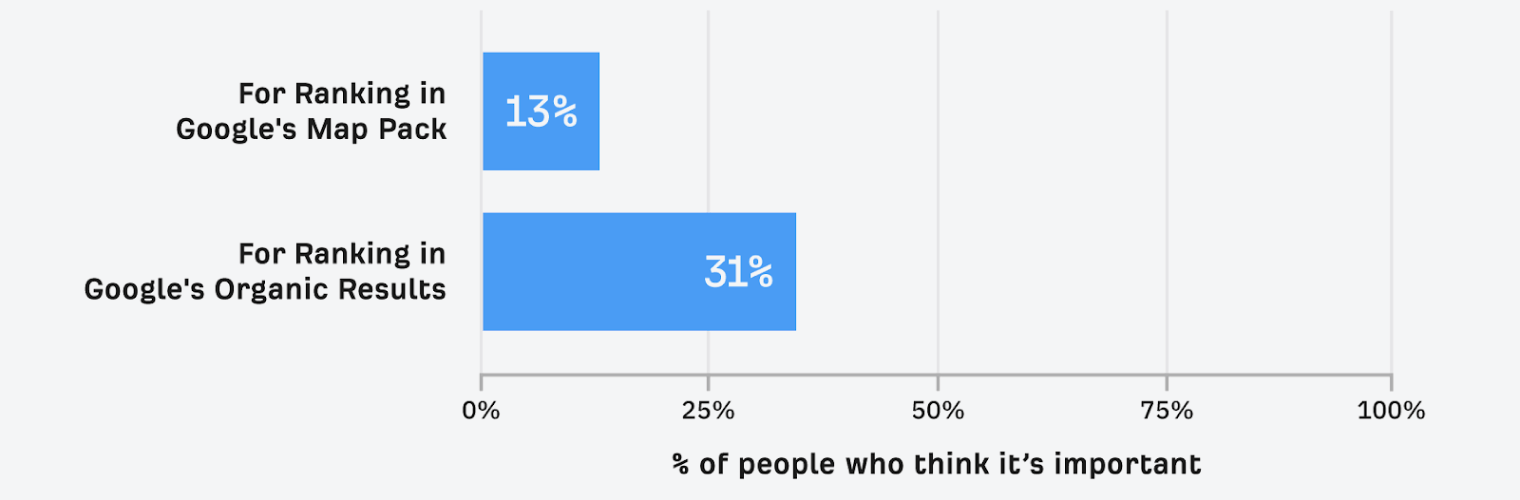
BrightLocal’s study shows that 31% of SEOs deem links the most important signal for ranking on regular organic search. 13% think the same for map pack rankings.
How many SEOs think links are the most important ranking factor?
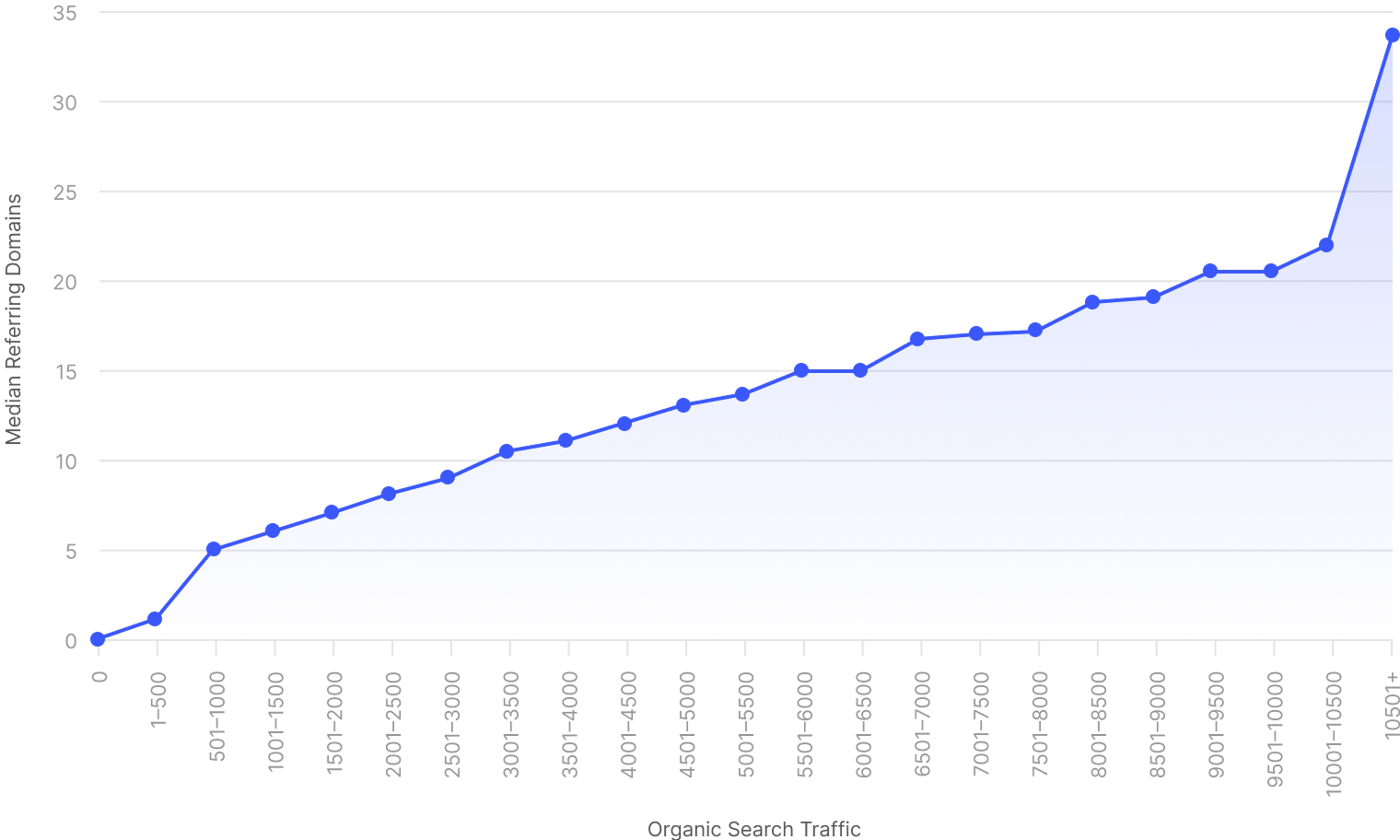
For many, this won’t come as much of a surprise. In 2016, Google said that backlinks are one of their top three ranking factors. Plus, many studies have found a strong correlation between links and organic traffic.
Links are increasing in their perceived importance for “regular” local rankings over time too. But their perceived importance for “map pack” rankings has stayed roughly the same.
The perceived importance of links over time
| 2013 | 2014 | 2015 | 2017 | 2018 | 2020 | 2021 | |
|---|---|---|---|---|---|---|---|
Local Pack/Finder | 12% | 12% | 15% | 17% | 17% | 15% | 13% |
Localized Organic Results | 24% | 25% | 25% | 29% | 28% | 31% | 31% |
Source: BrightLocal
Here are a few best practices:
Get links from other top-ranking sites
- Get links your competitors have (use Ahrefs’ Link Intersect tool for this)
Get local citations (these often have links)
- Claim unlinked mentions
Reclaim lost links by redirecting old versions of your pages to new versions
Further reading
Improve your on-page SEO
On-page SEO is where you make changes to the content of a page to help it rank higher on organic search results.
BrightLocal’s study shows that 34% of SEOs think on-page signals are the most important factor for regular organic search. And 16% believe it’s the most important factor for map pack rankings.
How many SEOs think on-page seo is the most important ranking factor?
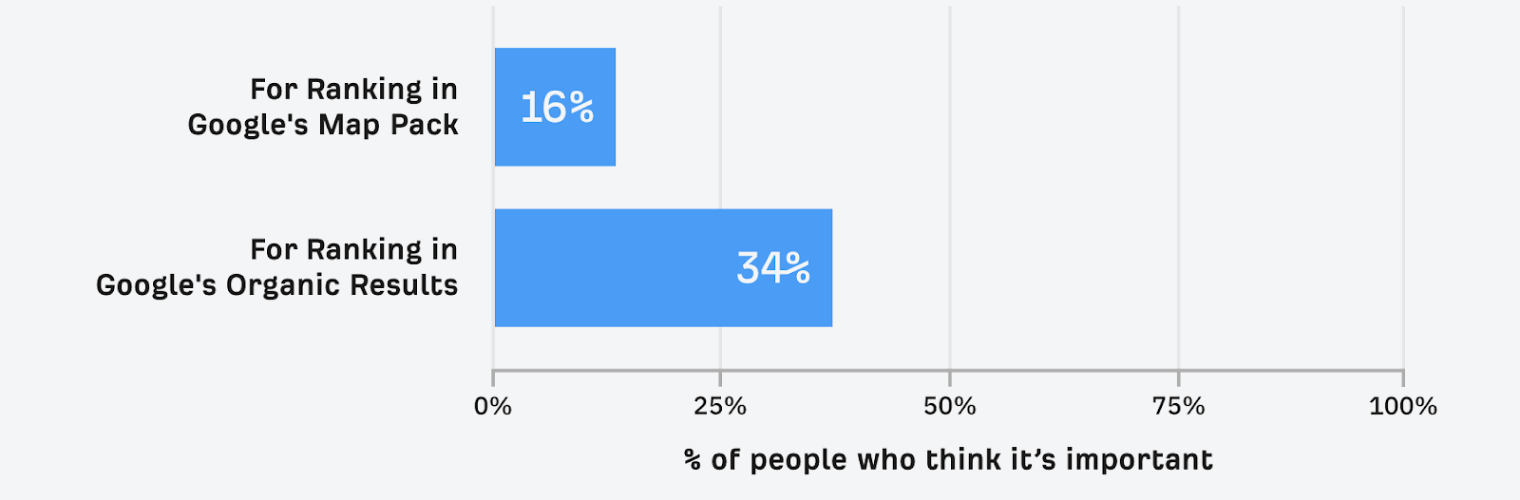
On-page signals are also growing in their perceived importance for local SEO. You can see this from the results of BrightLocal’s previous surveys.
The perceived importance of on-page signals over time
| 2013 | 2014 | 2015 | 2017 | 2018 | 2020 | 2021 | |
|---|---|---|---|---|---|---|---|
Local Pack/Finder | 18% | 15% | 14% | 14% | 14% | 15% | 16% |
Localized Organic Results | 27% | 27% | 26% | 24% | 26% | 32% | 34% |
Source: BrightLocal
Here are a few best practices:
Tailor your pages for search intent
Include your NAP information on your website
- Write compelling meta titles and descriptions
- Use descriptive, SEO-friendly URLs
- Internally link to and from pages where relevant
Include details that matter to searchers
Tip
One way to find details that matter to searchers is to check what top-ranking pages in your area talk about. You can do this by looking at the pages. Or you can use Keywords Explorer to find keywords mentioned on the top-ranking pages.
Here’s how to do that:
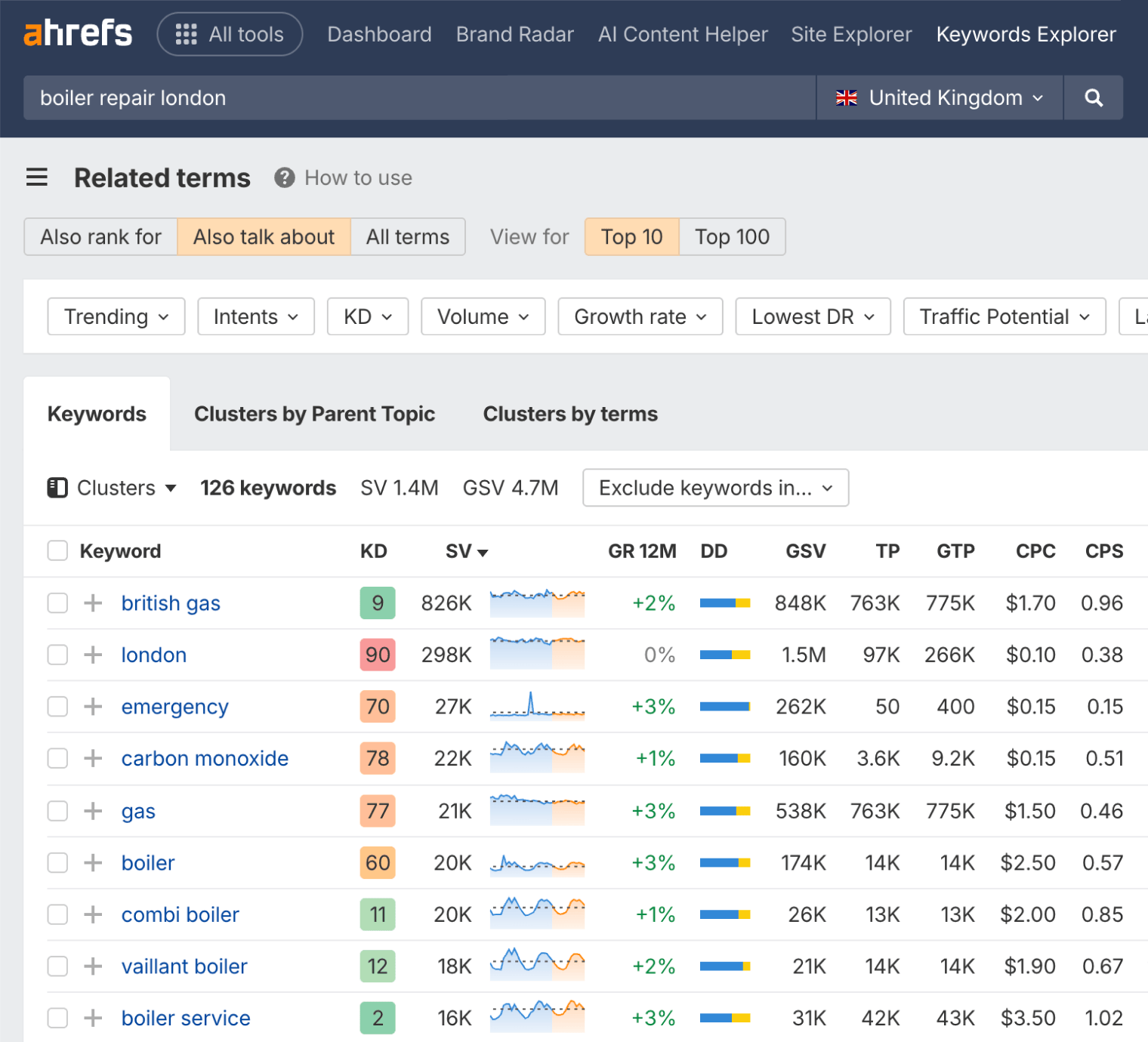
Here are some of the frequently mentioned keywords on the top-ranking pages for “boiler repair london” and what they likely infer:
- “gas safe” – Searchers probably want an engineer who’s on the Gas Safe Register, the official gas safety body in the U.K.
- “greater london” – Searchers probably want to know whether the business supplies this service in their area.
- “gas boiler” – Searchers probably want to know whether the business can repair their type of boiler.
- “emergency call” – Searchers probably want to know whether the business does emergency callouts.
It would be worth mentioning these things on your page.
Further reading
Local SEO tools
Let’s bring things to a close with a few local SEO tools you may find useful.
Google Business Manager
Google Business Manager, formerly Google My Business, is how you manage your Google Business Profile. Signing up for it is completely free and is something every local business owner should use.
Google Search Console
Google Search Console is a free tool for monitoring your website’s search performance. It tells you how much search traffic you’re getting, where it’s going, and what keywords it’s coming from.
Ahrefs’ Rank Tracker
Rank Tracker lets you track up to 10,000 keyword rankings for “regular” organic search by country, state, city, and even ZIP/postal code.
Ahrefs Link Intersect
Our Link Intersect tool lets you find websites that link to multiple competitors. This is useful for finding relevant local and industry-specific citations.
Grid My Business
Grid My Business shows map pack ranking positions for a keyword in the area around your business. It’s freemium and is useful for understanding if and where local searchers are likely to see your business.
Yext
Yext is a tool for syncing and managing business information across multiple listings. It’s useful for keeping citations consistent, although you can do this manually.
Google Keyword Planner
Google Keyword Planner is a free keyword research tool from Google. It’s a useful source of search volume ranges at the local level.
Learn more about local SEO
Hopefully, you now have a pretty good understanding of how local SEO works. If you want to dig deeper and continue learning, check out these resources:
Former Head of Content at Ahrefs (or, in plain English, I’m the guy responsible for ensuring that every blog post we publish is EPIC).
Master SEO Step by Step
How Search Engines Work
Before you start learning SEO, you need to understand how search engines work.
SEO Basics
Learn how to set your website up for SEO success, and get to grips with the four main facets of SEO.
Keyword Research
The starting point in SEO is to understand what your target customers are searching for.
SEO Content
Learn how to create content that ranks in search engines.
On-Page SEO
This is where you optimize your pages to help search engines understand them.
Link Building
Learn how to create content that ranks in search engines.
Technical SEO
Prevent technical problems that stop Google from accessing and understanding your website.
Local SEO
Learn how to improve your visibility in local search results and get more customers from your area.
What AI Means for SEO
You can’t talk about SEO today without mentioning generative AI.