


The 25 Fastest-Growing Cybersecurity Companies (September 2026)

Content Marketer at Ahrefs


- The 25 fastest growing cybersecurity companies
- 1. Huntress (+830%)
- 2. Undetectable (+750%)
- 3. Silentpush (+530%)
- 4. Metomic (+380%)
- 5. Cynomi (+220%)
- 6. Frontegg (+220%)
- 7. Supertokens (+210%)
- 8. Legit Security (+200%)
- 9. Apiiro (+170%)
- 10. Endor Labs (+160%)
- 11. Atomicmail (+150%)
- 12. Cycode (+150%)
- 13. Orca (+130%)
- 14. Deviceandbrowserinfo (+120%)
- 15. Securden (+120%)
- 16. Logto (+110%)
- 17. Anchore (+88%)
- 18. Miniorange (+64%)
- 19. Vanta (+56%)
- 20. Cymulate (+44%)
- 21. Salt (+36%)
- 22. Chainguard (+36%)
- 23. Hyperproof (+27%)
- 24. Pentera (+26%)
- 25. Cyera (+22%)
- The full list: fastest growing cybersecurity companies by organic traffic growth
- How to find this data in Ahrefs
- Final thoughts
We analyzed thousands of cybersecurity companies and ranked them by a metric that's hard to fake: how fast their organic search traffic grew over the last year. Rising organic traffic is a strong signal of real momentum, because it reflects growing awareness, demand, and a product people are actively looking for.
The cybersecurity market is enormous and still growing fast. It was estimated at $271.9 billion in 2025 and is projected to reach $663.2 billion by 2033, as rising threats push organizations to spend more on security every year.
AI is reshaping where that money flows: investors are pouring capital into AI-native security startups even as overall deal counts tighten, according to PitchBook's cybersecurity VC coverage, which makes fast-growing organic demand the clearest sign of a security company actually breaking out.
So the question we set out to answer is: which cybersecurity companies, across every category from cloud and application security to identity, threat detection, and developer security, are pulling in real, fast-growing organic demand right now?
This list was built with Letaido
This article was researched and built by Letaido, Ahrefs' AI marketing platform. Letaido pulls live Ahrefs data, runs its own analysis, and assembles findings like the ranking below, so the numbers you're about to read come straight from the same data set our tools run on.
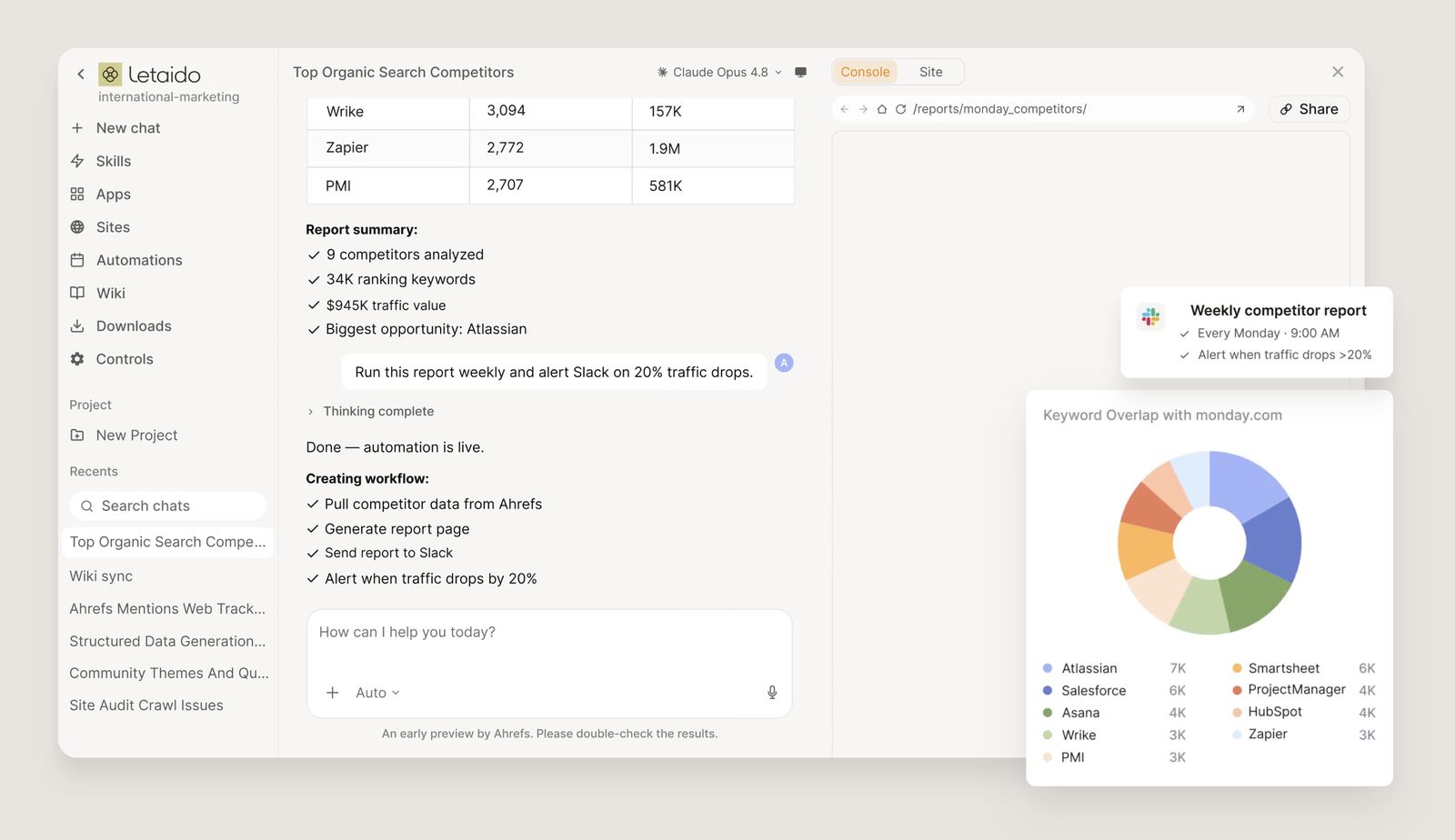
You can recreate this kind of research for your specific niche or vertical using Letaido.
Sidenote
We rank these companies by how much their organic search traffic grew over the past year: we compare each site's estimated monthly organic traffic now against twelve months ago, using Ahrefs. Organic traffic growth is a strong signal of real momentum because it reflects rising awareness and demand for a product people are actively searching for. To keep the percentages honest we only include companies that already had a real traffic base a year ago, so a jump from a handful of visits doesn't top the list. All data is from Ahrefs.
The 25 fastest growing cybersecurity companies
Below are the cybersecurity companies whose organic search traffic grew fastest over the past year, ordered from highest growth to lowest, each with a traffic chart, the key numbers, and a short read on what's driving their momentum.
1. Huntress (+830%)
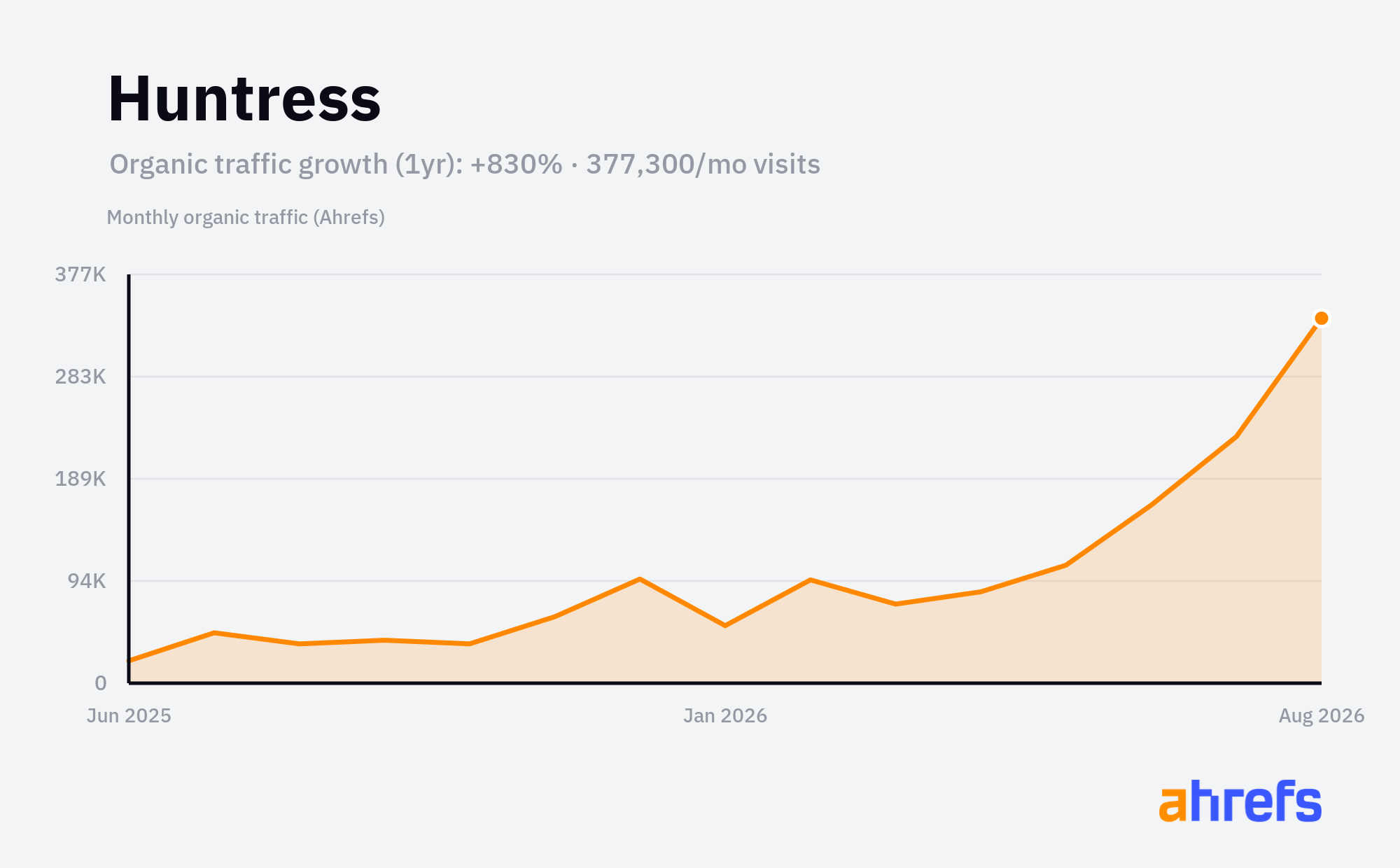
- Organic traffic growth (this year vs last): +830%
- Organic traffic (monthly): 400K
- Year founded: 2015
- Location: Columbia, United States
What they do
Huntress is a managed security platform built for small and mid-sized businesses, delivering threat detection, incident response, and managed antivirus through a network of IT partners and MSPs.
Huntress raised $150M in a Series D in June 2024, led by Kleiner Perkins, Meritech Capital, and Sapphire Ventures, which valued the company at over $1.5 billion.
Huntress is the fastest growing company on the whole list, and the +830% traffic growth over one year makes the scale of that climb almost hard to process. SMB security has gone from an afterthought to a boardroom priority, and Huntress has clearly become the name organizations reach for when they start searching for answers.
2. Undetectable (+750%)
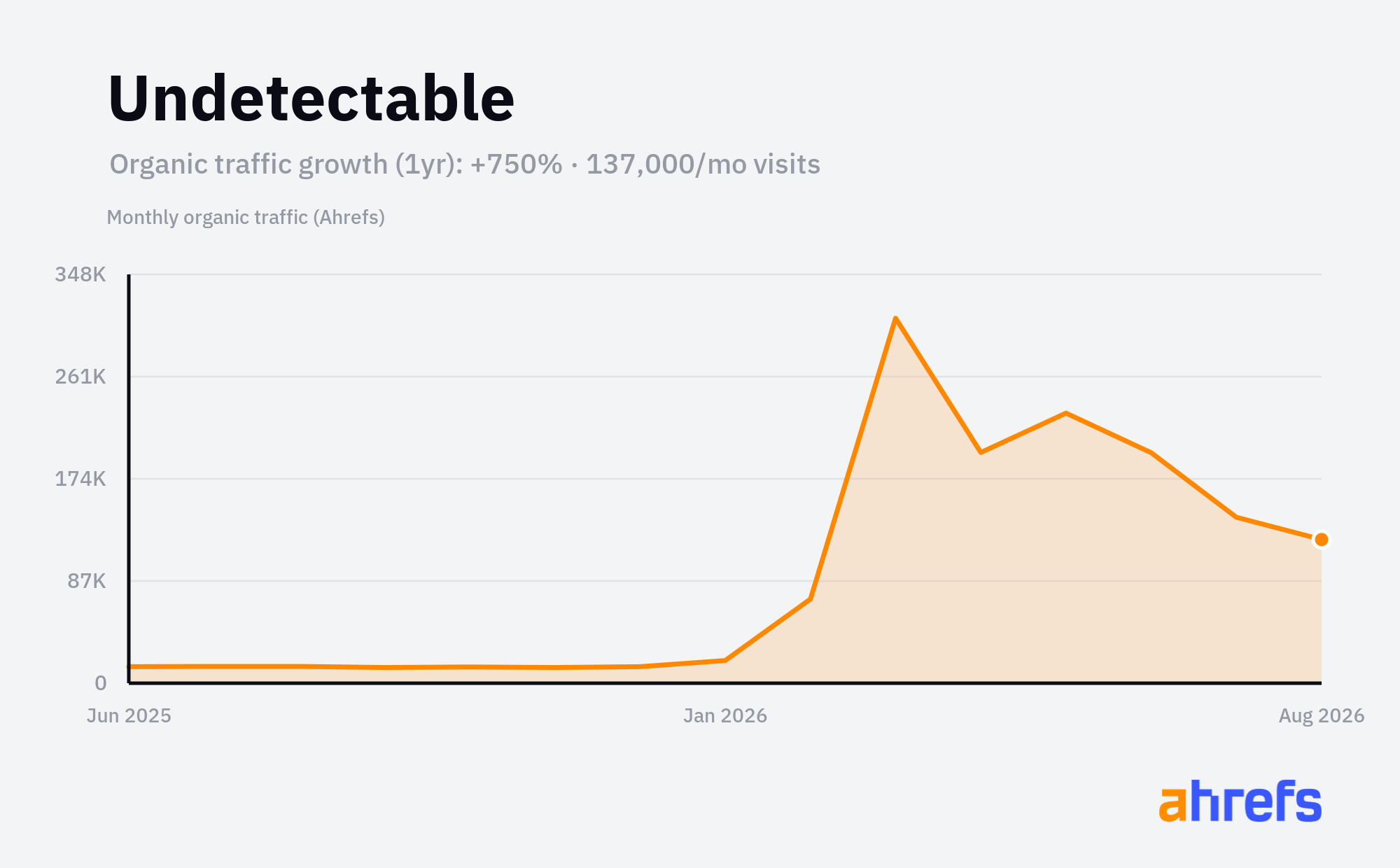
- Organic traffic growth (this year vs last): +750%
- Organic traffic (monthly): 150K
- Year founded: 2021
- Location: Sheridan, United States
What they do
Undetectable is an antidetect browser that lets users run multiple browser profiles with separate fingerprints, used by marketers, researchers, and privacy-conscious professionals who need to manage accounts without cross-contamination.
At ~140K monthly visits and +750% growth in a year, Undetectable has built one of the bigger traffic bases on this list from what is still a pretty niche product category. Anti-fingerprinting and multi-account privacy tools have found a surprisingly broad audience as both platform enforcement and personal privacy concerns have ramped up.
3. Silentpush (+530%)
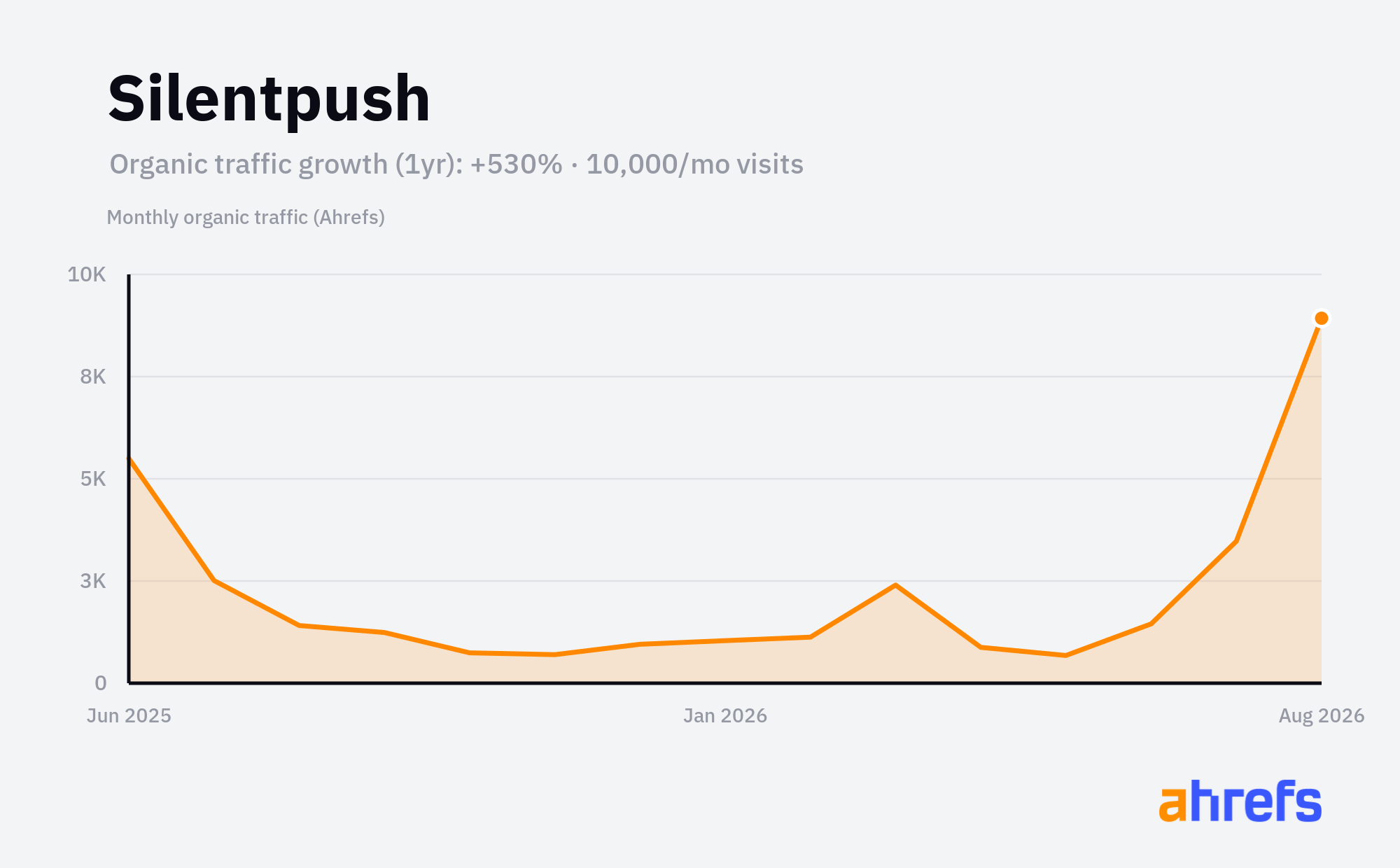
- Organic traffic growth (this year vs last): +530%
- Organic traffic (monthly): 10K
- Year founded: 2018
- Location: Reston, United States
What they do
Silentpush is a threat intelligence platform that helps security teams identify and track adversary infrastructure before attacks happen, using predictive data on domains, IPs, and attacker behavior patterns.
Proactive threat intelligence is a category that's been talked about for years, but search demand is only now catching up with the pitch. A +530% traffic jump signals that security teams are actively shopping this space, and Silent Push has positioned itself squarely in the path of that demand.
4. Metomic (+380%)
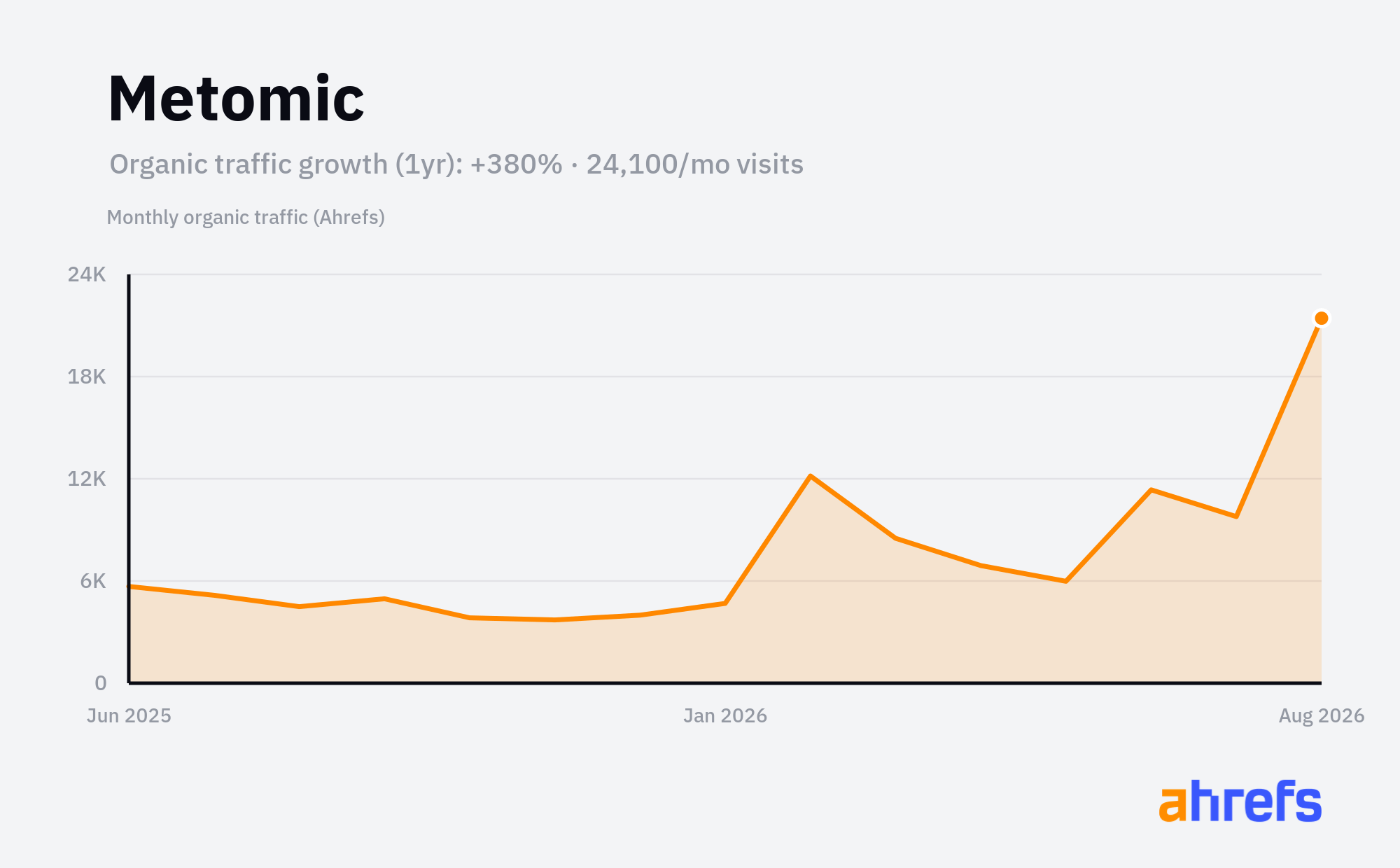
- Organic traffic growth (this year vs last): +380%
- Organic traffic (monthly): 24K
- Year founded: 2018
- Location: London, United Kingdom
What they do
Metomic is a data security platform that scans SaaS applications like Slack, Google Workspace, and Notion for sensitive data exposure, helping security teams find and remediate risks they didn't know they had.
As companies have piled more sensitive data into SaaS tools, the question of what's actually sitting in those apps has become genuinely uncomfortable to answer. Metomic's +380% traffic growth suggests that discomfort is now turning into active search, with security and compliance teams looking for tools to get a handle on SaaS data sprawl.
5. Cynomi (+220%)
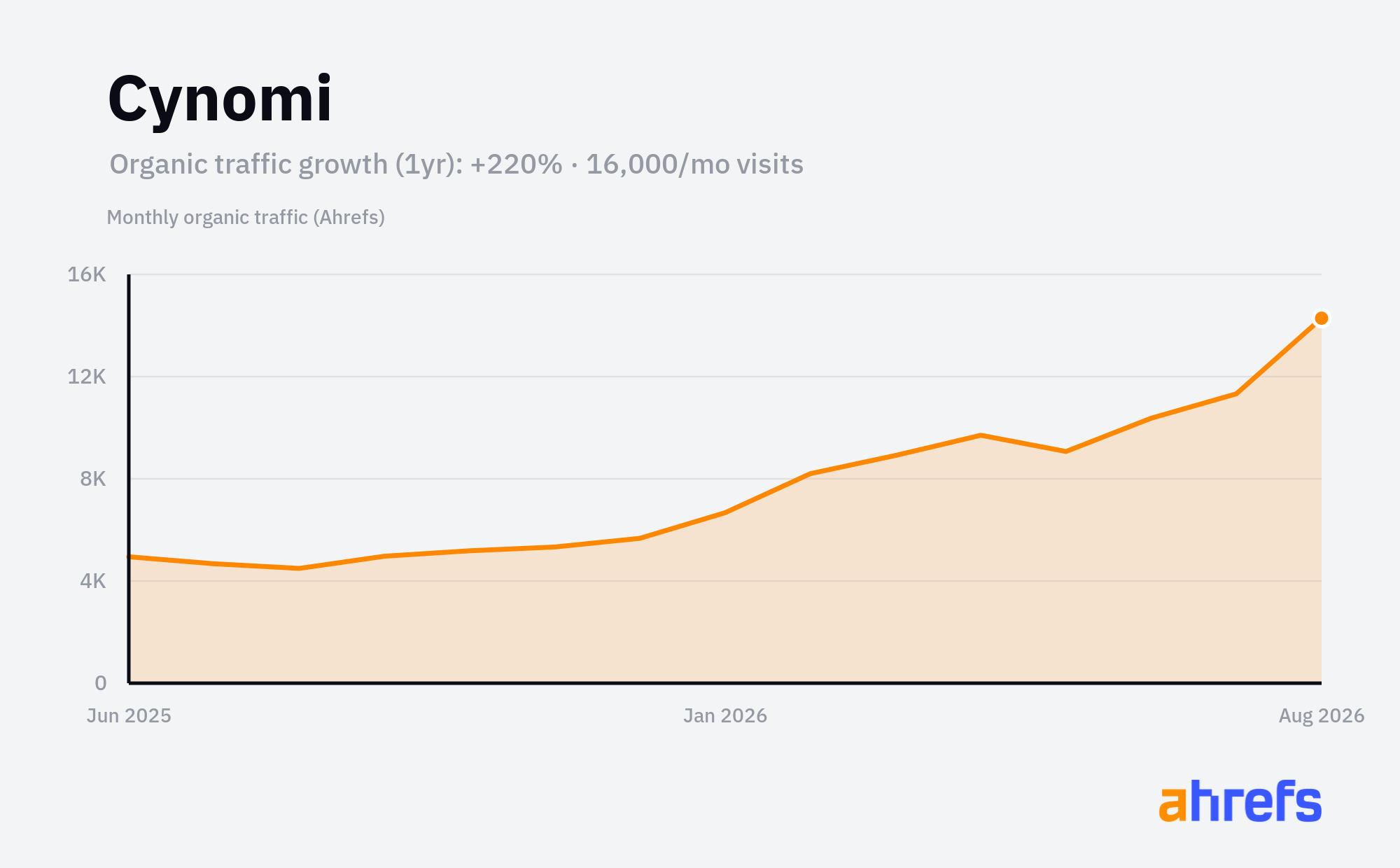
- Organic traffic growth (this year vs last): +220%
- Organic traffic (monthly): 16K
- Year founded: 2021
- Location: Herzliya, Israel
What they do
Cynomi is an AI-powered virtual CISO platform built for managed service providers and small businesses that need structured cybersecurity strategy and risk management without a full-time security leader on staff.
The vCISO category has grown in step with the realization that most SMBs simply can't hire a real CISO, and Cynomi has been one of the louder voices making that case to MSPs. The +220% traffic growth over the past year reflects a market that's moved from curiosity to genuine procurement activity.
6. Frontegg (+220%)
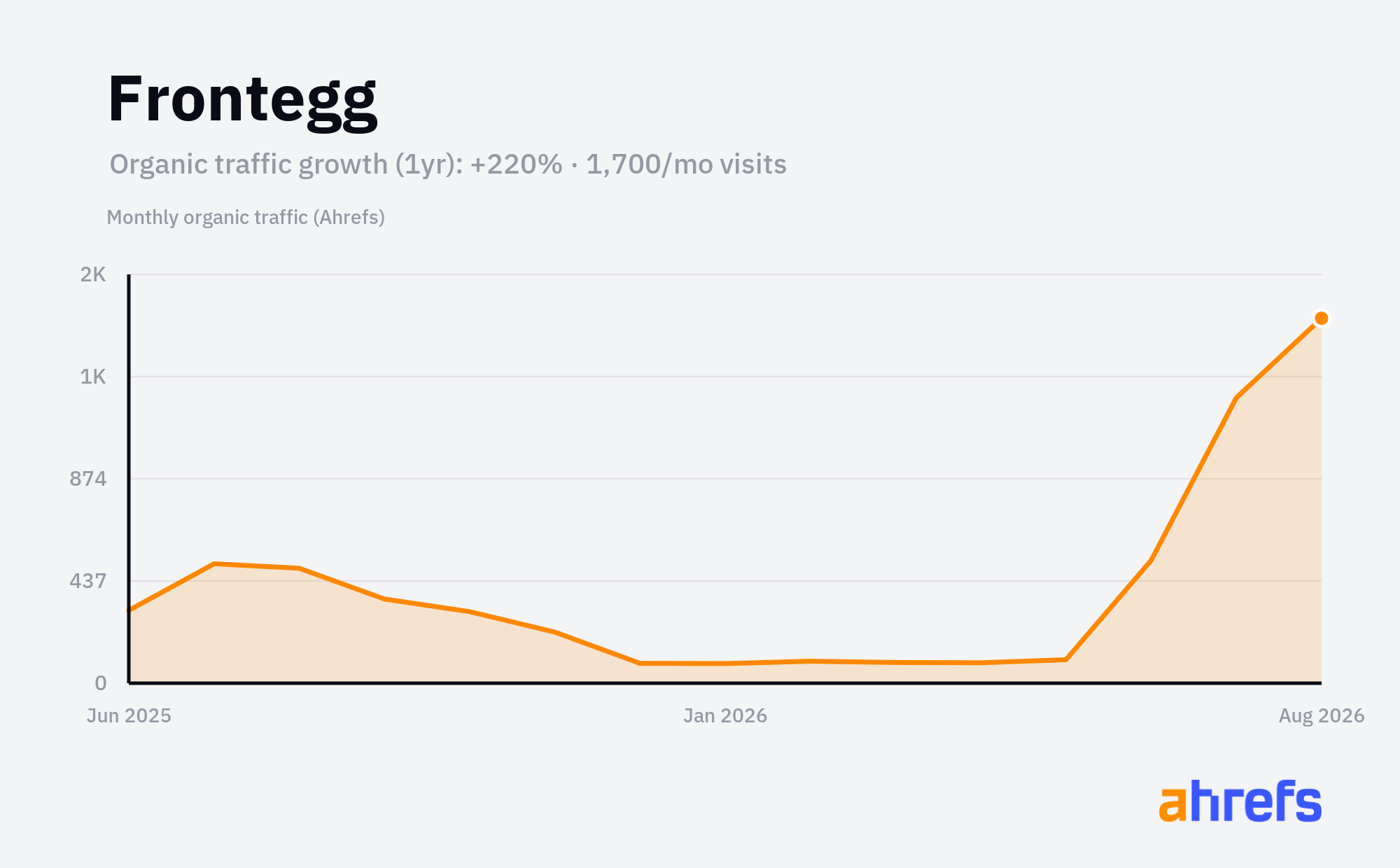
- Organic traffic growth (this year vs last): +220%
- Organic traffic (monthly): 1.5K
- Year founded: 2019
- Location: Tel Aviv, Israel
What they do
Frontegg is a user management and authentication platform for SaaS companies, providing SSO, multi-tenancy, role-based access control, and audit logs that product teams can embed directly into their applications.
Frontegg raised $40M in a Series B in July 2022, led by Stripes and Insight Partners, bringing its total disclosed funding to $70M.
Frontegg is one of the smaller brands on this list by monthly traffic, so a +220% jump in a year is genuinely meaningful for a developer-focused identity tool. The developer docs subdomain ranking here suggests that the product is finding real traction where it counts: with the engineers actually building on it.
7. Supertokens (+210%)
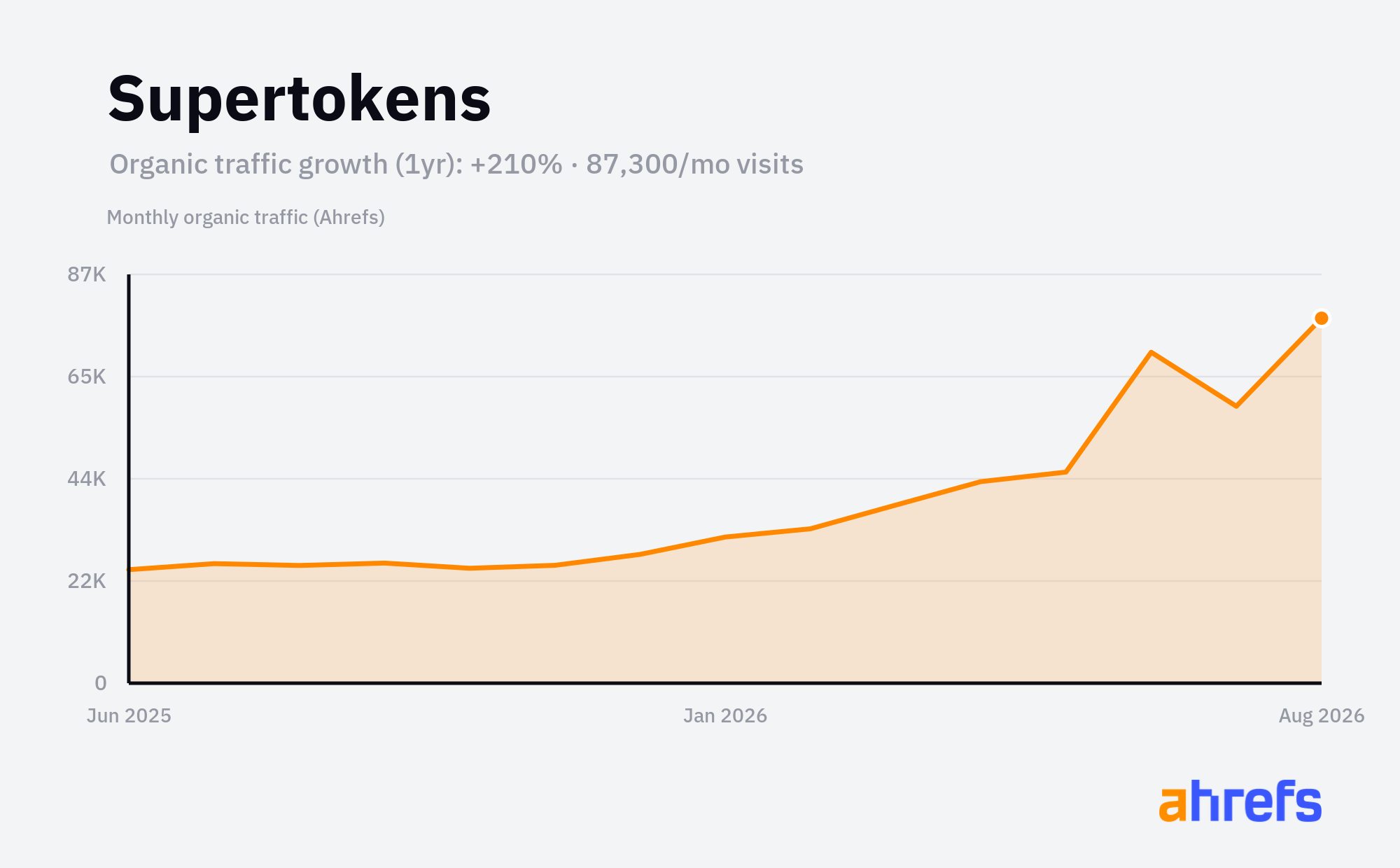
- Organic traffic growth (this year vs last): +210%
- Organic traffic (monthly): 87.5K
- Year founded: 2020
- Location: San Francisco, United States
What they do
Supertokens is an open-source authentication platform that gives developers a self-hostable alternative to managed identity services like Auth0, covering login, session management, and user roles for web and mobile apps.
Supertokens received a $125K seed investment from Y Combinator in August 2020.
At ~90K monthly visits and +210% growth, Supertokens has built a traffic base that most enterprise identity vendors would envy, largely on the back of developer trust in open-source and genuine frustration with the pricing of managed auth services. It's a category where the build-vs-buy debate is very much alive, and Supertokens is benefiting from every team that decides to look for an alternative.
8. Legit Security (+200%)
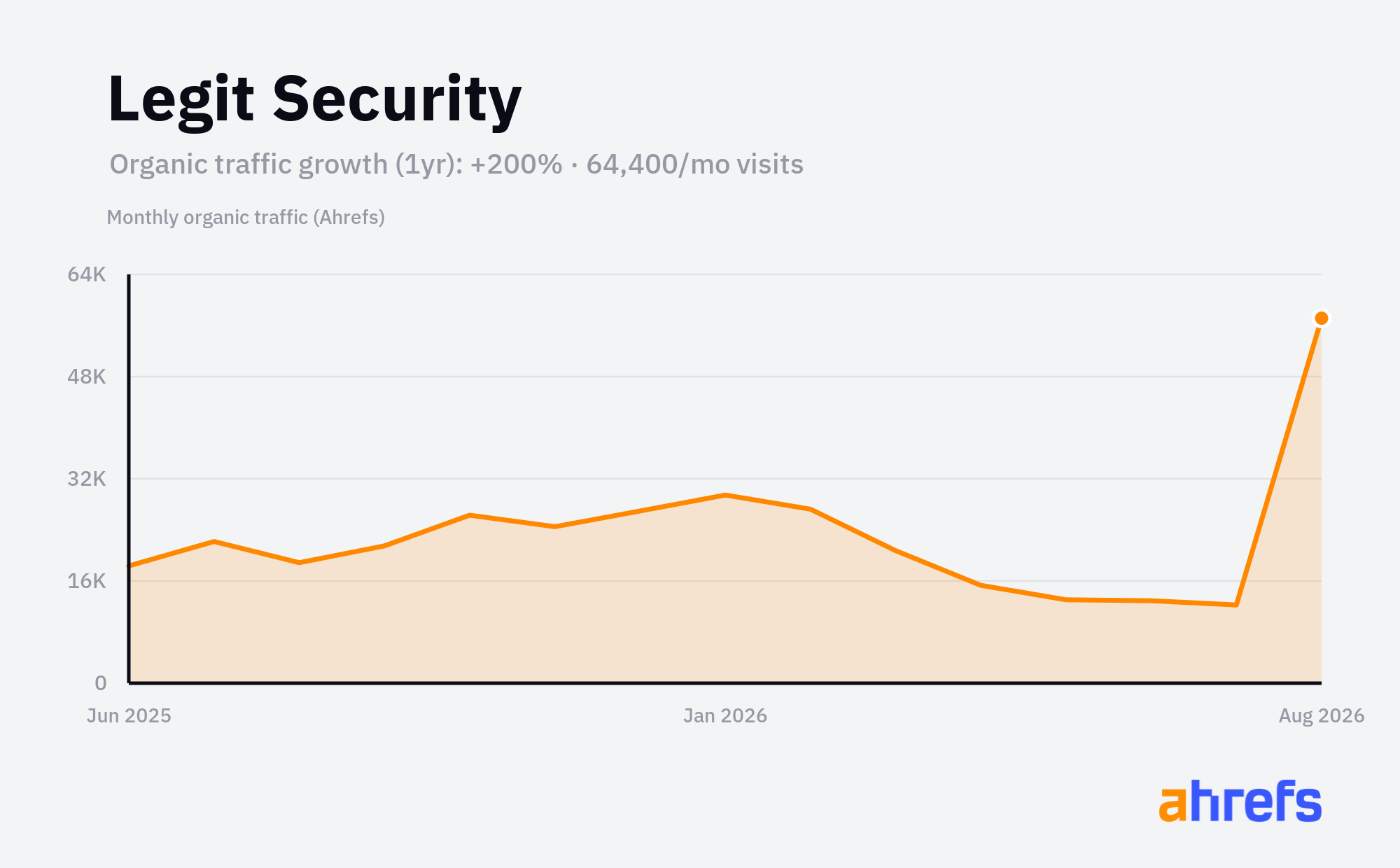
- Organic traffic growth (this year vs last): +200%
- Organic traffic (monthly): 64.5K
- Year founded: 2020
- Location: Boston, United States
What they do
Legit Security is an application security and software supply chain security platform that gives security teams visibility and control over their development environments, pipelines, and code assets.
Legit Security raised $40M in a Series B in September 2023, led by CRV, with participation from Cyberstarts, Bessemer Venture Partners, and TCV, bringing total funding to $70M.
Software supply chain security went from a specialist concern to a mainstream priority after a string of high-profile incidents, and Legit Security has been riding that wave hard. A tripling of organic traffic in a year, reaching ~60K monthly visits, tells you the search demand is real and that buyers are actively evaluating options.
9. Apiiro (+170%)
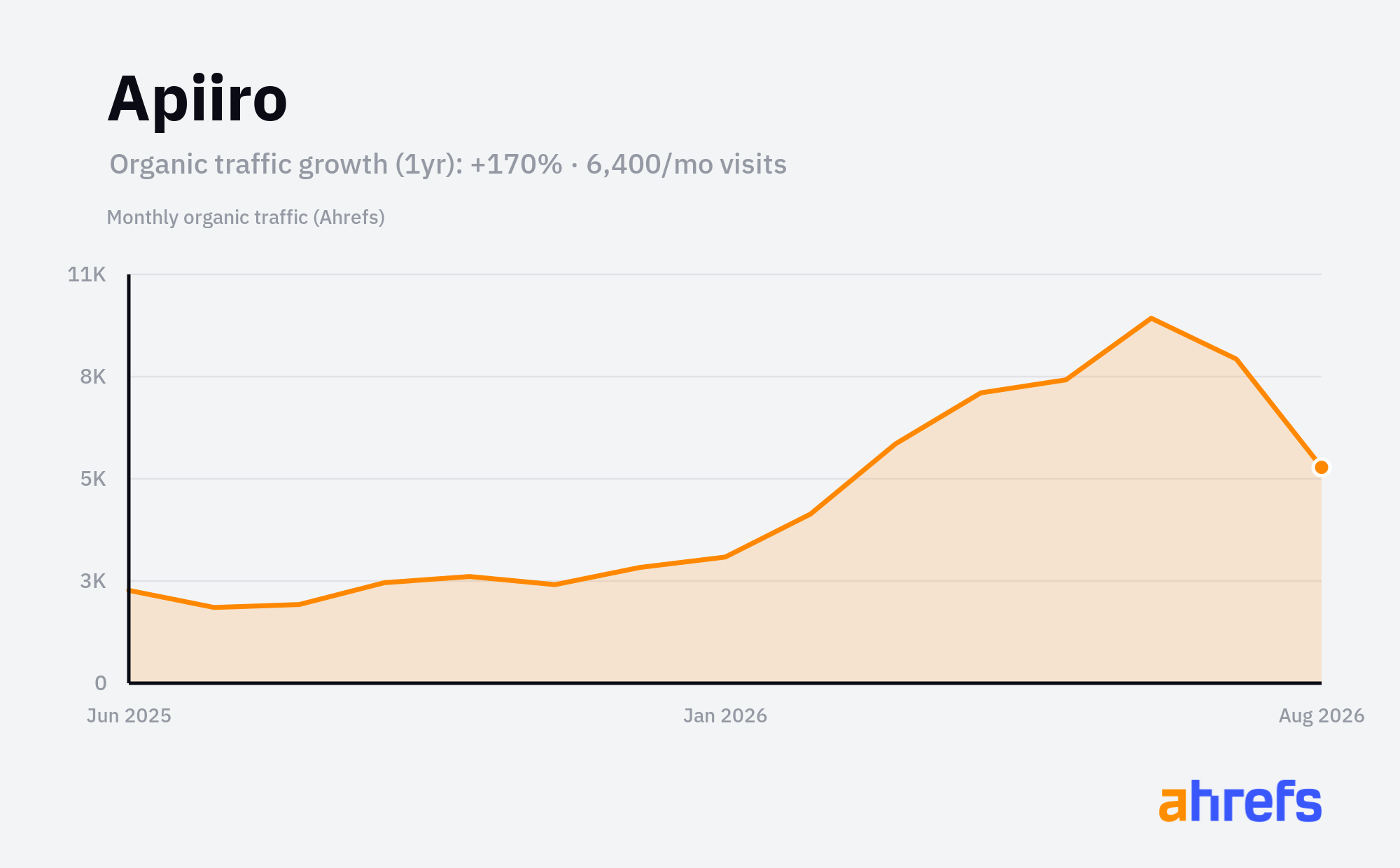
- Organic traffic growth (this year vs last): +170%
- Organic traffic (monthly): 6.5K
- Year founded: 2019
- Location: Tel Aviv, Israel
What they do
Apiiro is a cloud-native application security platform that analyzes code, infrastructure, and developer behavior to identify and prioritize security risks across the software supply chain.
Apiiro raised $100M in a Series B in November 2022, led by General Catalyst with participation from Greylock and Kleiner Perkins, on top of a $35M Series A raised in 2020.
Risk-based application security is a nuanced sell, but the +170% traffic growth suggests Apiiro is winning the content and search game in its category. Security teams searching for ways to prioritize what actually matters, rather than chasing every CVE, are landing on Apiiro in increasing numbers.
10. Endor Labs (+160%)
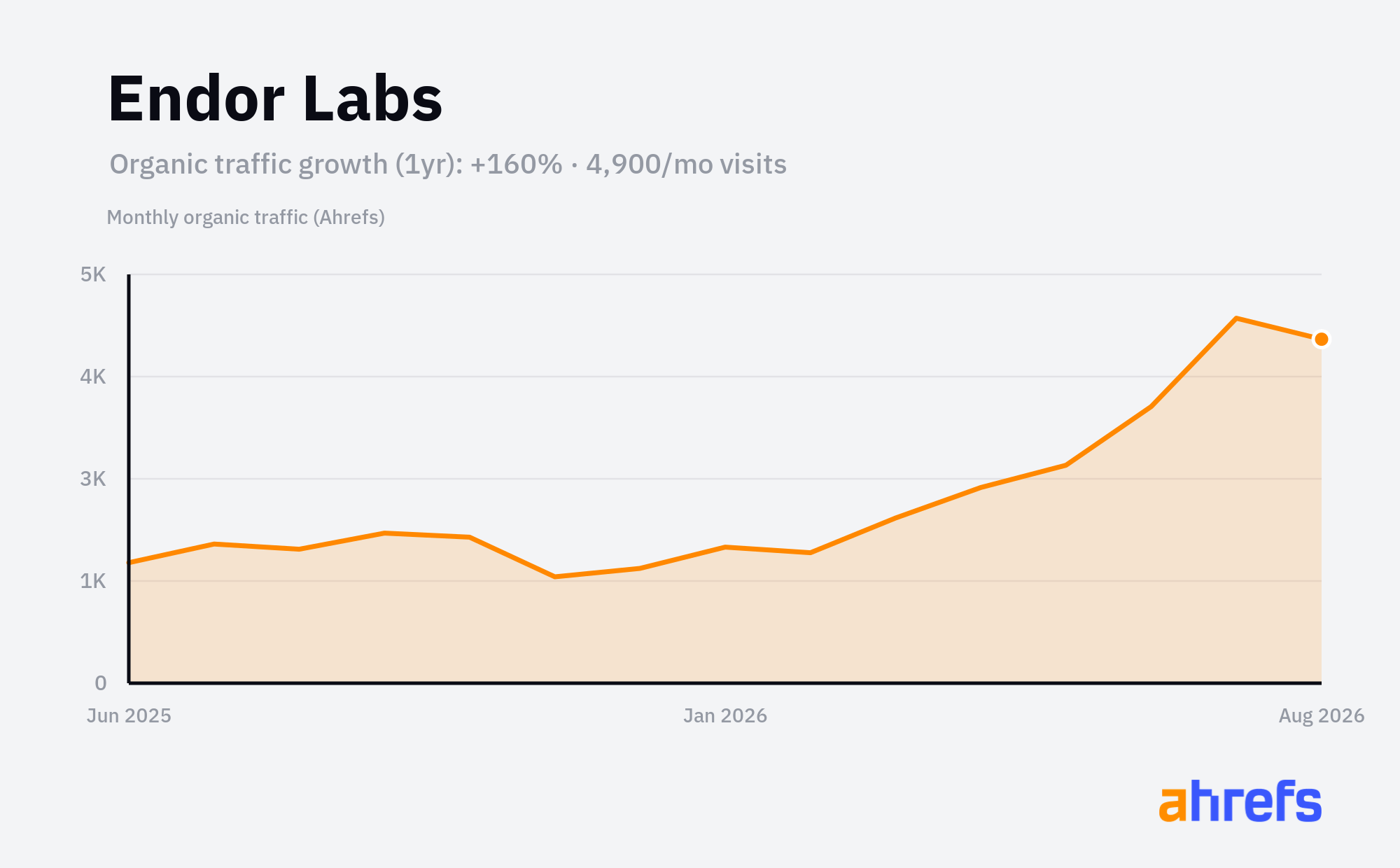
- Organic traffic growth (this year vs last): +160%
- Organic traffic (monthly): 5K
- Year founded: 2021
- Location: Palo Alto, United States
What they do
Endor Labs is a software supply chain security platform focused on helping engineering teams manage open-source dependency risk, including vulnerabilities in AI-generated and third-party code.
The explosion of AI-generated code has created a fresh layer of supply chain anxiety for security teams, and Endor Labs has been sharp about addressing it directly. The +160% traffic growth reflects a category that's moving from "emerging" to "we need a solution for this now."
11. Atomicmail (+150%)
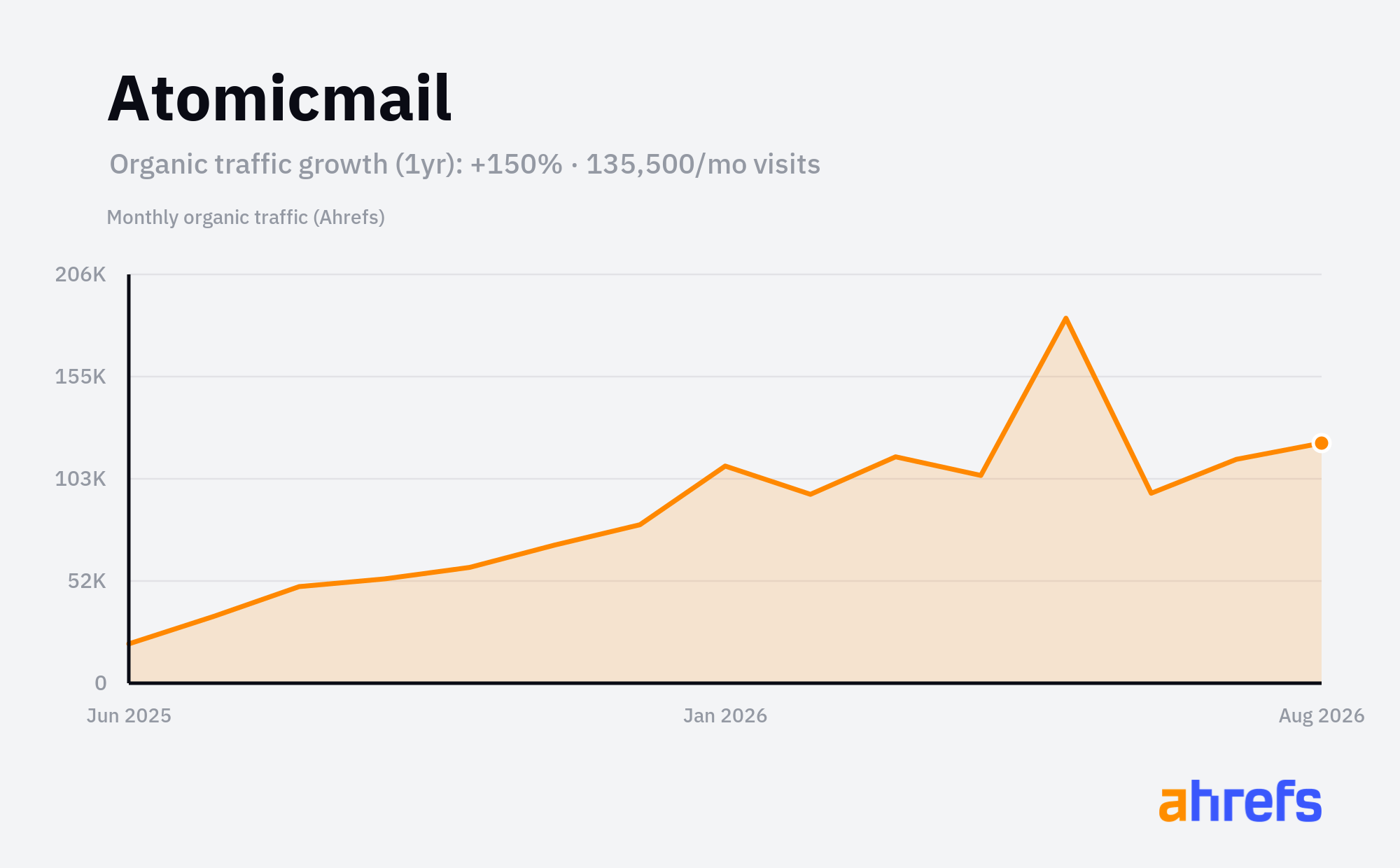
- Organic traffic growth (this year vs last): +150%
- Organic traffic (monthly): 150K
- Year founded: n/a
- Location: Tallinn, Estonia
What they do
Atomicmail is a privacy-focused encrypted email service aimed at users who want a secure alternative to mainstream providers like Gmail, with end-to-end encryption and minimal data collection built in.
Atomic Mail hit 1 million users within its first ten months, and the organic traffic growth tells a similar story: ~140K monthly visits, up 150% in a year. Privacy email as a category has been quietly building a large and loyal audience, and Atomic Mail is pulling in a significant share of that demand.
12. Cycode (+150%)
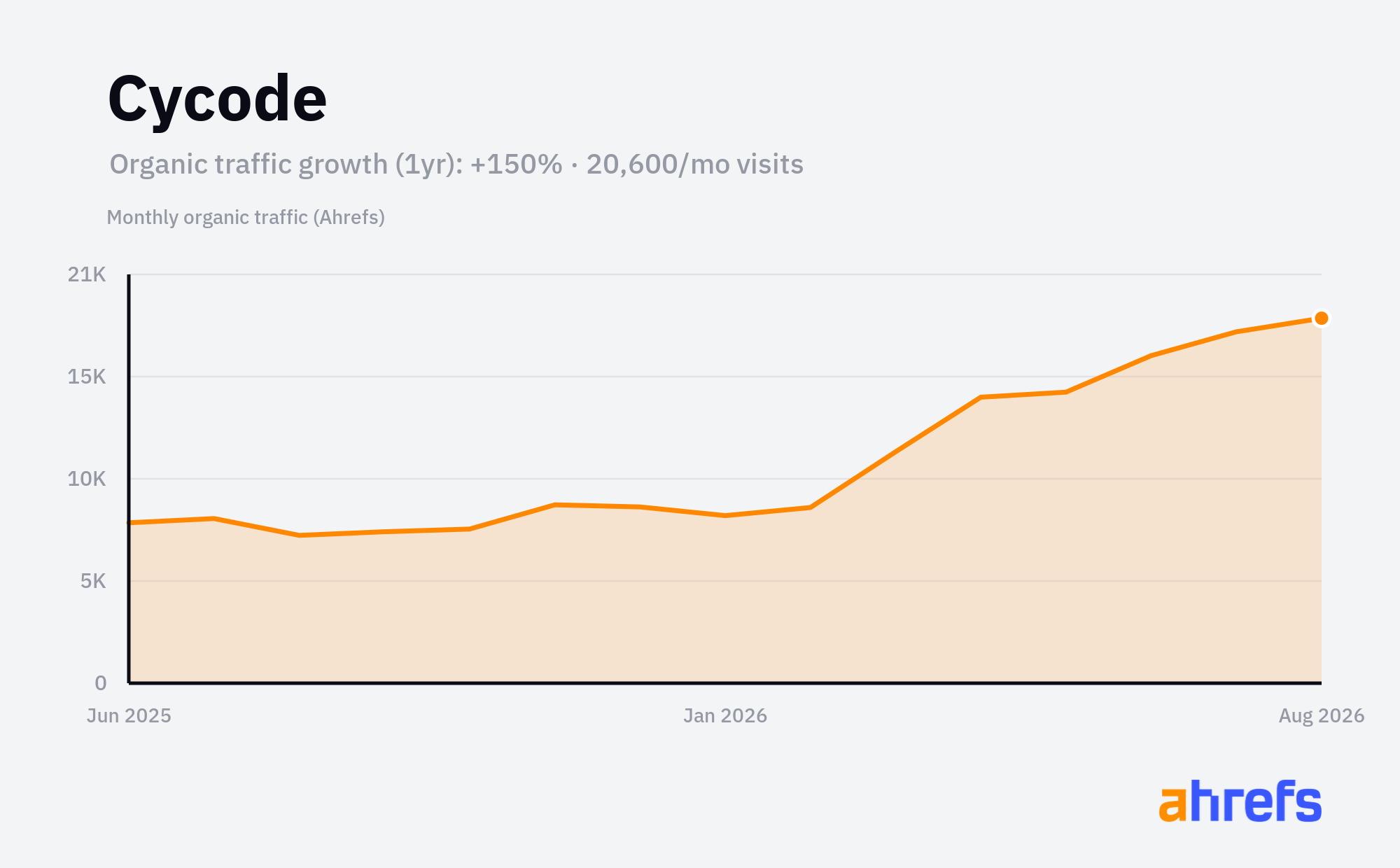
- Organic traffic growth (this year vs last): +150%
- Organic traffic (monthly): 20.5K
- Year founded: 2019
- Location: Tel Aviv, Israel
What they do
Cycode is an application security posture management (ASPM) platform that consolidates security scanning across the software development lifecycle, from code to cloud, giving teams a unified view of their security posture.
Cycode raised $56M in a Series B in November 2021, led by Insight Partners, following a $20M Series A earlier that year, bringing total disclosed funding to approximately $80M.
ASPM is still a young category, but it's filling a real gap: security teams that are drowning in scanner output from a dozen different tools and need a way to make sense of it all. Cycode's +150% traffic growth suggests that the category is graduating from analyst reports to active buyer searches.
13. Orca (+130%)
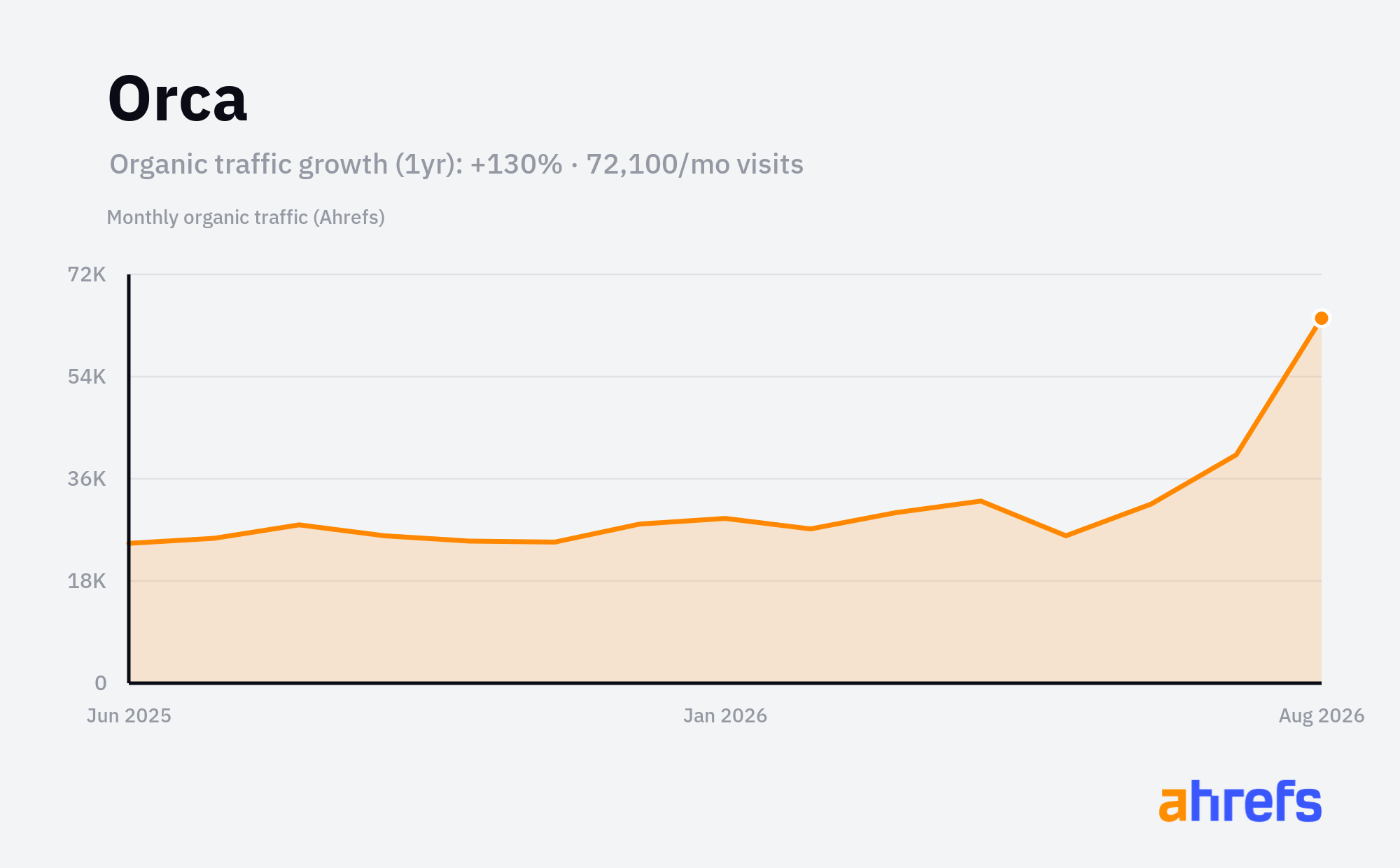
- Organic traffic growth (this year vs last): +130%
- Organic traffic (monthly): 72K
- Year founded: 2019
- Location: Portland, United States
What they do
Orca Security is a cloud security platform that provides agentless visibility across AWS, Azure, and Google Cloud, covering cloud infrastructure security, vulnerability management, and compliance in a single platform.
Orca Security has raised $640M in total funding, including a $550M extended Series C in October 2021 led by Temasek, following a $210M Series C led by CapitalG and Redpoint Ventures.
Orca is an established name in cloud security, and the fact that it's still growing organic traffic by 130% in a year is a sign of how much headroom remains in the cloud security market. CNAPP as a buying category is still gaining definition, and Orca's agentless approach keeps it in the shortlist for teams who don't want the overhead of deploying agents everywhere.
14. Deviceandbrowserinfo (+120%)
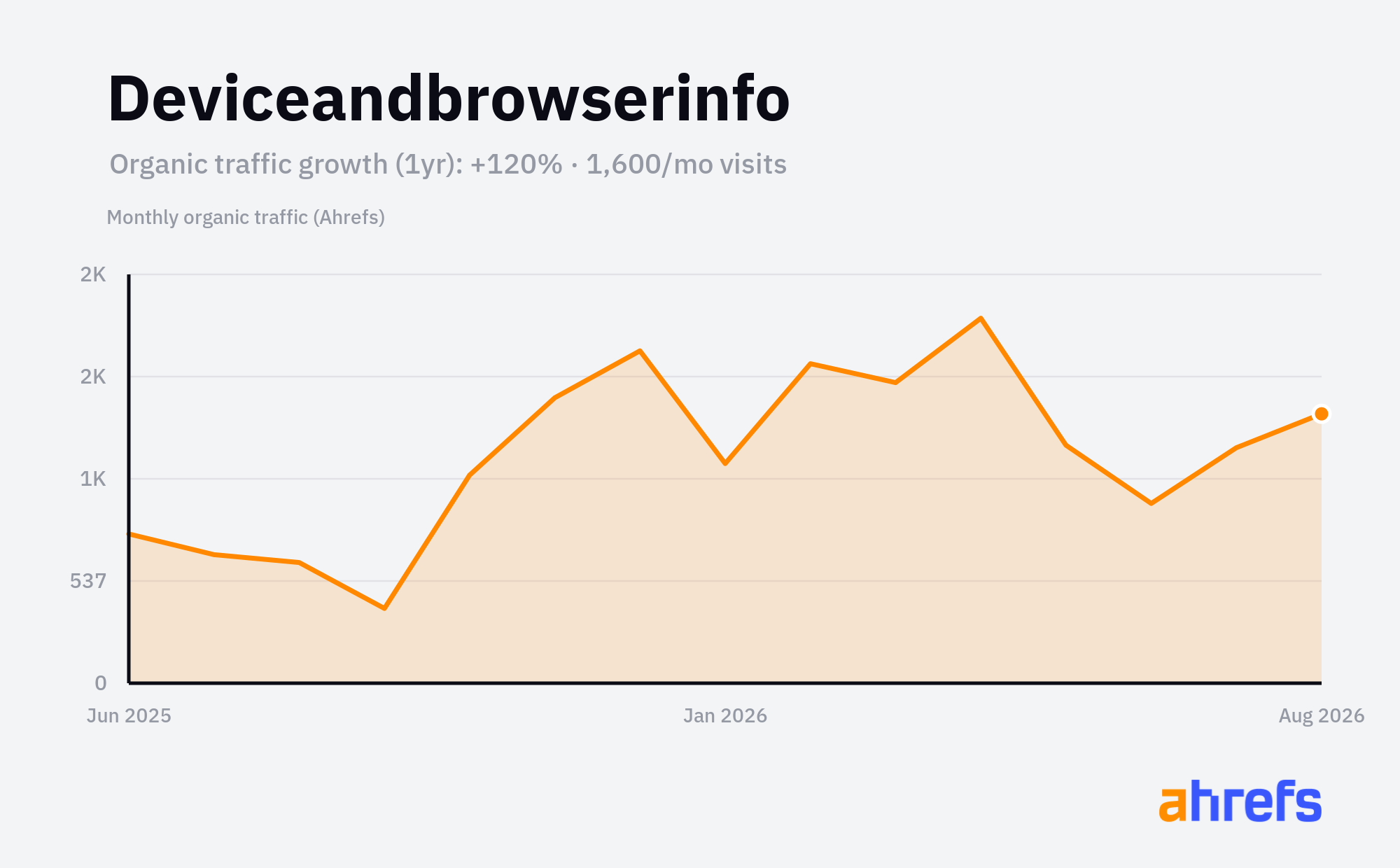
- Organic traffic growth (this year vs last): +120%
- Organic traffic (monthly): 1.5K
- Year founded: n/a
- Location: Nantes, France
What they do
Deviceandbrowserinfo is a browser fingerprinting and device information lookup tool that shows users exactly what data their browser exposes, used by developers, security testers, and privacy-conscious users checking their digital footprint.
It's one of the smaller brands on this list by monthly traffic, but doubling organic visits in a year from what is essentially a free developer utility is hard to dismiss. Browser fingerprinting awareness has grown alongside the broader privacy conversation, and tools that make the invisible visible tend to pick up organic traction steadily over time.
15. Securden (+120%)
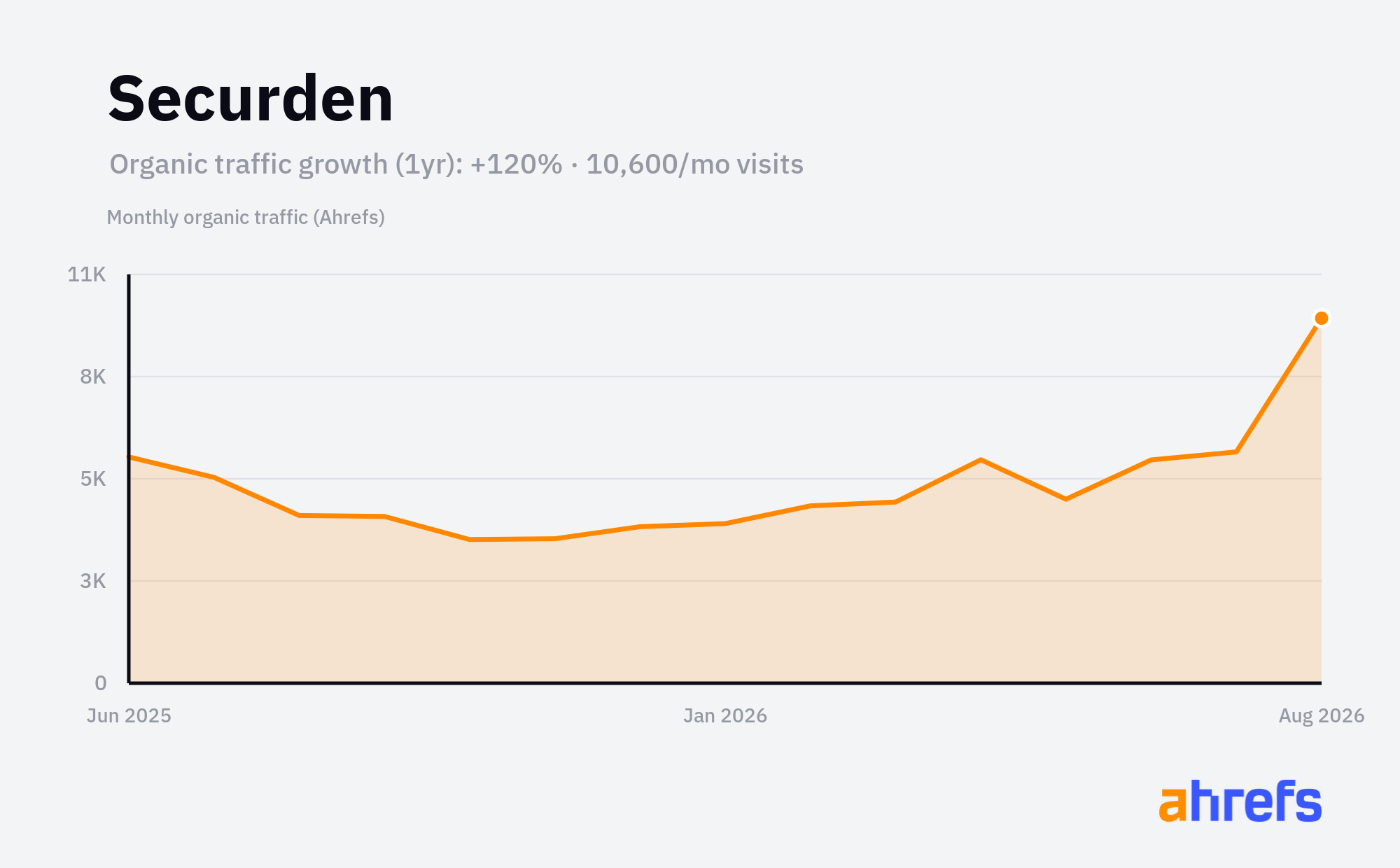
- Organic traffic growth (this year vs last): +120%
- Organic traffic (monthly): 10.5K
- Year founded: 2017
- Location: Chennai, India
What they do
Securden is a Privileged Access Management (PAM) platform that helps IT teams control access to privileged accounts, manage passwords, and secure remote access across on-premises and cloud infrastructure.
PAM has long been a category dominated by legacy vendors with eye-watering price tags, and Securden has been quietly picking up the teams who need a capable alternative without the enterprise complexity. The +120% traffic growth points to a steady, compounding demand signal that tends to mean durable market traction rather than a one-time spike.
16. Logto (+110%)
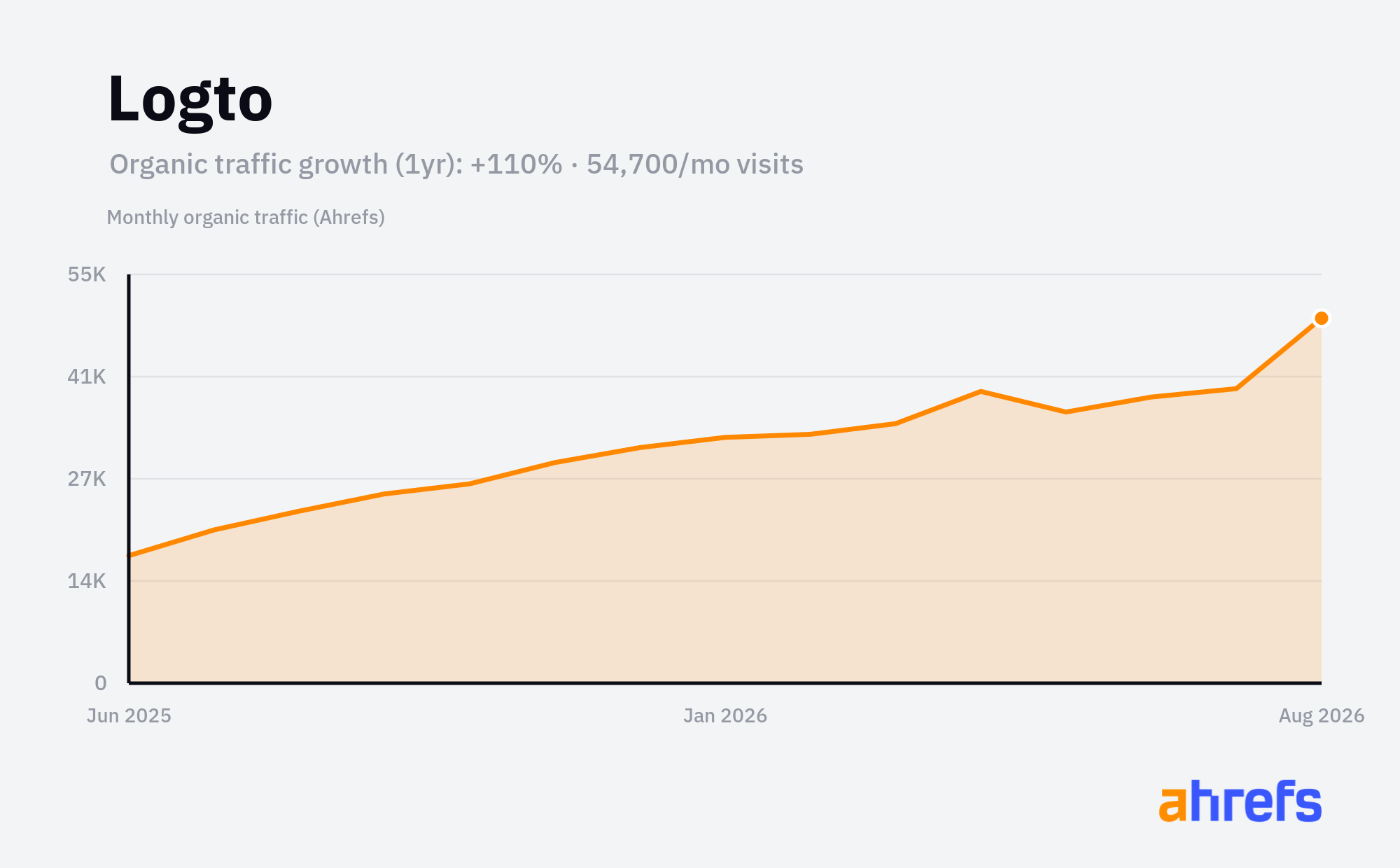
- Organic traffic growth (this year vs last): +110%
- Organic traffic (monthly): 54.5K
- Year founded: 2022
- Location: null
What they do
Logto is an open-source customer identity and access management (CIAM) platform that provides authentication, authorization, and user management infrastructure for developers building SaaS and consumer applications.
Logto has raised $5M in a Series A, with Source Code Capital as an investor, per PitchBook.
As one of the youngest companies on this list, Logto has moved fast: founded in 2022 and already pulling ~50K monthly organic visits, up 110% in a year. The open-source CIAM space is competitive, but developer appetite for self-hostable identity infrastructure is real, and Logto has clearly found a meaningful foothold.
17. Anchore (+88%)
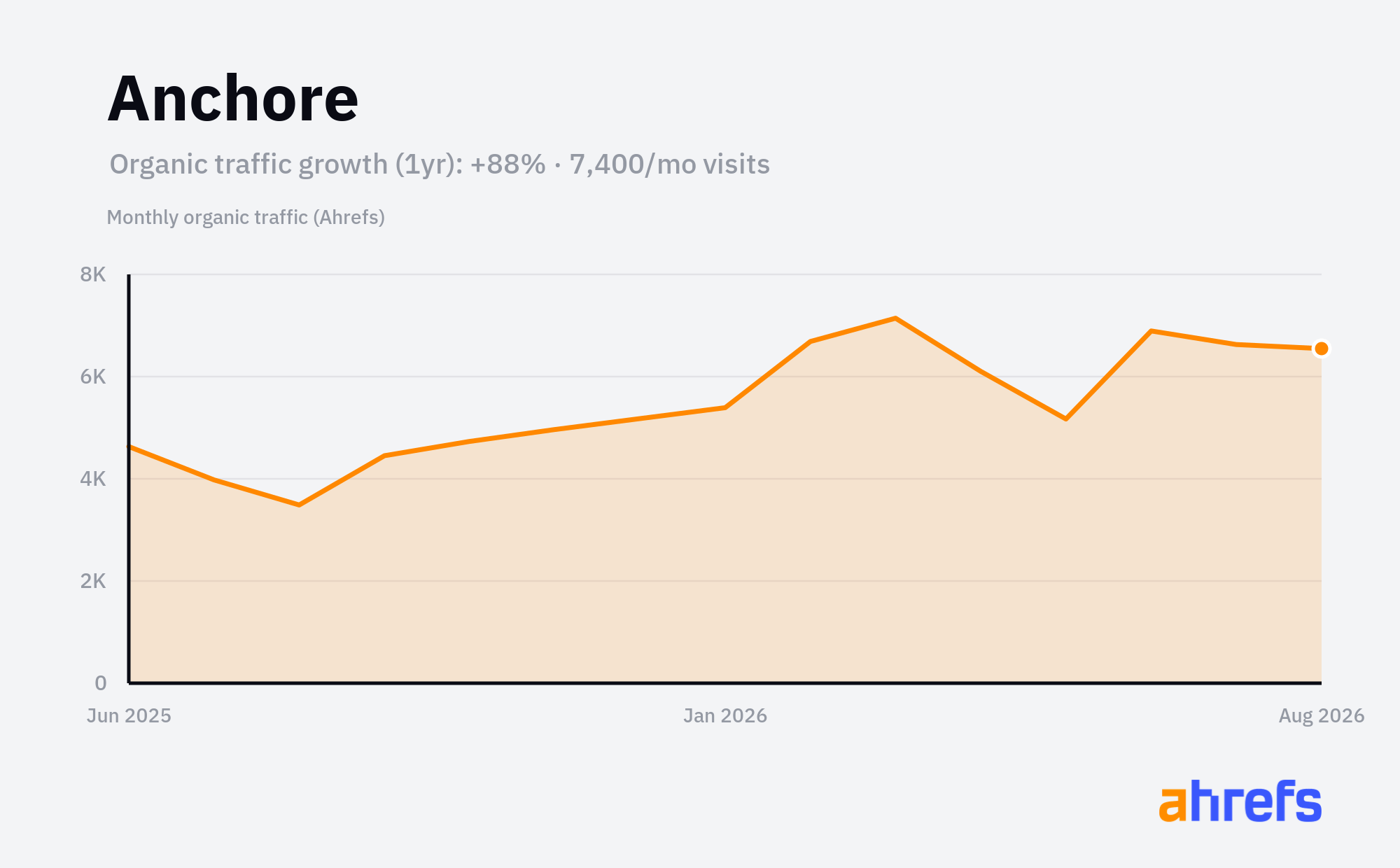
- Organic traffic growth (this year vs last): +88%
- Organic traffic (monthly): 7.5K
- Year founded: 2016
- Location: Santa Barbara, USA
What they do
Anchore is a software supply chain security platform specializing in container image scanning, software bill of materials (SBOM) generation, and vulnerability management for teams building and shipping containerized software.
Anchore raised a $20M Series A in January 2020, led by SignalFire.
Federal mandates around SBOMs and executive orders pushing software transparency have created a very specific, searchable demand that Anchore is well-placed to capture. The +88% traffic growth reflects a category that went from voluntary best practice to compliance requirement almost overnight.
18. Miniorange (+64%)
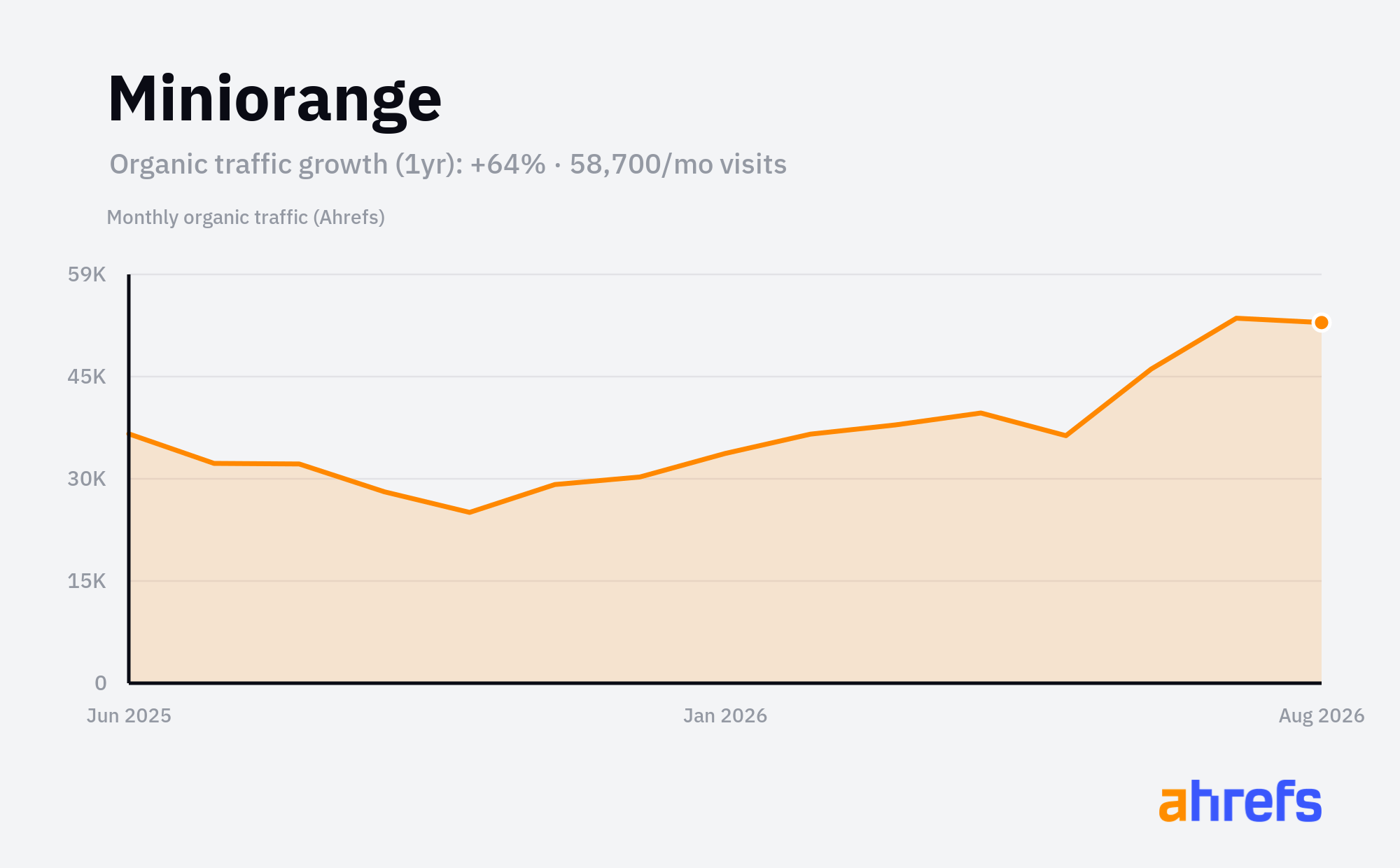
- Organic traffic growth (this year vs last): +64%
- Organic traffic (monthly): 58.5K
- Year founded: 2015
- Location: Pune, India
What they do
miniOrange is an identity and access management (IAM) platform offering MFA, SSO, and OAuth solutions across a wide range of applications and enterprise systems, with a particular strength in WordPress and Atlassian integrations.
miniOrange is bootstrapped, with no outside funding raised. The company states explicitly on its website that it builds and innovates without investor interference.
As one of the most established companies on this list, miniOrange has been building for over a decade without outside capital, and the +64% traffic growth on a base of ~60K monthly visits is a healthy signal that the compounding effect of long-term content and product investment still pays off.
19. Vanta (+56%)
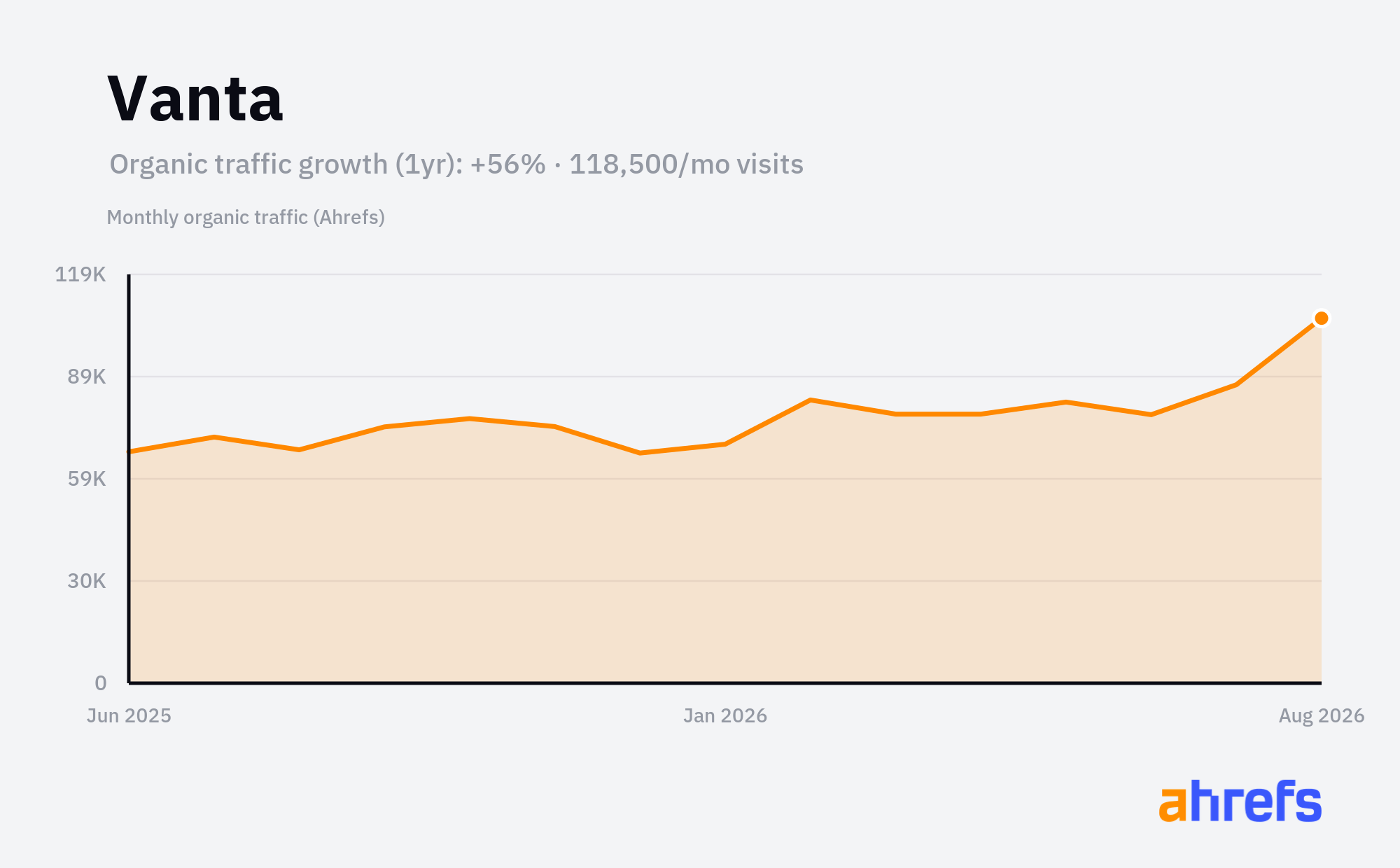
- Organic traffic growth (this year vs last): +56%
- Organic traffic (monthly): 100K
- Year founded: 2018
- Location: San Francisco, United States
What they do
Vanta is a trust management and security compliance platform that automates SOC 2, ISO 27001, HIPAA, and other framework audits for companies that need to demonstrate security posture to enterprise customers.
Morgan, and others.
Security compliance has gone from a checkbox exercise to a genuine business requirement as enterprise buyers get more rigorous about vendor security reviews, and Vanta has become the default destination for teams trying to get audit-ready. Growing to ~120K monthly organic visits while at that scale is a strong result.
20. Cymulate (+44%)
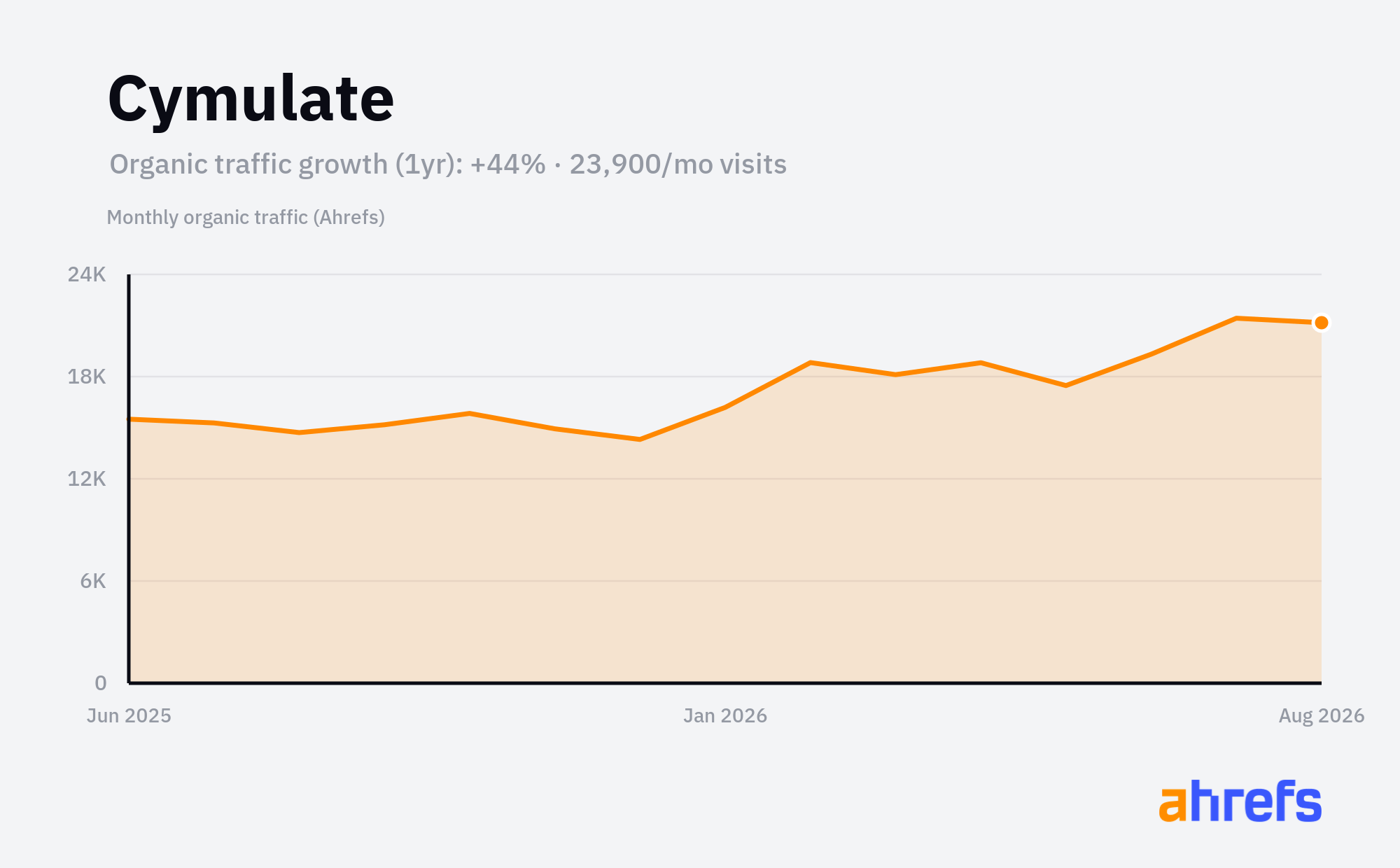
- Organic traffic growth (this year vs last): +44%
- Organic traffic (monthly): 24K
- Year founded: 2016
- Location: Rishon LeZion, Israel
What they do
Cymulate is a breach and attack simulation (BAS) platform that lets security teams continuously test and validate their defenses against real-world attack scenarios, without waiting for a red team engagement.
Cymulate raised $70M in a Series D in September 2022, led by One Peak with participation from Susquehanna Growth Equity, Vertex Ventures Israel, Vertex Growth, and Dell Technologies Capital, bringing total funding to $141M.
Breach and attack simulation has matured from a niche red-team tool into something security teams are actively budgeting for, and Cymulate's +44% traffic growth on a steady base of ~20K monthly visits reflects a platform that's finding its footing in a category finally getting real commercial attention.
21. Salt (+36%)
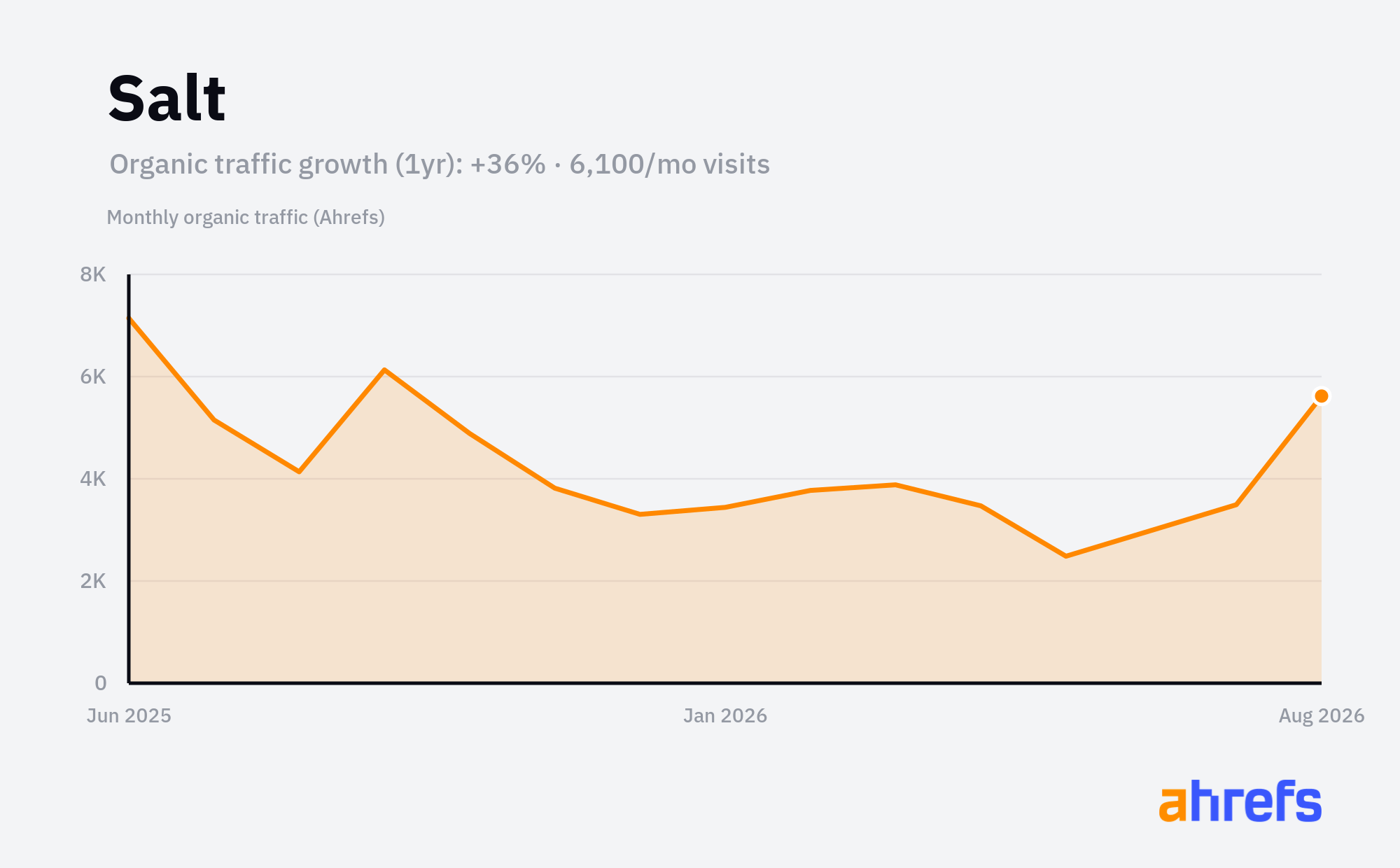
- Organic traffic growth (this year vs last): +36%
- Organic traffic (monthly): 6K
- Year founded: 2018
- Location: Palo Alto, United States
What they do
Salt Security is an API security platform that discovers, inventories, and protects APIs by analyzing traffic patterns to detect attacks and data exposure risks across an organization's API ecosystem.
Salt Security raised $140M in a Series D in February 2022, led by CapitalG with participation from all existing investors, bringing total disclosed funding to $271M.
API security has gone from a problem most companies acknowledged in theory to one they're actively trying to solve in practice, driven by a string of high-profile API breaches and expanding API footprints across nearly every enterprise. Salt's +36% traffic growth is measured and steady, which for a company at this funding level usually means the commercial motion is working.
22. Chainguard (+36%)
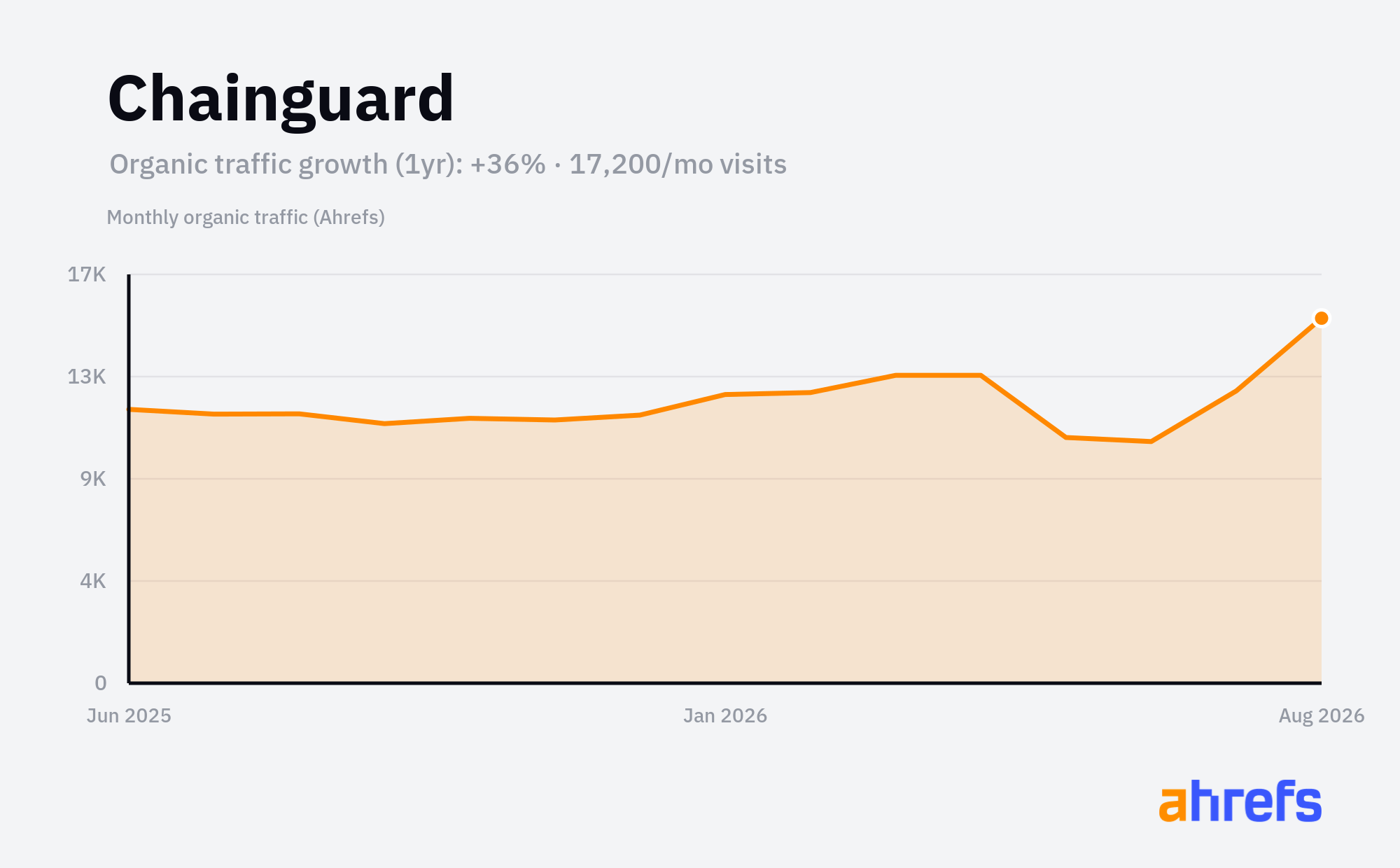
- Organic traffic growth (this year vs last): +36%
- Organic traffic (monthly): 17K
- Year founded: 2021
- Location: Kirkland, WA, USA
What they do
Chainguard provides secure-by-default container base images and software supply chain security tools, built to minimize vulnerabilities and CVEs in the containers teams ship to production.
Chainguard raised $356M in a Series D in April 2025, led by Kleiner Perkins and IVP, bringing total funding to $612M.
The supply chain security conversation has created a whole new procurement category around "secure by default" container infrastructure, and Chainguard is the company that's most clearly defined that space. Growing ~20K monthly organic visits while closing a $356M round signals that investor conviction and genuine market demand are moving in the same direction.
23. Hyperproof (+27%)
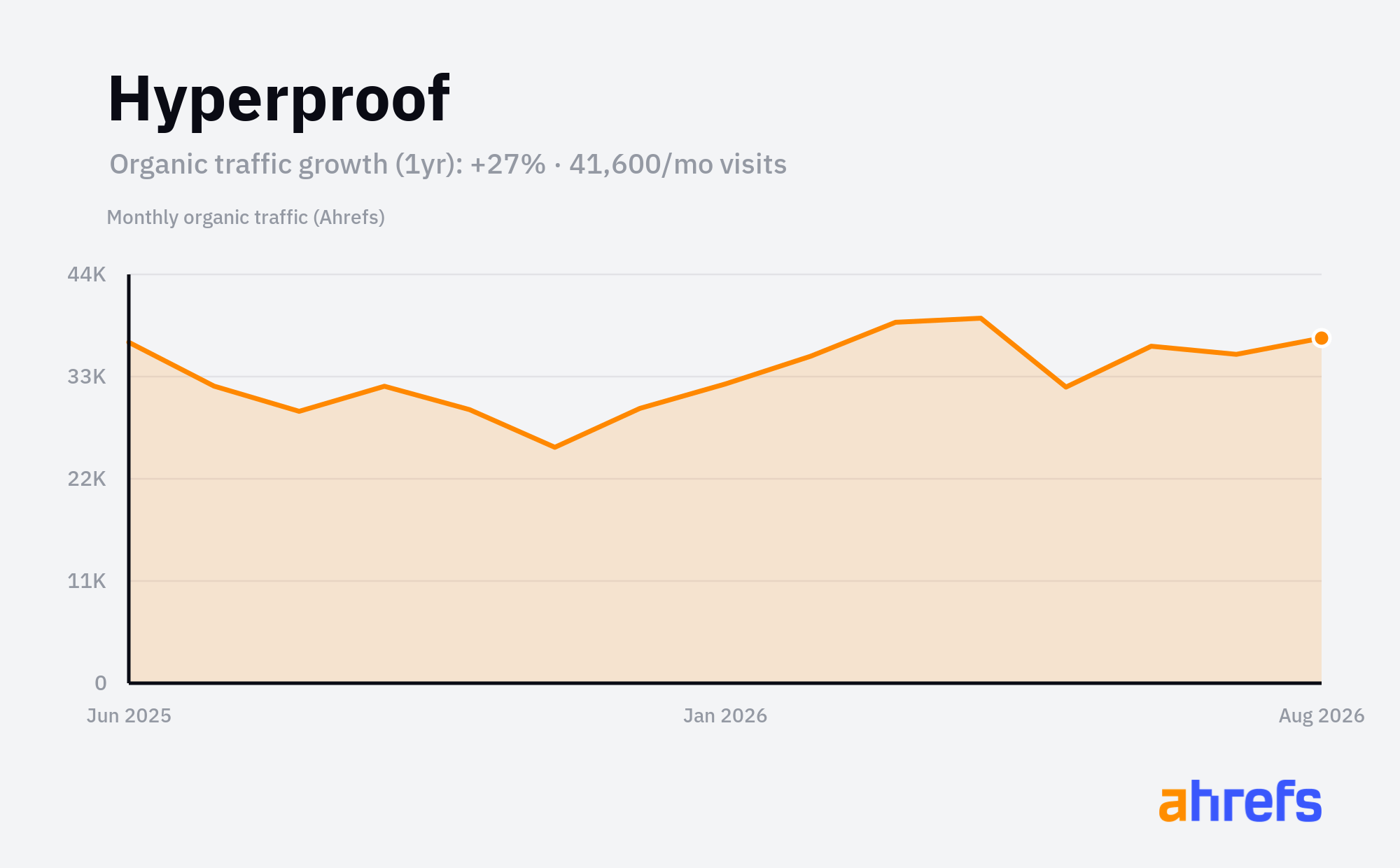
- Organic traffic growth (this year vs last): +27%
- Organic traffic (monthly): 41.5K
- Year founded: 2019
- Location: Seattle, United States
What they do
Hyperproof is a compliance operations platform that helps security and risk teams manage frameworks like SOC 2, ISO 27001, and FedRAMP, centralizing evidence collection, control testing, and audit workflows.
Hyperproof closed $40M in growth investment in October 2024, led by Riverwood Capital with participation from Toba Capital.
Compliance operations is a category that's quietly generated serious search demand as companies realize that managing a patchwork of frameworks in spreadsheets doesn't scale. Hyperproof's ~40K monthly organic visits and steady +27% growth suggest a platform that's compounding on a strong content and SEO foundation in a category with durable search intent.
24. Pentera (+26%)
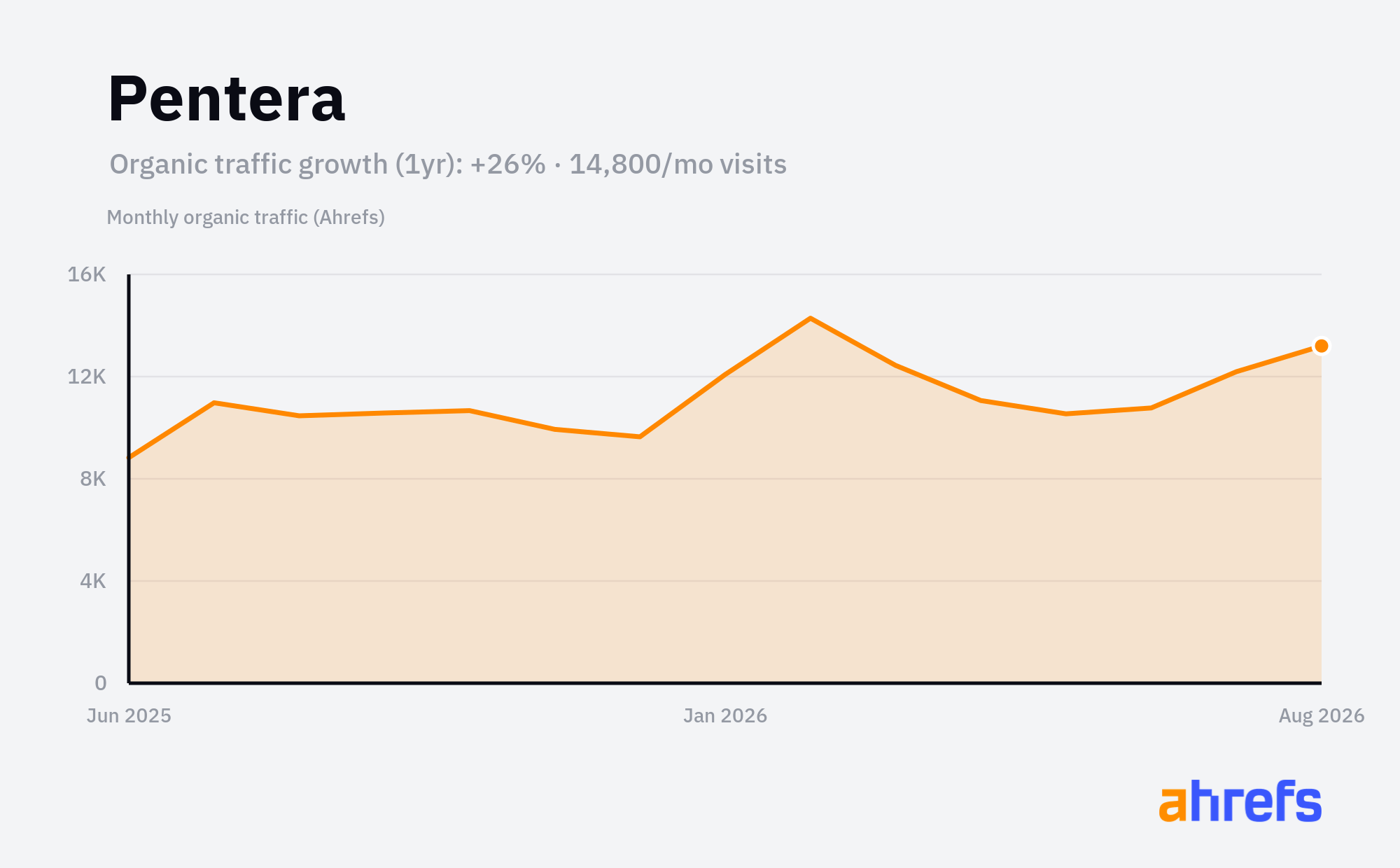
- Organic traffic growth (this year vs last): +26%
- Organic traffic (monthly): 15K
- Year founded: 2015
- Location: Burlington, Massachusetts, United States
What they do
Pentera is an automated security validation platform that continuously runs simulated attacks against an organization's real environment to find exploitable weaknesses before attackers do, without requiring a manual red team.
Automated penetration testing is having a real moment as security teams are asked to validate their defenses continuously rather than once a year, and Pentera has been one of the clearest voices articulating that shift. The +26% traffic growth is steady rather than explosive, which is what you'd expect from a platform that's moved well into the commercial stage.
25. Cyera (+22%)
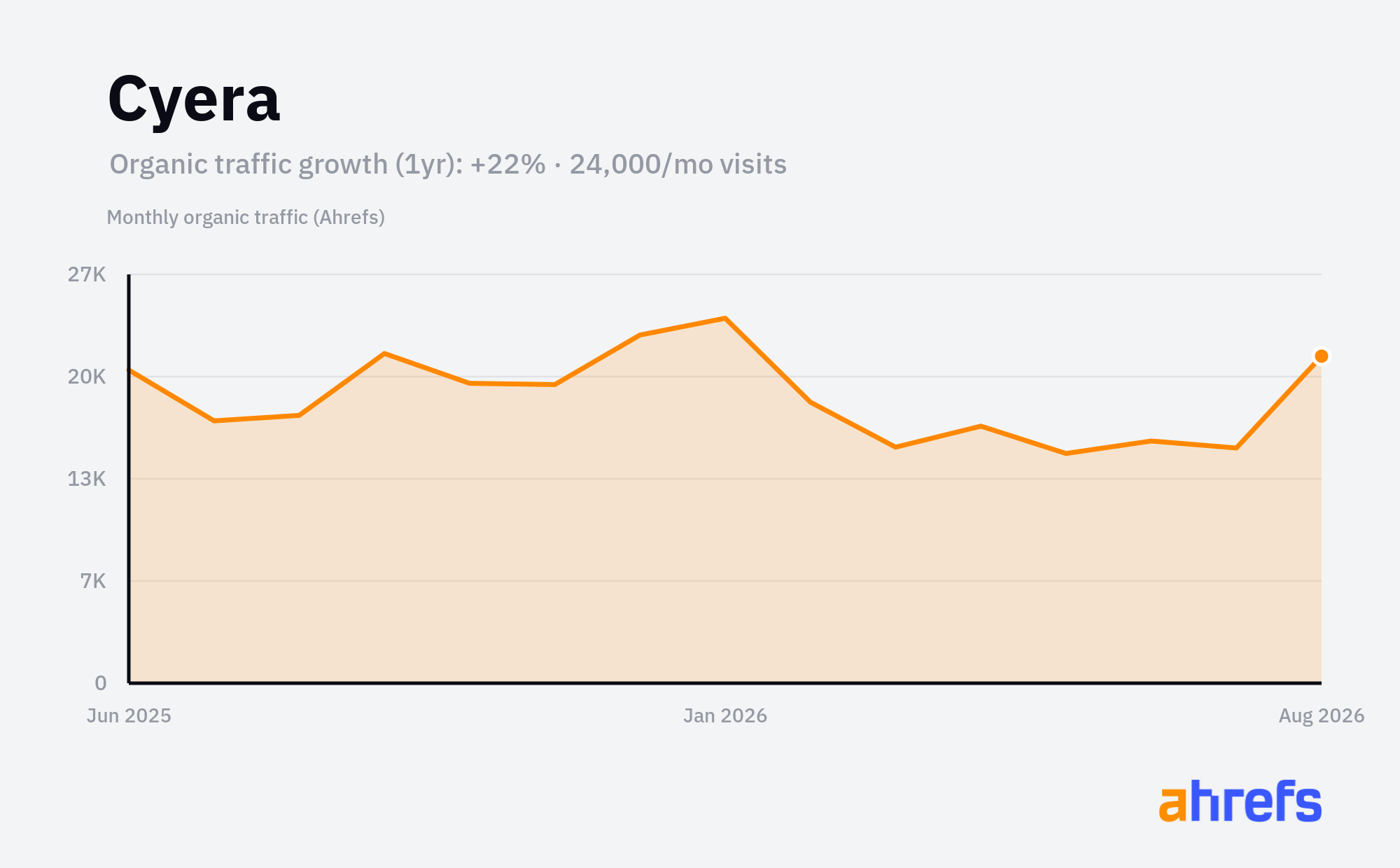
- Organic traffic growth (this year vs last): +22%
- Organic traffic (monthly): 24K
- Year founded: 2021
- Location: New York, United States
What they do
Cyera is a data security platform that gives enterprises visibility and control over their sensitive data across cloud environments, covering discovery, classification, and risk remediation across structured and unstructured data stores.
Cyera raised $600M in a late-stage round announced in June 2026, led by Evolution Equity Partners with participation from Cyberstarts and Temasek, bringing total funding to over $2.1 billion.
Founded in 2021 and already one of the best-funded companies in security, Cyera is an example of investor conviction running well ahead of brand familiarity, and the organic traffic is now starting to close that gap. Data security has become a board-level conversation in the AI era, and the +22% traffic growth on ~20K monthly visits gives you a sense of where that demand is heading.
The full list: fastest growing cybersecurity companies by organic traffic growth
# | Company | Industry | Organic traffic growth | Monthly organic traffic |
|---|---|---|---|---|
1 | Security | +830% (1-year) | 400K | |
2 | Security | +750% (1-year) | 150K | |
3 | Security | +530% (1-year) | 10K | |
4 | Security | +380% (1-year) | 24K | |
5 | Security | +220% (1-year) | 16K | |
6 | Dev tools | +220% (1-year) | 1.5K | |
7 | Dev tools | +210% (1-year) | 87.5K | |
8 | Security | +200% (1-year) | 64.5K | |
9 | Security | +170% (1-year) | 6.5K | |
10 | Security | +160% (1-year) | 5K | |
11 | Security | +150% (1-year) | 150K | |
12 | Security | +150% (1-year) | 20.5K | |
13 | Security | +130% (1-year) | 72K | |
14 | Security | +120% (1-year) | 1.5K | |
15 | Security | +120% (1-year) | 10.5K | |
16 | Dev tools | +110% (1-year) | 54.5K | |
17 | Security | +88% (1-year) | 7.5K | |
18 | Security | +64% (1-year) | 58.5K | |
19 | Security | +56% (1-year) | 100K | |
20 | Security | +44% (1-year) | 24K | |
21 | Security | +36% (1-year) | 6K | |
22 | Security | +36% (1-year) | 17K | |
23 | Security | +27% (1-year) | 41.5K | |
24 | Security | +26% (1-year) | 15K | |
25 | Security | +22% (1-year) | 24K |
Organic traffic growth = growth in estimated monthly organic search traffic over the past year (now vs twelve months ago). Monthly organic traffic = current estimated monthly organic search traffic (Ahrefs). Data: Ahrefs · September 2026.
How to find this data in Ahrefs
You can rebuild this entire analysis yourself in Ahrefs. Here's the short version:
- Open Site Explorer, enter a company's domain, and look at the Organic traffic graph. The growth over the last year is what we ranked on.
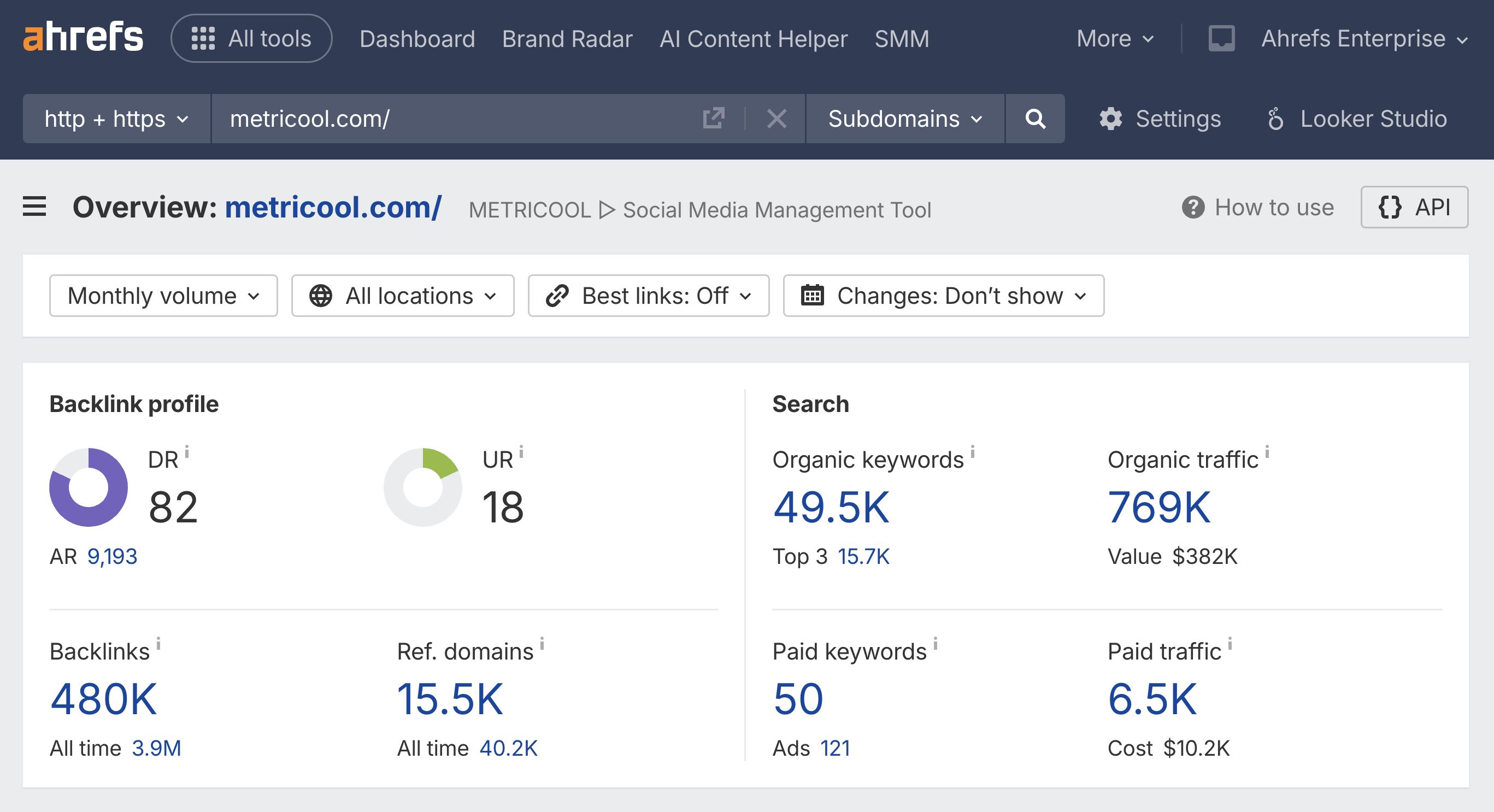
- Use the Overview to read the current Organic traffic, Referring domains, and Domain Rating shown in the profiles above, and switch the date range to compare year over year.
- Or skip the manual work and let Letaido run the whole pull, filtering, and ranking for any niche you choose, the same way it built this list.
Final thoughts
What's clear across this list of fastest growing cybersecurity companies is how broad the field is: supply chain security, identity, compliance, cloud security, privacy tools, and automated pentesting all show up here, a reminder that the security market is generating fresh demand in many directions at once.
The common thread is that organic traffic doesn't lie. The cybersecurity companies showing the sharpest climbs are the ones where search demand has gone from a trickle to a torrent in a single year, often because a real-world event or a shift in how companies build software made their category impossible to ignore.
If you're watching where the next wave of the security market is forming, these 25 companies are a pretty good place to start.
Louise is a Content Marketer at Ahrefs. Over the past ten years, she has held senior content positions at SaaS brands: Pi Datametrics, BuzzSumo, and Cision. During this time, she has published hundreds of blog posts, spearheaded industry-leading research, and developed expert-led webinar programs.
Louise first learned the ropes of SEO during her time at enterprise SEO company, Pi. Within weeks of joining, she had published a piece on cannibalization that caught the attention of the biggest name in SEO at the time: Rand Fishkin. Since then, she has written on topics ranging from manipulative link building, to content syndication, and search demand forecasting. In her spare time, she has deepened her practical understanding of SEO by building websites for two local businesses.
You can read Louise's words in industry publications like Search Engine Watch, The Drum, The Telegraph, and Spin Sucks.

Keep learning



Your weekly marketing’s must-reads
Join 284K marketers for weekly news, useful reads, industry updates, and the memes you didn’t know you needed.
Explore what’s inside the newsletter →