
The 50 Fastest Growing AI Companies (October 2026)

Content Marketer at Ahrefs
- The 25 fastest growing AI companies
- 1. Fish Audio (+980%)
- 2. MusicGPT (+970%)
- 3. Genspark (+240%)
- 4. Retell AI (+210%)
- 5. Lovable (+190%)
- 6. Arcads (+190%)
- 7. Browse AI (+170%)
- 8. Reface AI (+160%)
- 9. Baseten (+140%)
- 10. OpenArt (+130%)
- 11. StudyFetch (+110%)
- 12. Liquid AI (+100%)
- 13. AI21 Labs (+94%)
- 14. ProFaceFinder (+92%)
- 15. ElevenLabs (+85%)
- 16. Contextual AI (+83%)
- 17. Manus (+74%)
- 18. World Labs (+62%)
- 19. SeaArt AI (+60%)
- 20. Flagright (+59%)
- 21. Prodigal (+55%)
- 22. Glass Health (+54%)
- 23. Pictory AI (+54%)
- 24. Read AI (+52%)
- 25. Hedra (+52%)
- The full list: fastest-growing AI companies by brand search
- How to find this data in Ahrefs
- Final thoughts
We analyzed hundreds of AI companies and ranked them by a metric that's hard to fake: how many people search for them by name, and how fast that demand is growing this year versus last.
AI funding has never moved faster. In the first quarter of 2026, AI companies pulled in $242 billion, or 80% of all global venture funding, up from 55% a year earlier.
But that money is pooling at the very top: just three frontier labs, OpenAI, Anthropic and xAI, raised $172 billion between them, so for everyone else real organic demand is what separates the winners from the merely well-funded.
So the question we set out to answer is: which AI companies, across every category from foundation models to AI agents to generative tools, are actually growing real demand right now?
This list was built with Letaido
This article was researched and built by Letaido, Ahrefs' AI marketing platform. Letaido pulls live Ahrefs data, runs its own analysis, and assembles findings like the ranking below, so the numbers you're about to read come straight from the same data set our tools run on.
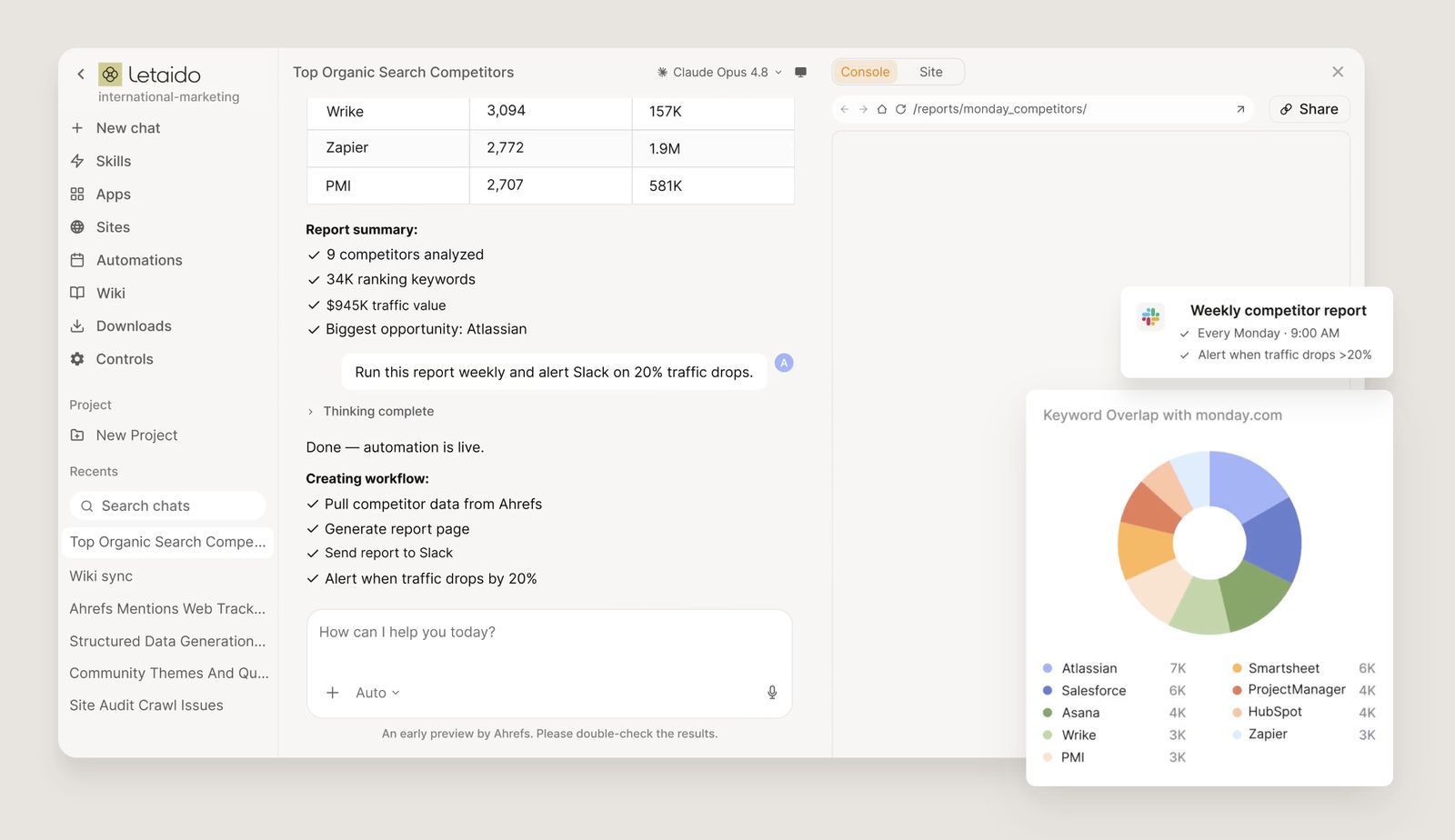
You can recreate this kind of research for your specific niche or vertical using Letaido.
Sidenote
We rank these companies by how much their brand-name search demand grew this year versus last: we compare the average monthly searches for each company name over the last 12 months against the 12 months before that. That comparison is the cleanest signal of fresh, unprompted demand, and because it rolls forward every month it surfaces companies breaking out right now rather than ones that grew years ago. All data is from Ahrefs.
The 25 fastest growing AI companies
Below are the AI companies whose brand-name search demand has climbed fastest this year versus last, ordered from the steepest growth down, each with a chart, the key numbers, and a short read on what's actually driving the momentum.
1. Fish Audio (+980%)
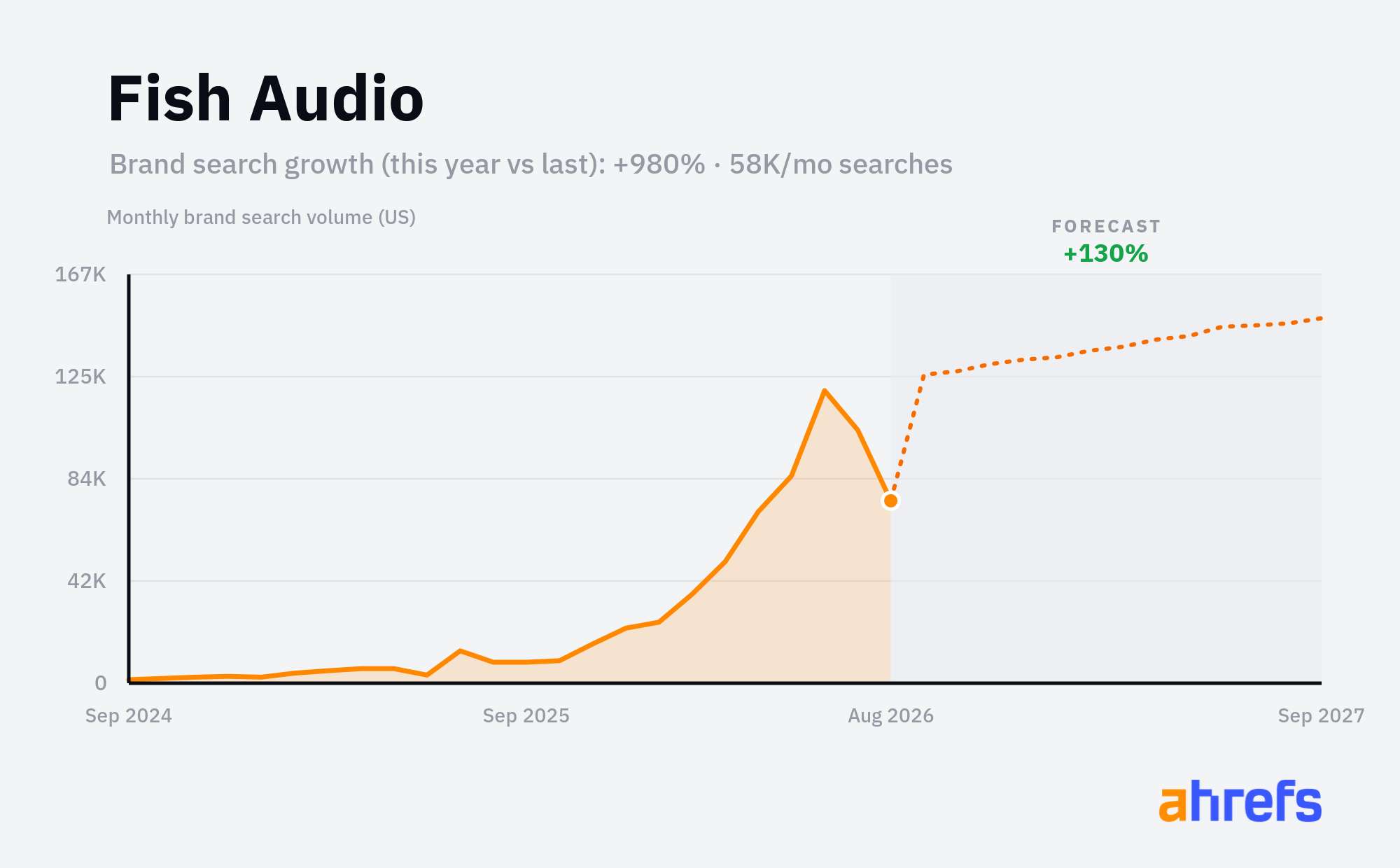
- Brand search growth (this year vs last): +980%
- Search growth forecast (next 12 months): +130%
- Brand search volume (monthly): 58K
- Organic traffic (monthly): 950K
- Year founded: 2022
- Location: Palo Alto, United States
What they do
Fish Audio is an AI voice platform where users can clone voices, build custom text-to-speech models, and browse a marketplace of community-created AI voice models.
Fish Audio is the fastest growing company on this list, and it's not especially close. A +980% jump in brand searches reflects what happens when a voice AI platform that started as a passion project suddenly finds itself at the center of a category everyone wants a piece of, with the $52M seed round dropping right in the middle of this year's search spike and almost certainly amplifying it.
2. MusicGPT (+970%)
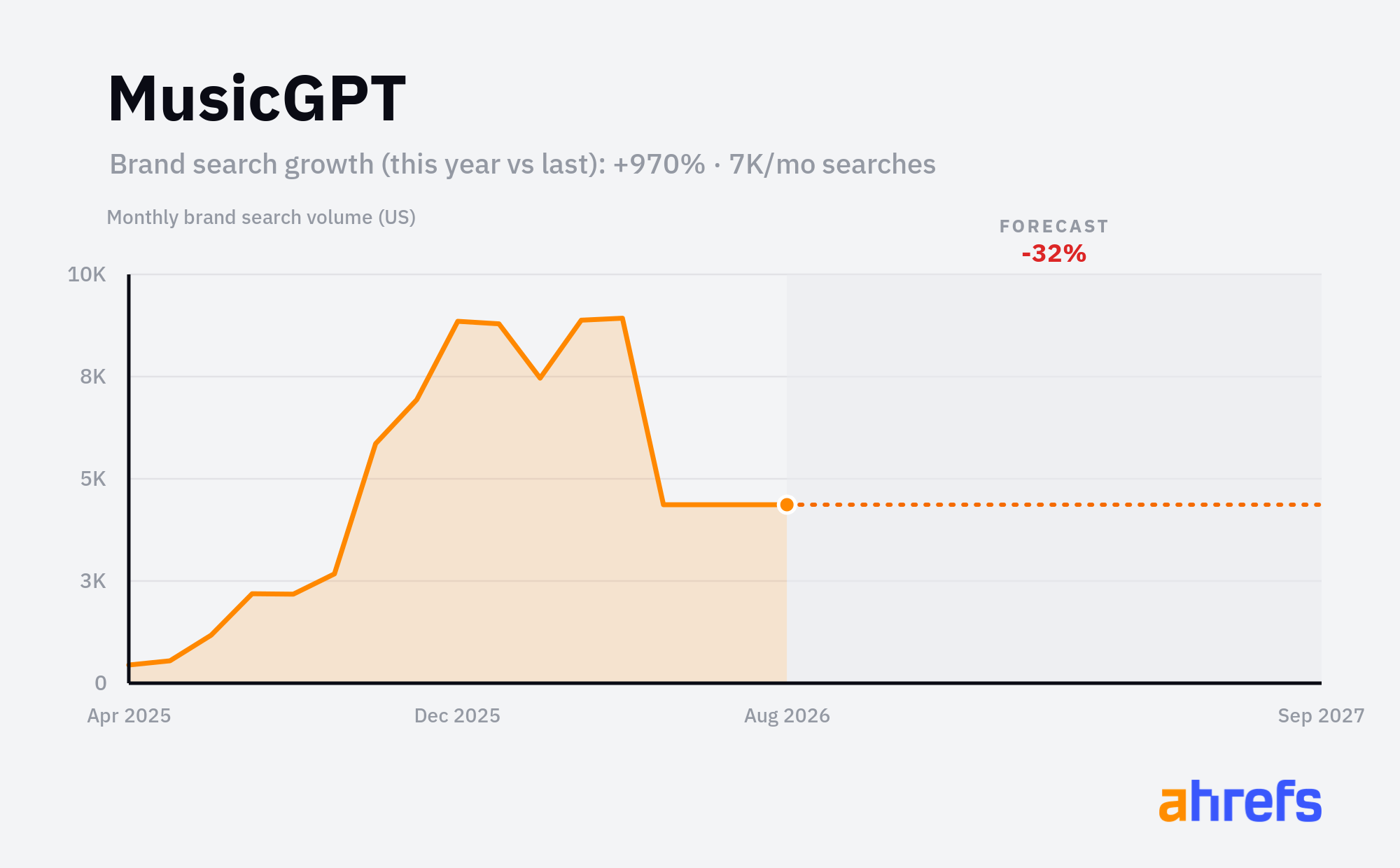
- Brand search growth (this year vs last): +970%
- Search growth forecast (next 12 months): -32%
- Brand search volume (monthly): 7K
- Organic traffic (monthly): 100K
- Year founded: n/a
- Location: Singapore
What they do
MusicGPT is an AI music generation platform that lets users describe what they want to hear in plain language and get a track back.
Funding for MusicGPT is not publicly disclosed.
A +970% rise in brand searches is a remarkable number for a tool that most people outside of AI music circles hadn't heard of a year ago. The timing tracks with a broader wave of interest in AI-generated audio: as tools like Suno and Udio pulled music generation into mainstream conversation, users started actively searching for alternatives, and MusicGPT picked up a lot of that overflow. The forecast dip is worth watching, but the initial climb was real.
3. Genspark (+240%)
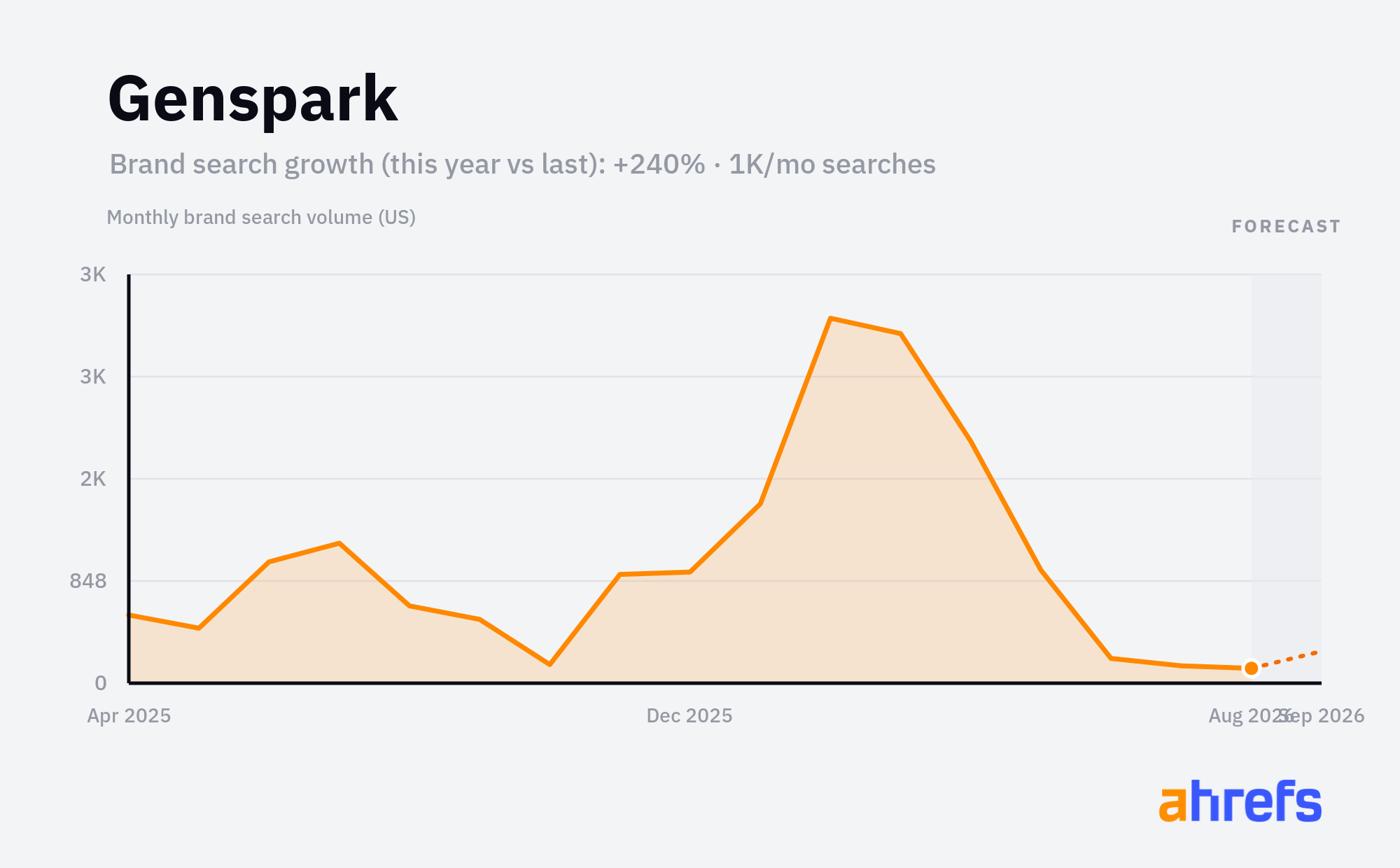
- Brand search growth (this year vs last): +240%
- Search growth forecast (next 12 months): n/a
- Brand search volume (monthly): 1K
- Organic traffic (monthly): 1M
- Year founded: 2023
- Location: Palo Alto, USA
What they do
Genspark is an AI agent workspace designed to handle research, writing, and busywork tasks autonomously on behalf of professionals and teams.
Genspark has raised a total of $485M in Series B financing, including a $100M extension announced in June 2026 at a $2.6 billion valuation, backed by Sozo Ventures, Korea Mirae Asset, and UpHonest Capital.
A +240% jump in brand searches for a company that pulled in nearly half a billion dollars in funding tells you the demand here is real, beyond PR-driven. Genspark crossed $100M ARR earlier this year, and the combination of that milestone and the funding announcements clearly pushed the brand into the awareness of a much wider audience than it had before.
4. Retell AI (+210%)
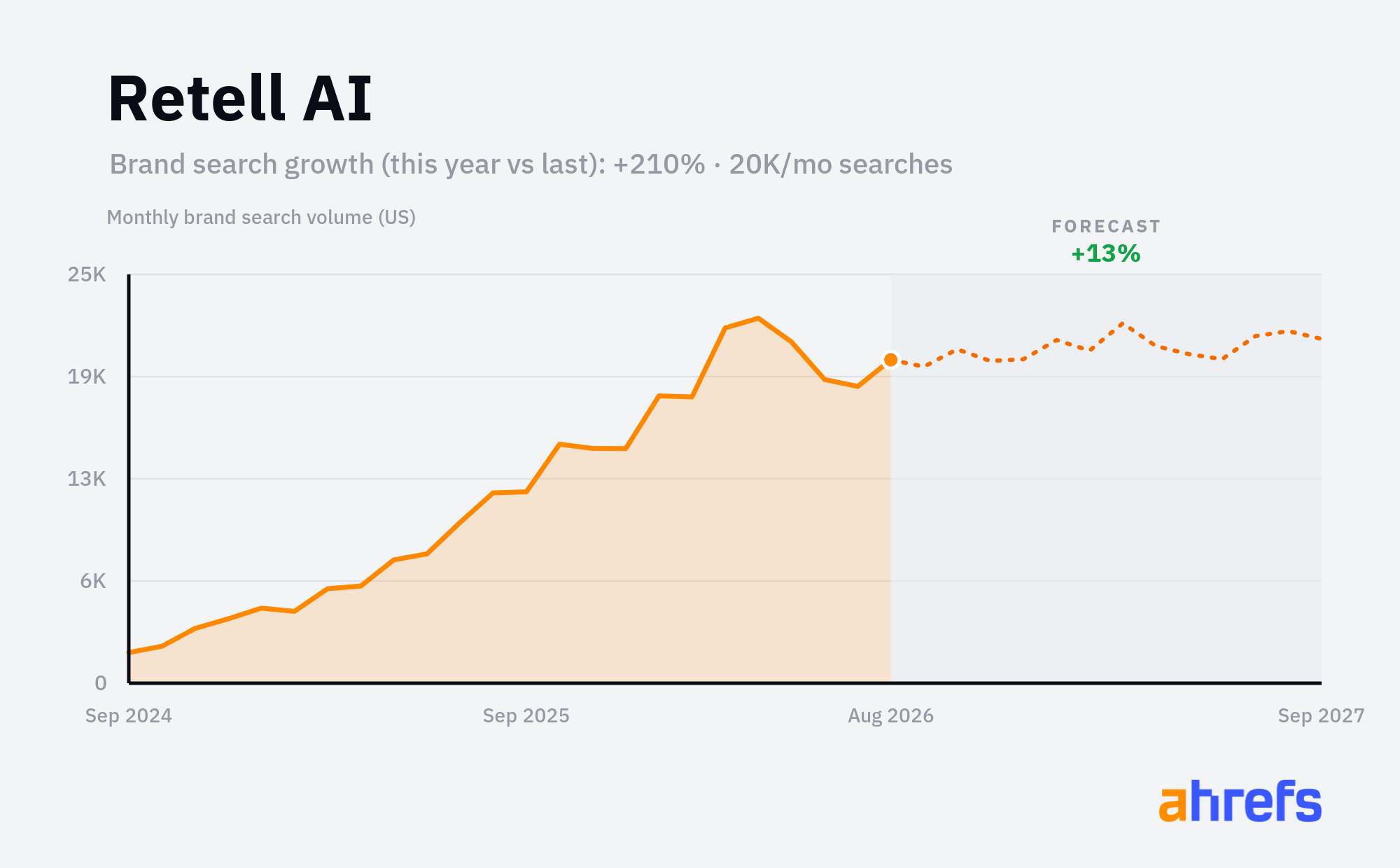
- Brand search growth (this year vs last): +210%
- Search growth forecast (next 12 months): +13%
- Brand search volume (monthly): 20K
- Organic traffic (monthly): 50K
- Year founded: 2023
- Location: San Francisco, USA
What they do
Retell AI is a platform for building and deploying AI-powered voice agents, used by companies that want to automate inbound and outbound phone calls without building the underlying infrastructure themselves.
The voice AI agent space has gone from a niche developer curiosity to something businesses are actively budgeting for, and Retell AI has been one of the clearest beneficiaries of that shift. A +210% rise in brand searches, with ~20K monthly searches now landing on a company that raised just $4.6M, suggests the growth here is coming from genuine word-of-mouth among builders and operators rather than from a big marketing push.
5. Lovable (+190%)
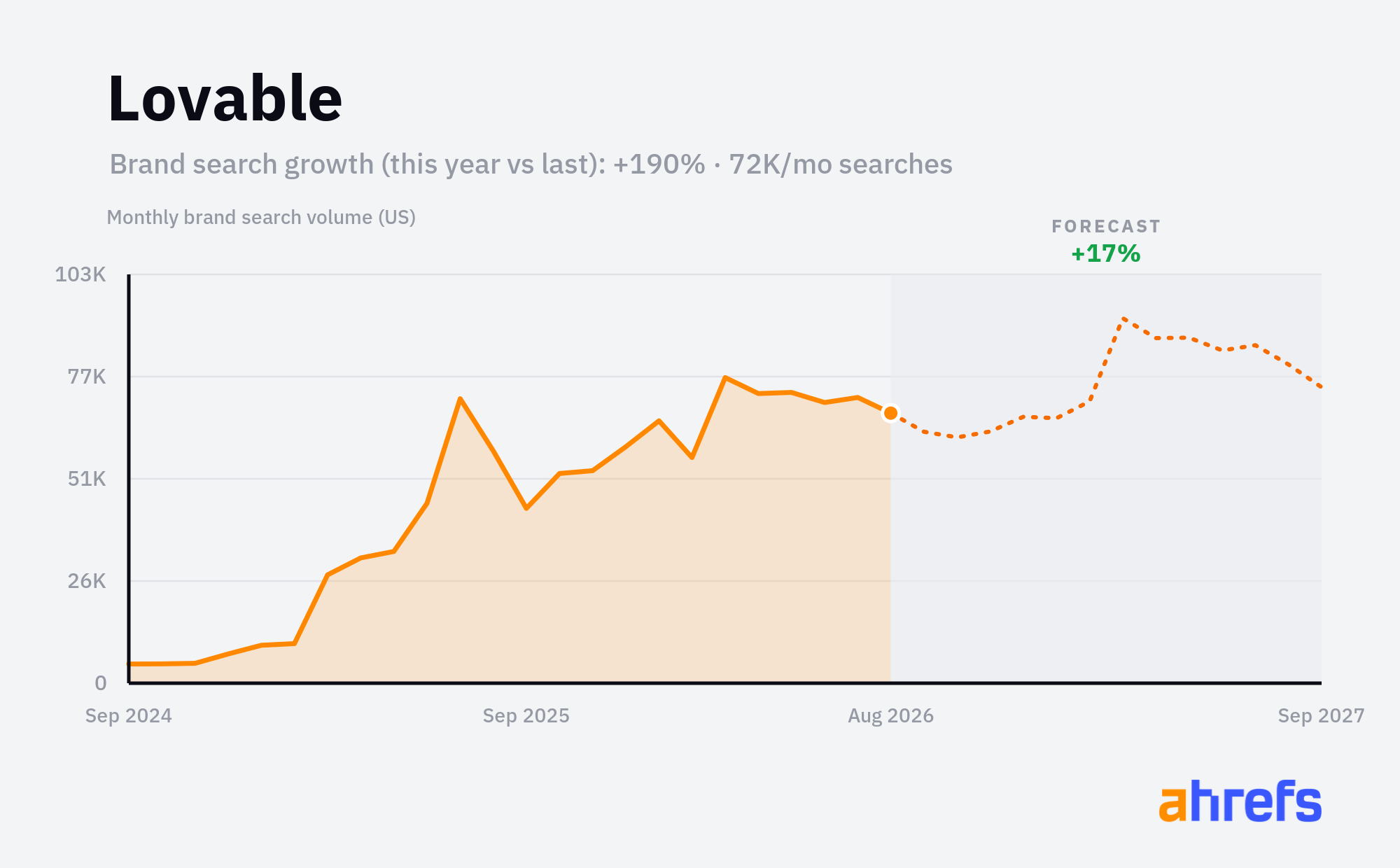
- Brand search growth (this year vs last): +190%
- Search growth forecast (next 12 months): +17%
- Brand search volume (monthly): 72K
- Organic traffic (monthly): 300K
- Year founded: 2023
- Location: Stockholm, Sweden
What they do
Lovable is an AI-powered app builder that lets users describe what they want to build in plain language and get a working web application out the other side, without writing code.
Lovable rode the vibe coding wave as well as any company in the category, and the +190% brand search growth reflects how quickly it went from a Stockholm startup to a tool people were genuinely talking about. The funding trajectory is aggressive even by 2026 AI standards, which means there's real pressure to sustain that demand curve, but for now the search numbers suggest the brand has real momentum with a growing audience.
6. Arcads (+190%)
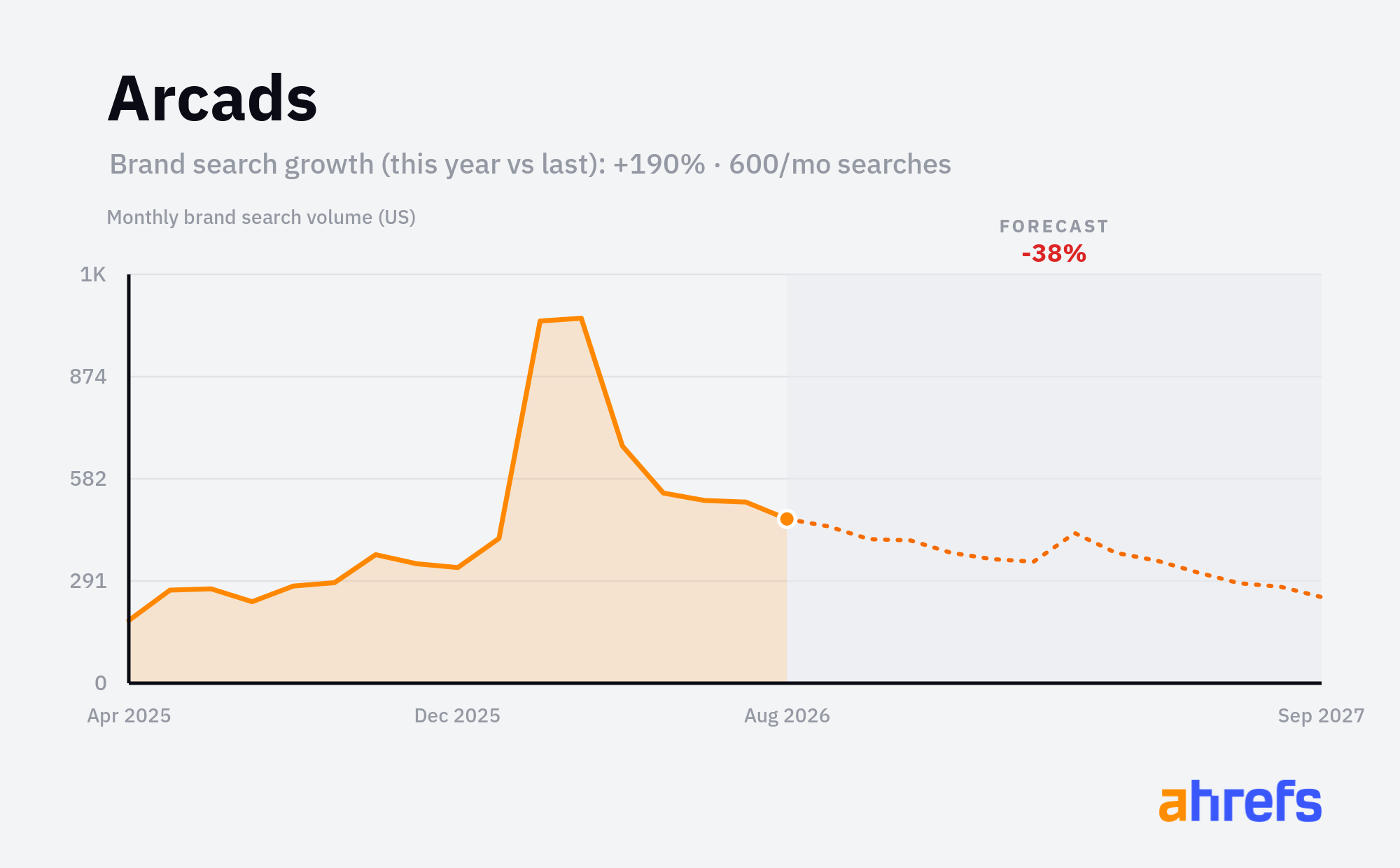
- Brand search growth (this year vs last): +190%
- Search growth forecast (next 12 months): -38%
- Brand search volume (monthly): 600
- Organic traffic (monthly): 17.5K
- Year founded: 2023
- Location: Paris, France
What they do
Arcads is an AI video ad platform that generates UGC-style video creatives using AI actors, aimed at performance marketers who need high volumes of ad creative without running productions.
Arcads raised $16M in a seed round announced in December 2025, led by Eurazeo with participation from Alpha Intelligence Capital and the Sequoia Scout Fund.
Arcads is one of the smallest brands on the list by monthly search volume, which makes a +190% growth rate worth taking seriously rather than dismissing as noise. Performance marketers have been under real pressure to produce more creative variations faster and cheaper, and AI-generated video ads have gone from a novelty to a genuine workflow option over the past year. The negative forecast is a flag, but the core demand signal that got it here was genuine.
7. Browse AI (+170%)
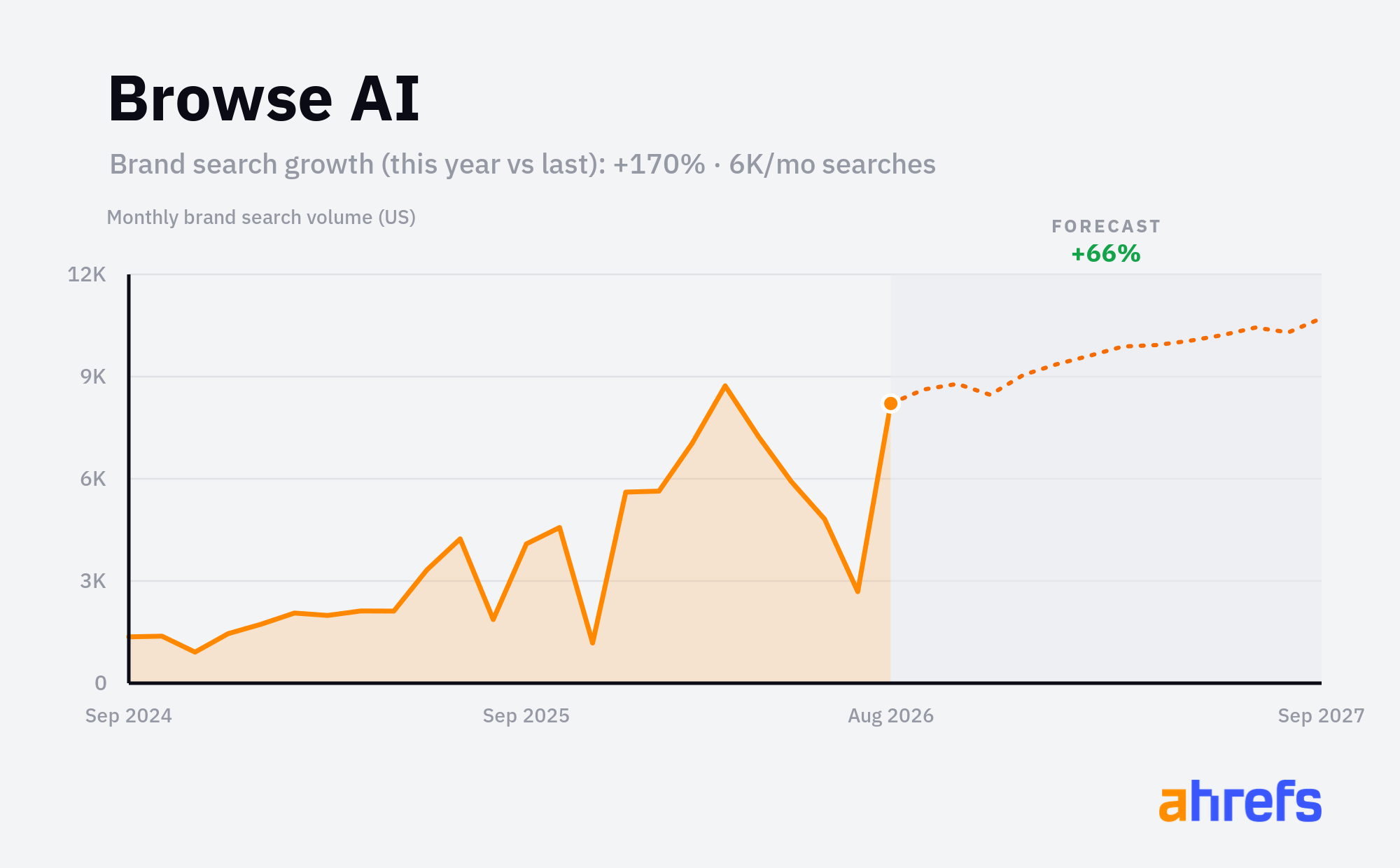
- Brand search growth (this year vs last): +170%
- Search growth forecast (next 12 months): +66%
- Brand search volume (monthly): 6K
- Organic traffic (monthly): 12.5K
- Year founded: 2020
- Location: San Francisco, USA
What they do
Browse AI is a no-code web scraping and monitoring tool that lets users extract and track data from websites by training a robot on the target page, without writing any code.
Browse AI raised $2.8M in a seed round in 2023, from a group of investors including Interface Capital, Alpine VC, AltaIR Capital, and Goodwater Capital.
Web scraping has always had demand, but the rise of AI agents that need structured data pipelines has given no-code scraping tools a new and much larger audience. Browse AI's +170% brand search growth, combined with a +66% forecast for the next 12 months, suggests this isn't a spike that's already burning off, and that's a healthier-looking growth profile than most tools on this list.
8. Reface AI (+160%)
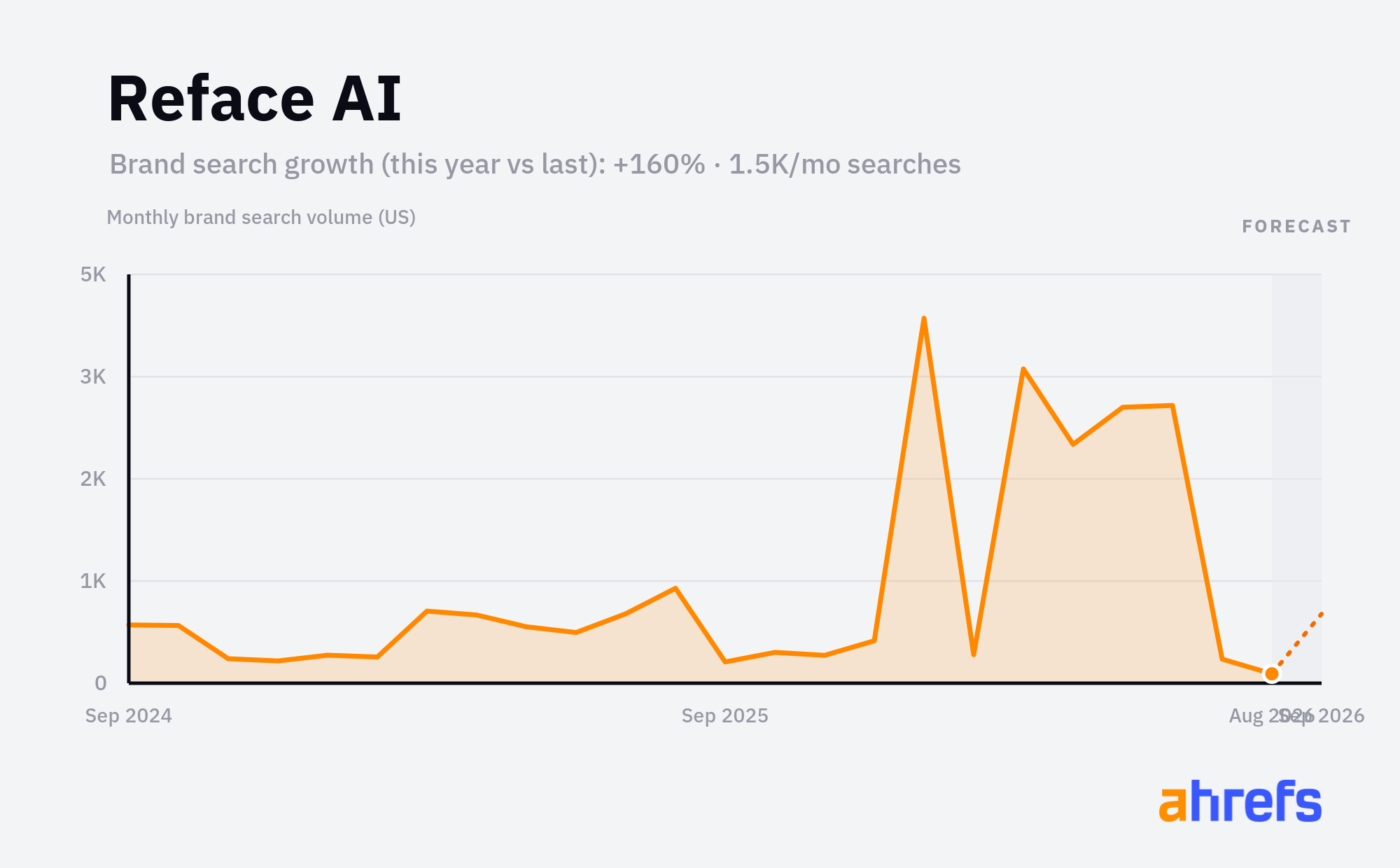
- Brand search growth (this year vs last): +160%
- Search growth forecast (next 12 months): n/a
- Brand search volume (monthly): 1.5K
- Organic traffic (monthly): 23.5K
- Year founded: 2019
- Location: Kyiv, Ukraine
What they do
Reface AI is an app that uses generative AI to let users swap faces into videos, GIFs, and photos, turning a technically complex transformation into something anyone can do on their phone.
Reface AI raised a $5.5M seed round back in 2020, led by Andreessen Horowitz.
Reface has been around since 2019, so the +160% jump in brand searches represents a meaningful second wind for a product most people wrote off as a novelty app years ago. The quality of AI face-swapping has improved enough that the use cases have broadened well beyond the original meme-making crowd, and that's showing up in the search data.
9. Baseten (+140%)
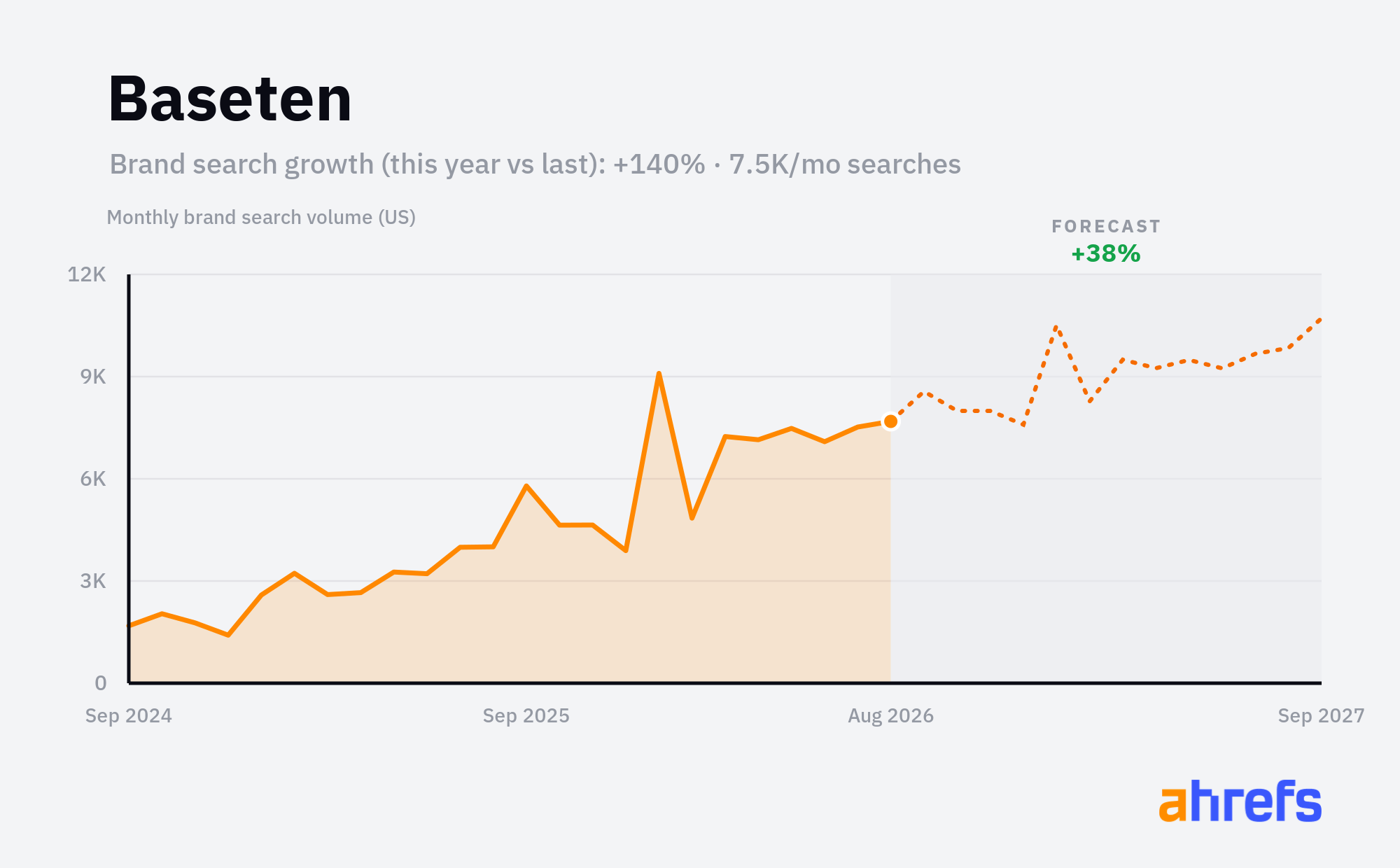
- Brand search growth (this year vs last): +140%
- Search growth forecast (next 12 months): +38%
- Brand search volume (monthly): 7.5K
- Organic traffic (monthly): 12K
- Year founded: 2019
- Location: San Francisco, USA
What they do
Baseten is an AI inference infrastructure platform that lets machine learning teams deploy and serve models at scale, handling the compute, reliability, and performance side of getting a model into production.
AI inference is the part of the stack that actually costs money at scale, and as more companies have moved from experimenting with models to running them in production, demand for infrastructure like Baseten's has grown sharply. The +140% brand search growth, with a healthy +38% forecast, reflects a company that's benefiting from a structural shift in how the AI industry spends its engineering budget.
10. OpenArt (+130%)
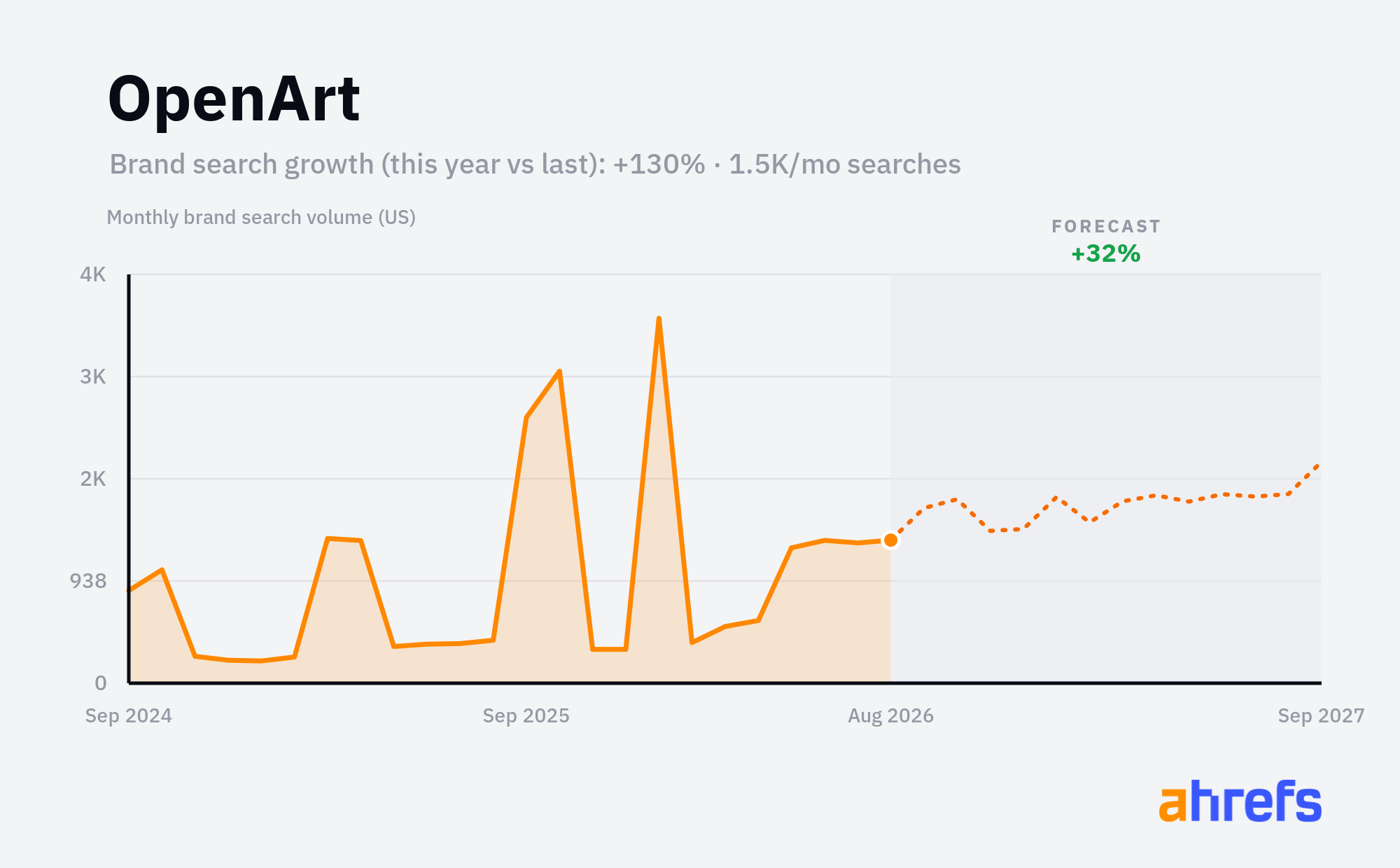
- Brand search growth (this year vs last): +130%
- Search growth forecast (next 12 months): +32%
- Brand search volume (monthly): 1.5K
- Organic traffic (monthly): 750K
- Year founded: 2022
- Location: San Francisco, United States
What they do
OpenArt is an AI image generation platform that lets users create and edit images using models like Stable Diffusion and other generative tools, with a library of community-shared workflows and styles.
Funding for OpenArt is not publicly disclosed.
OpenArt's traffic profile is interesting: ~750K monthly organic visitors on just 1.5K monthly brand searches tells you most of its audience is arriving through image search and content rather than typing the brand name directly. The +130% brand search growth suggests that's starting to change, with more users actively seeking the tool out by name, and the +32% forecast points to that trend continuing.
11. StudyFetch (+110%)
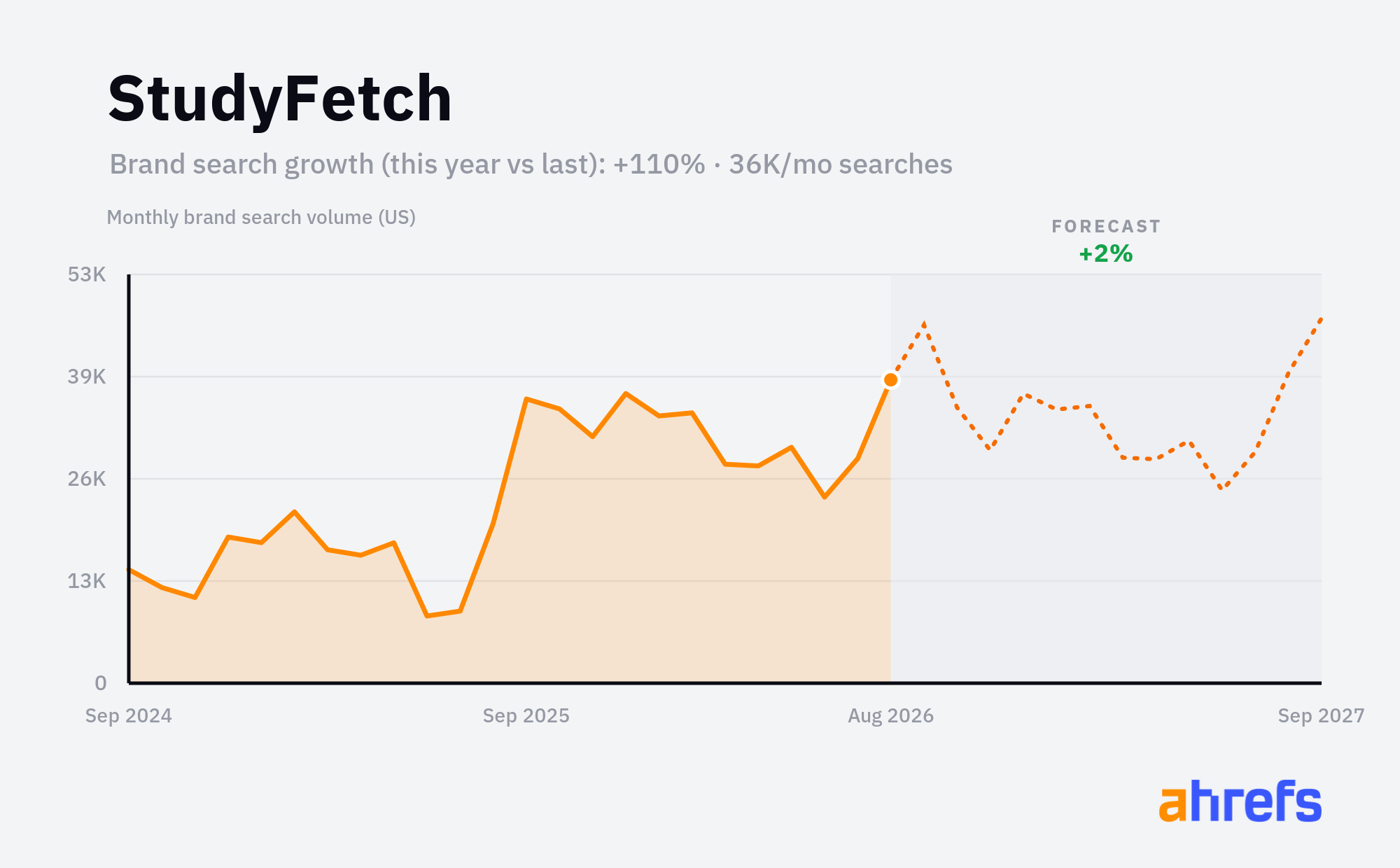
- Brand search growth (this year vs last): +110%
- Search growth forecast (next 12 months): +2%
- Brand search volume (monthly): 36K
- Organic traffic (monthly): 150K
- Year founded: 2023
- Location: United States
What they do
StudyFetch is an AI study platform aimed at students, who can upload their course materials and have the tool automatically generate flashcards, practice tests, and other study aids from them.
StudyFetch raised $11.5M in a Series A in June 2025, led by Owl Ventures with participation from College Board.
The AI edtech category has been crowded for a couple of years now, but StudyFetch's +110% brand search growth signals it's managed to carve out real student loyalty rather than just riding the general wave. With ~40K monthly brand searches for a company founded in 2023, it's grown a recognizable name fast in a market where students are notorious for switching tools the moment something better shows up.
12. Liquid AI (+100%)
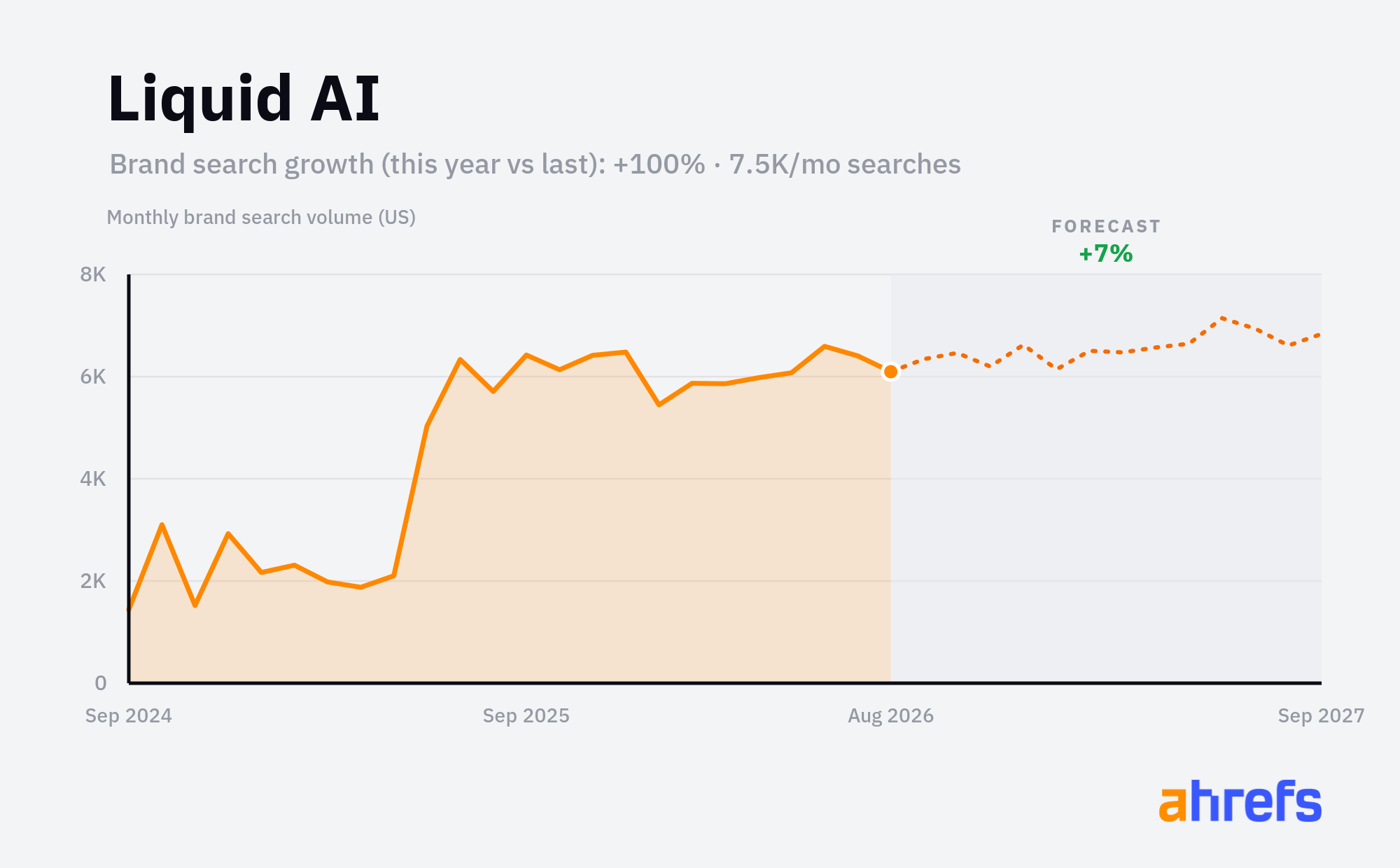
- Brand search growth (this year vs last): +100%
- Search growth forecast (next 12 months): +7%
- Brand search volume (monthly): 7.5K
- Organic traffic (monthly): 3K
- Year founded: 2023
- Location: Cambridge, USA
What they do
Liquid AI is an AI lab building its own foundation models using a novel architecture called Liquid Foundation Models, designed to be more efficient than traditional transformers, and targeting enterprise customers who need capable models at lower compute cost.
Liquid AI closed a $250M Series A in December 2024, led by AMD Ventures, with OSS Capital, Duke Capital Partners, and PagsGroup also participating.
Liquid AI's +100% brand search growth is particularly notable given how little organic traffic the site itself pulls in, which means the search demand is coming from people who've specifically heard about the company and want to know more, rather than stumbling across it through content. For an AI lab competing in the same general space as much better-funded rivals, that kind of direct name recognition matters.
13. AI21 Labs (+94%)
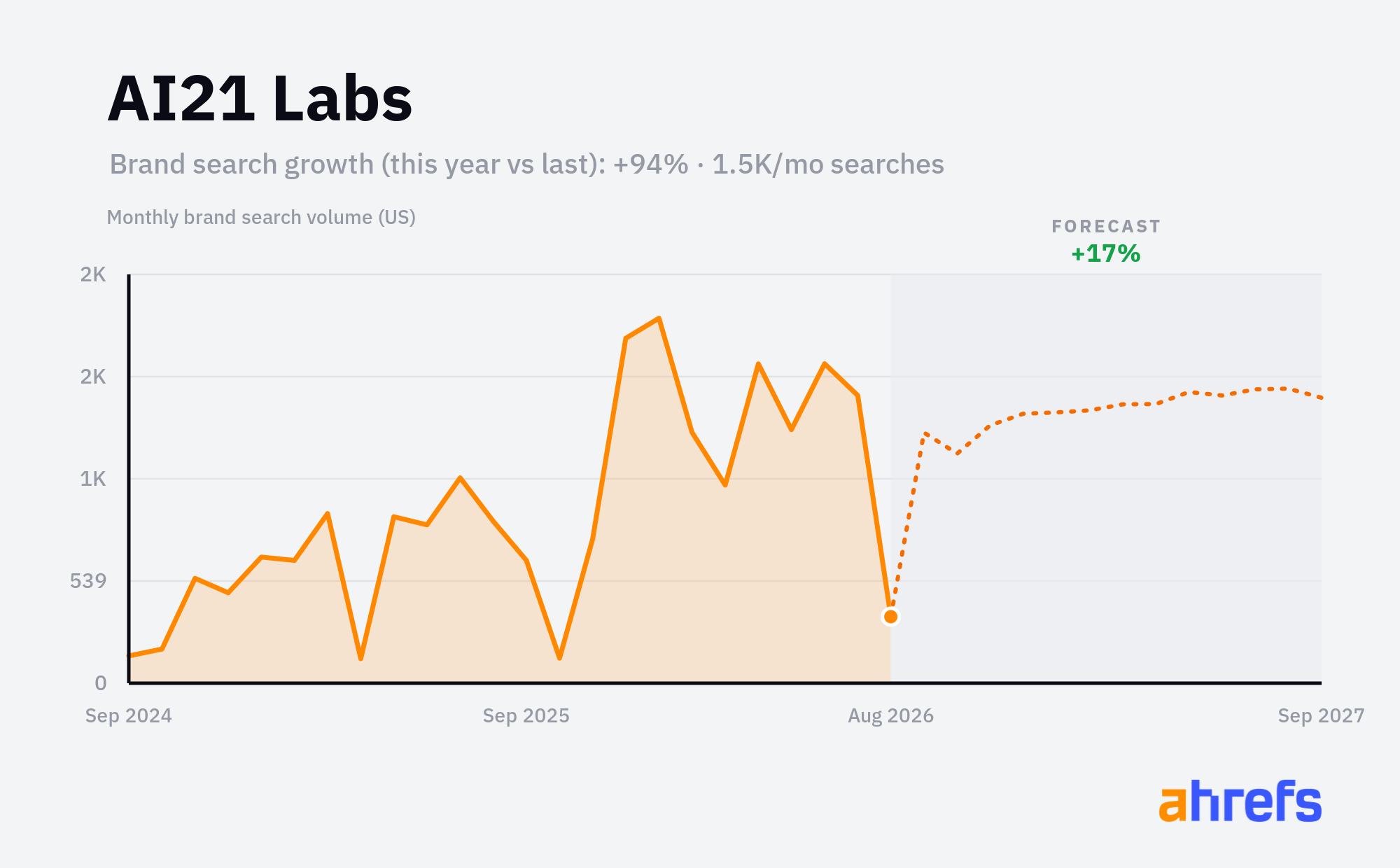
- Brand search growth (this year vs last): +94%
- Search growth forecast (next 12 months): +17%
- Brand search volume (monthly): 1.5K
- Organic traffic (monthly): 84K
- Year founded: 2017
- Location: Tel-Aviv, Tel-Aviv District
What they do
AI21 Labs is a Tel Aviv-based AI lab that builds large language models and enterprise AI products, including its Jamba foundation model and a range of task-specific models for business applications.
AI21 Labs raised a $300M Series D in May 2025, with Google and Nvidia as lead investors.
Founded in 2017, AI21 Labs is one of the most established companies on this list, which makes a +94% jump in brand searches this year meaningful in a different way than it would be for a 2023 startup. The Jamba model launch and the high-profile Google and Nvidia investment clearly pushed the brand into conversations it wasn't part of before, pulling in a new wave of enterprise buyers and researchers who want to evaluate what's available beyond the most obvious names.
14. ProFaceFinder (+92%)
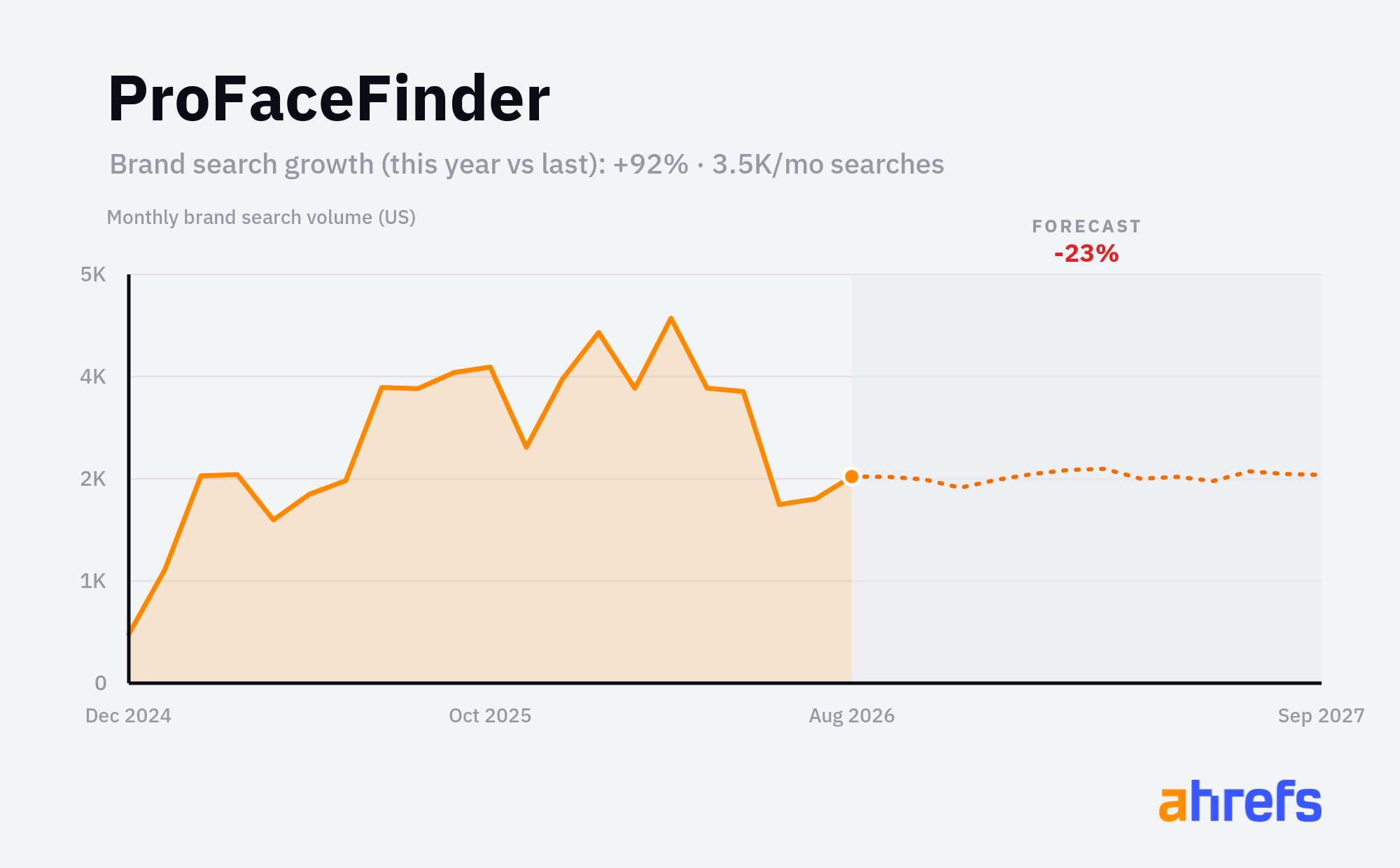
- Brand search growth (this year vs last): +92%
- Search growth forecast (next 12 months): -23%
- Brand search volume (monthly): 3.5K
- Organic traffic (monthly): 17K
- Year founded: n/a
- Location: United States
What they do
ProFaceFinder is an AI-powered facial recognition and people-search platform that lets users search for individuals by face across public web sources.
Funding for ProFaceFinder is not publicly disclosed.
ProFaceFinder sits in a category that tends to generate demand in surges, driven by specific news cycles or social media moments around facial recognition and online privacy rather than steady professional adoption. The +92% brand search growth is real, but the negative forecast and relatively thin backlink profile suggest the audience it found this year may be more curiosity-driven than sticky.
15. ElevenLabs (+85%)
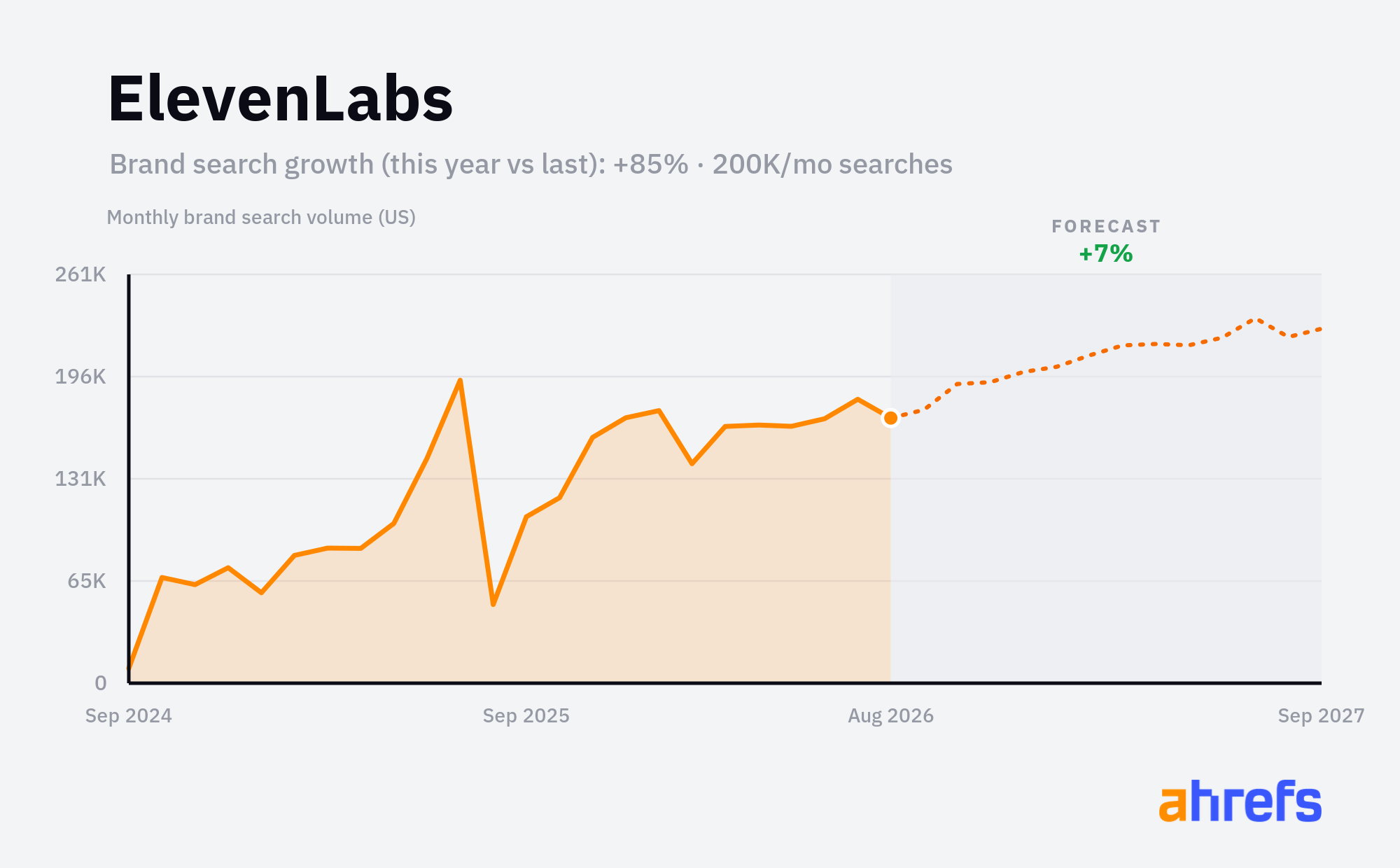
- Brand search growth (this year vs last): +85%
- Search growth forecast (next 12 months): +7%
- Brand search volume (monthly): 200K
- Organic traffic (monthly): 4.6M
- Year founded: 2022
- Location: London, UK
What they do
ElevenLabs is the AI voice company behind some of the most widely used text-to-speech and voice cloning tools available, used by creators, developers, and media companies who need high-quality synthetic audio.
ElevenLabs raised $500M in a Series D in February 2026, led by Sequoia Capital at an $11 billion valuation, with Andreessen Horowitz, ICONIQ, Lightspeed, and others participating.
ElevenLabs is one of the biggest brands on the list, with ~180K monthly brand searches and 4.6M monthly organic visitors, and it's still growing at +85% year over year. That's genuinely hard to do at that scale, and it reflects a company that has managed to stay at the center of the AI voice conversation even as the category has filled with competitors.
16. Contextual AI (+83%)
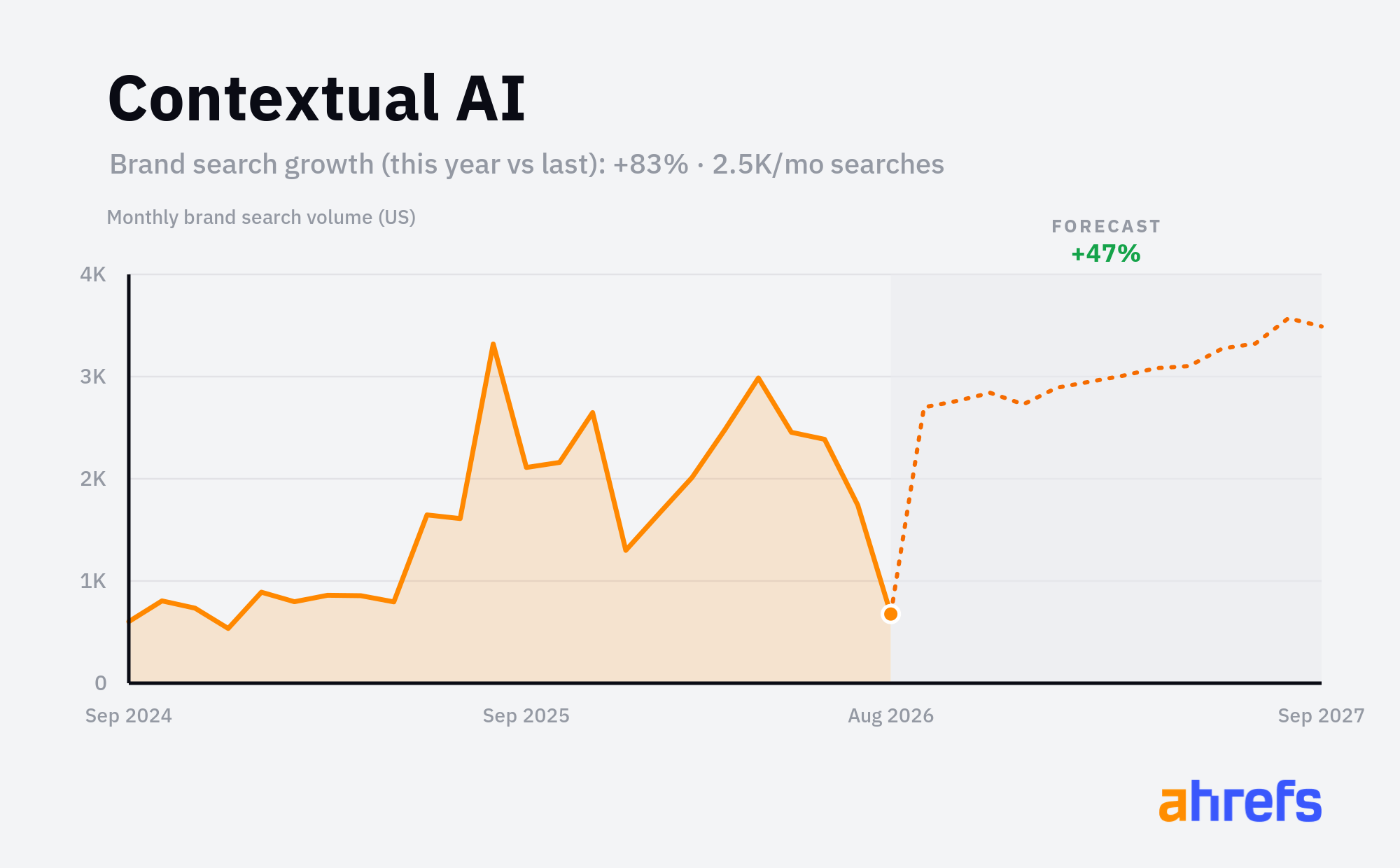
- Brand search growth (this year vs last): +83%
- Search growth forecast (next 12 months): +47%
- Brand search volume (monthly): 2.5K
- Organic traffic (monthly): 1.5K
- Year founded: 2023
- Location: Mountain View, USA
What they do
Contextual AI is an enterprise AI company building retrieval-augmented generation systems for large organizations that need AI to work reliably on their own proprietary data.
Contextual AI is one of the lowest-traffic sites on the list, with just ~1.3K monthly organic visitors, so the +83% brand search growth here is coming almost entirely from direct name recognition in enterprise AI circles rather than any content or SEO surface area. A +47% forecast for the next 12 months is about as bullish as any company on the list, and it's worth tracking whether that translates into the kind of broader awareness that eventually shows up in traffic.
17. Manus (+74%)
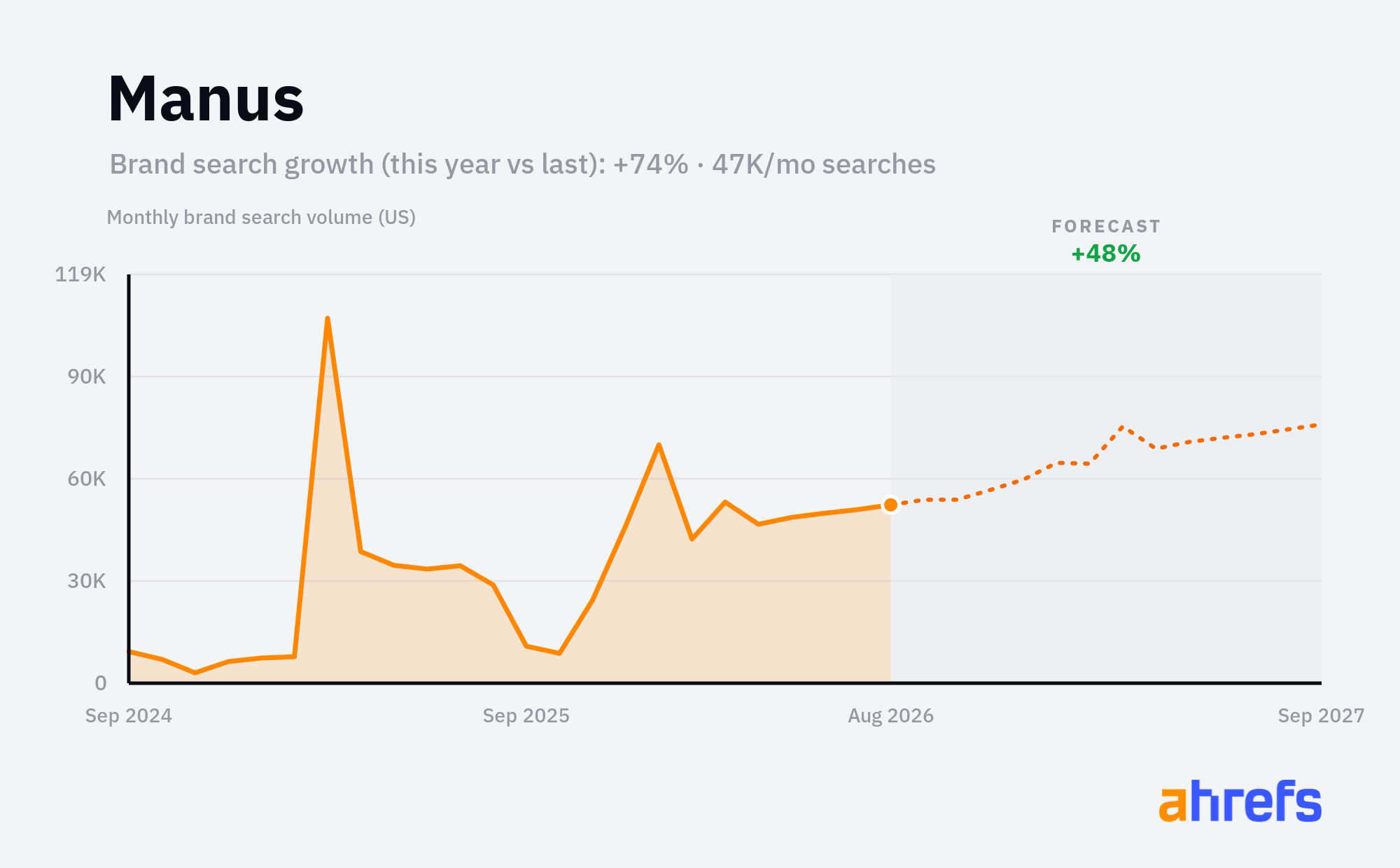
- Brand search growth (this year vs last): +74%
- Search growth forecast (next 12 months): +48%
- Brand search volume (monthly): 47K
- Organic traffic (monthly): 1.1M
- Year founded: 2024
- Location: Singapore
What they do
Manus is a general-purpose AI agent that can autonomously carry out multi-step tasks on a user's behalf, from research and writing to coding and web browsing, without requiring the user to break the task down manually.
Funding for Manus is not publicly disclosed.
Manus is one of the youngest companies on the list, founded in 2024, which makes its ~50K monthly brand searches and 1.1M in organic traffic a remarkable early footprint. The AI agent category captured an enormous amount of attention this year, and Manus arrived with enough capability to generate real earned media and developer buzz, rather than just riding the category hype.
18. World Labs (+62%)
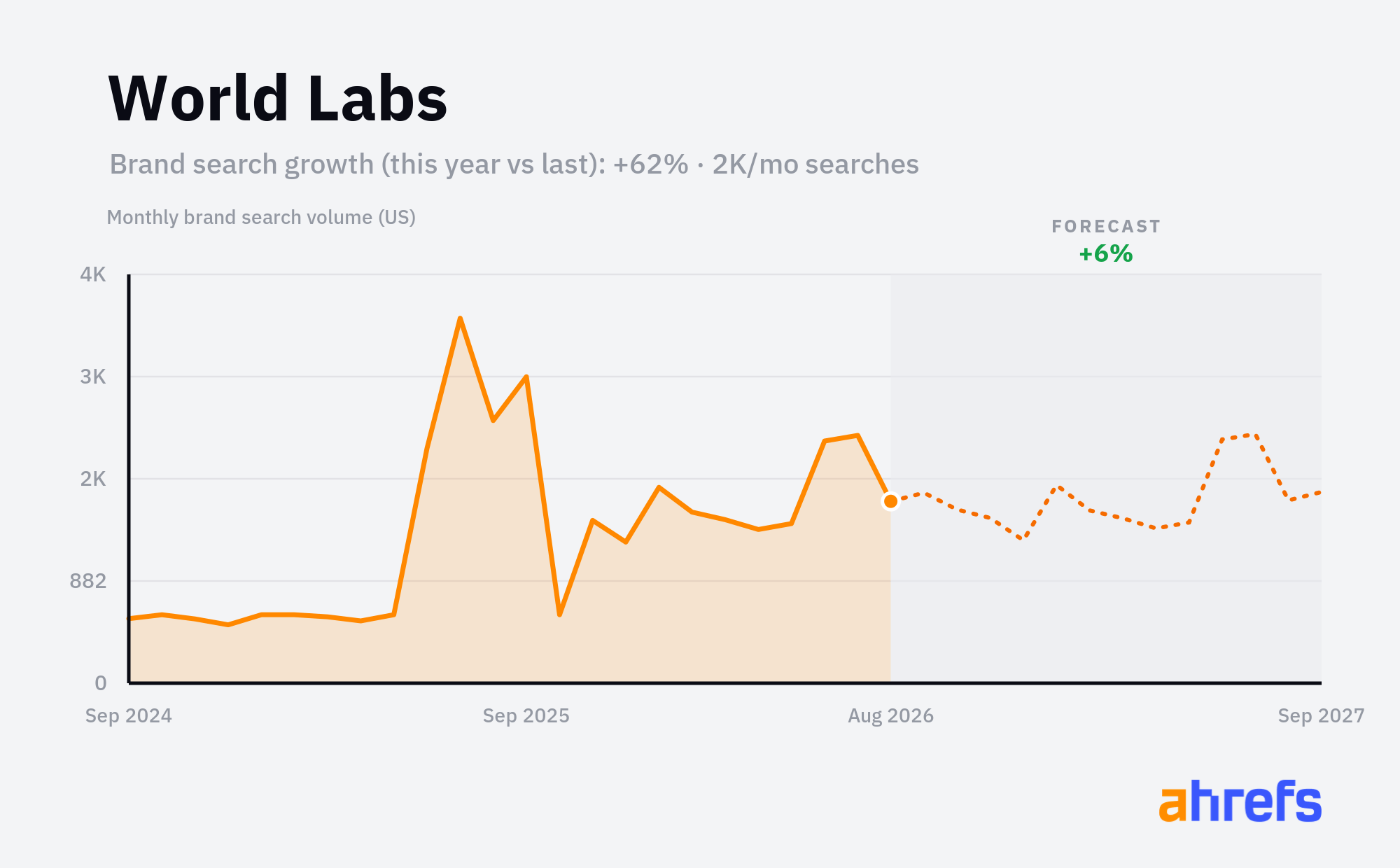
- Brand search growth (this year vs last): +62%
- Search growth forecast (next 12 months): +6%
- Brand search volume (monthly): 2K
- Organic traffic (monthly): 21.5K
- Year founded: 2024
- Location: San Francisco, USA
What they do
World Labs is an AI research company founded by Fei-Fei Li that's building large world models, AI systems that can understand and generate three-dimensional spatial environments rather than just text or images.
World Labs raised $1 billion in new funding announced in February 2026, with AMD, Autodesk, NVIDIA, Fidelity, and Emerson Collective among the named investors.
World Labs is one of the youngest companies on the list, founded in 2024, and the brand search growth here is largely a function of who founded it and how much money it raised rather than a broad consumer audience finding the product. The billion-dollar raise and AMD's subsequent acquisition interest kept the brand in the news throughout the year, which is a reasonable explanation for a +62% jump in searches for a company whose product is still very much in development.
19. SeaArt AI (+60%)
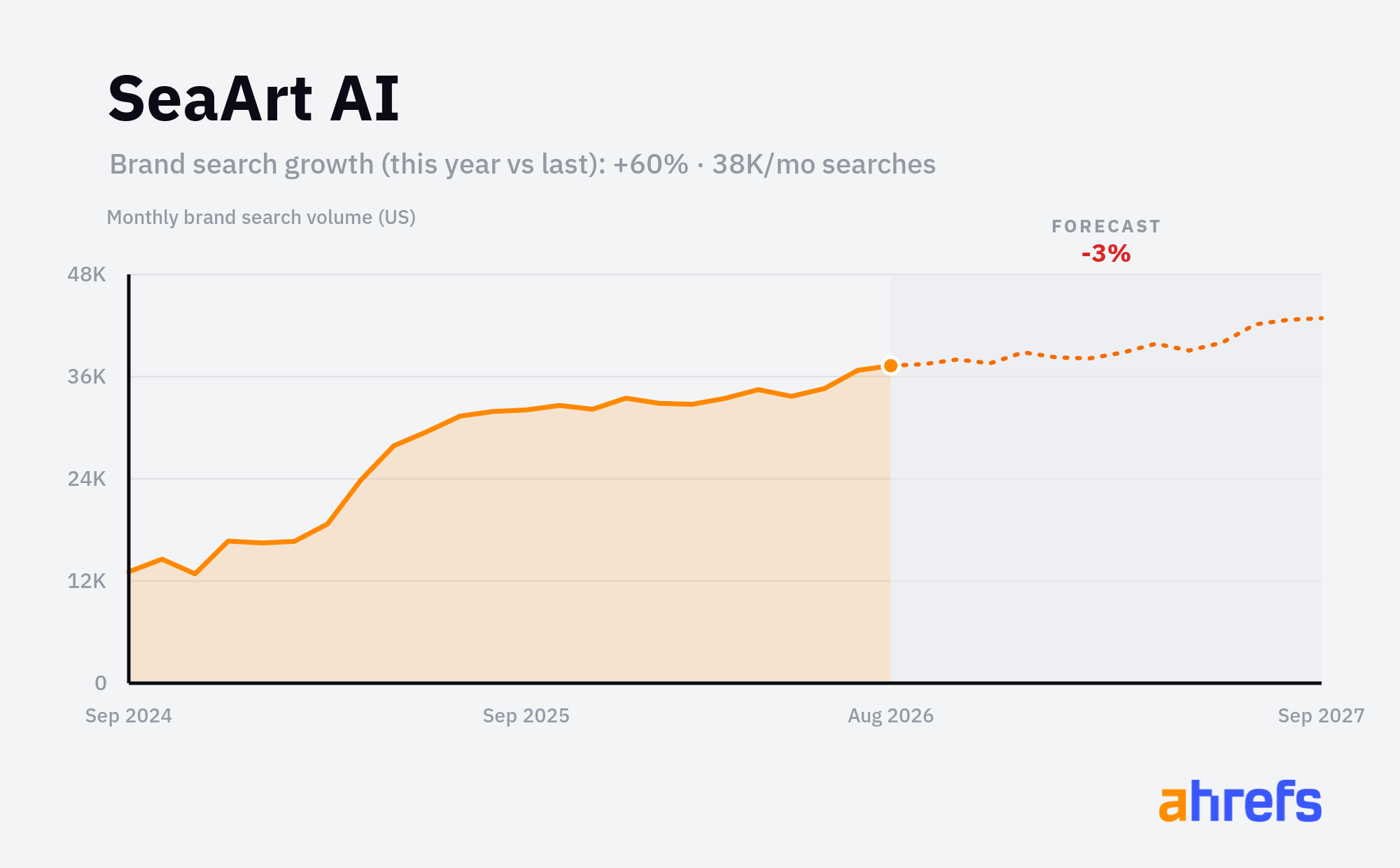
- Brand search growth (this year vs last): +60%
- Search growth forecast (next 12 months): -3%
- Brand search volume (monthly): 38K
- Organic traffic (monthly): 1.9M
- Year founded: 2023
- Location: Hong Kong, China
What they do
SeaArt AI is an AI image generation platform where users can create and share AI-generated artwork using a range of generative models, with a particular focus on anime and stylized illustration.
SeaArt AI raised a Series B in July 2026 of more than 100 million yuan, co-led by Visual China Group, Huagai Chuangying and Vertex China.
SeaArt AI is one of the highest-traffic sites on the list, pulling in 1.9M monthly organic visitors, and its ~40K monthly brand searches reflect a platform that's built a genuinely large user base. The +60% growth in brand searches on top of that existing scale is notable, and the Asian AI art community has been a meaningful driver, with stylized generative art remaining far more popular in those markets than Western commentary on AI image generation typically acknowledges.
20. Flagright (+59%)
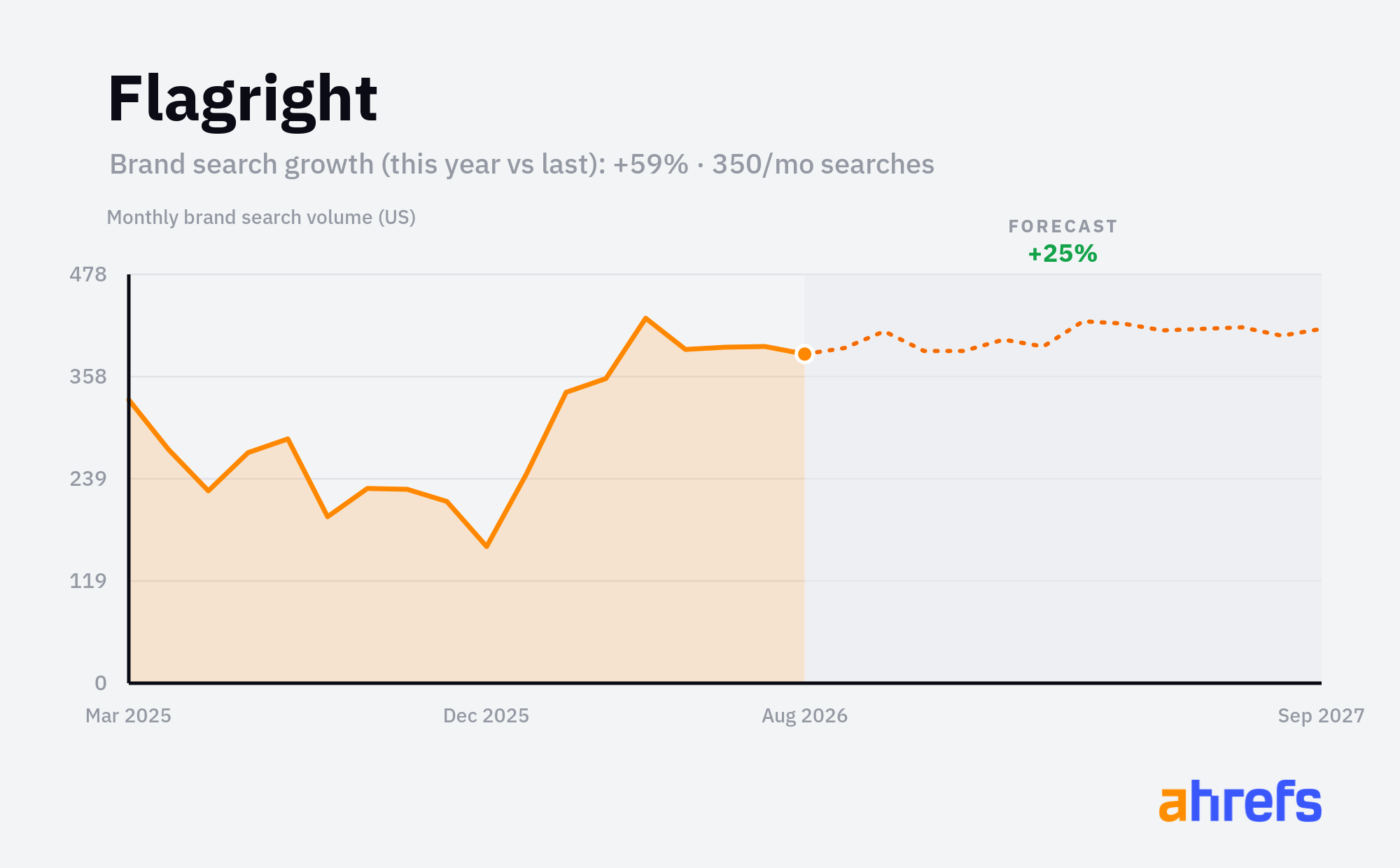
- Brand search growth (this year vs last): +59%
- Search growth forecast (next 12 months): +25%
- Brand search volume (monthly): 350
- Organic traffic (monthly): 5.5K
- Year founded: 2021
- Location: Singapore
What they do
Flagright is an AI-native anti-money laundering compliance platform that gives financial institutions tools for transaction monitoring, risk scoring, case management, and AML screening, without requiring heavy engineering work to implement.
Flagright is one of the smallest brands on the list by search volume, with just 350 monthly brand searches, so a +59% growth rate in a niche B2B compliance category is actually a healthy signal rather than a weak one. Financial crime compliance is a space where buying decisions happen slowly and through word of mouth among a small community of specialists, and growing name recognition in that audience is genuinely hard.
21. Prodigal (+55%)
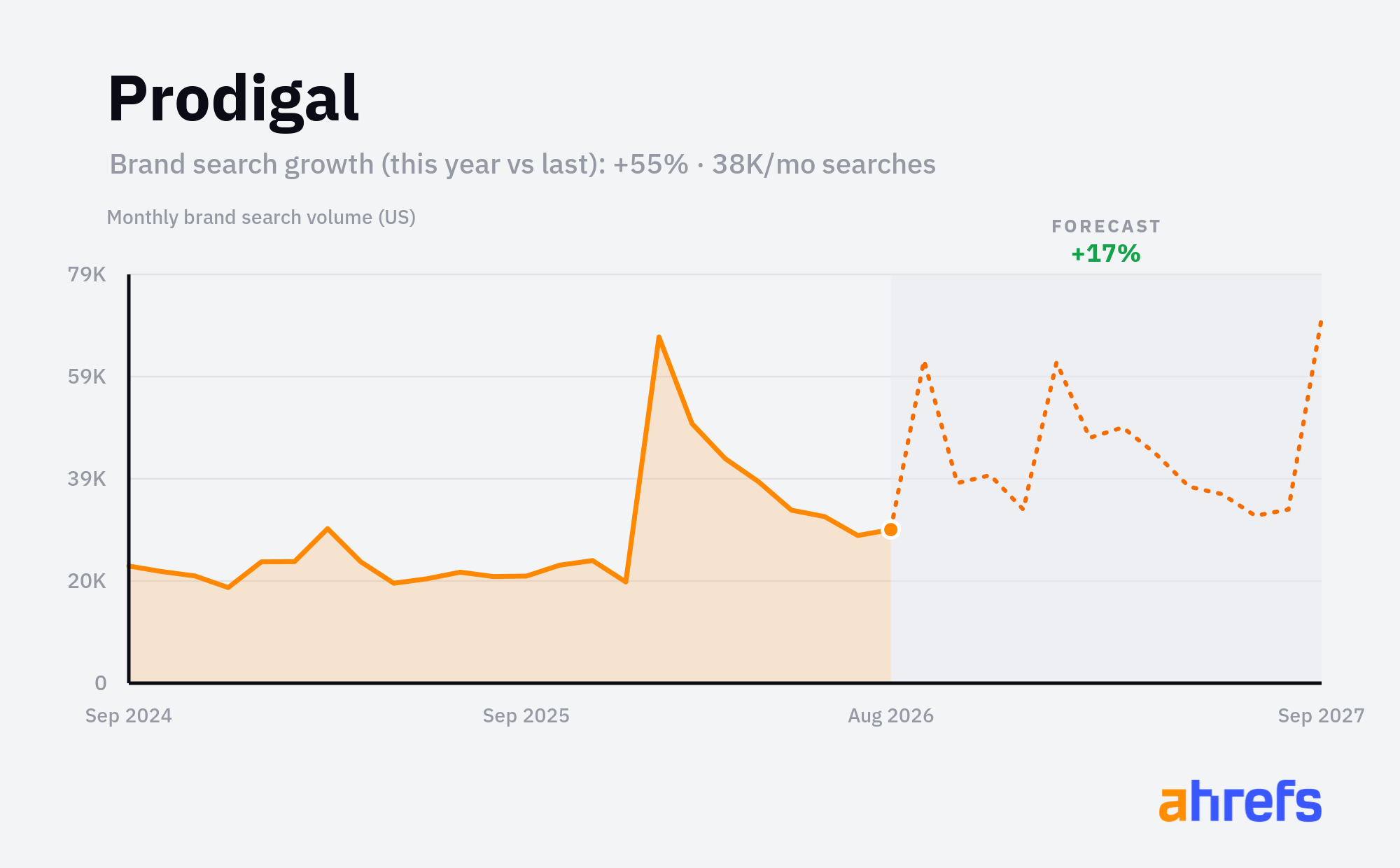
- Brand search growth (this year vs last): +55%
- Search growth forecast (next 12 months): +17%
- Brand search volume (monthly): 38K
- Organic traffic (monthly): 1.5K
- Year founded: 2018
- Location: Mountain View, California
What they do
Prodigal is an AI platform for consumer finance, trained on hundreds of millions of debt collection and lending conversations, and used by lenders and collectors to automate and improve recovery operations.
Prodigal raised a total of $14M, comprising a $12M Series A led by Menlo Ventures and a prior $2M seed round, with Accel, Y Combinator, and MGV participating across both rounds.
Prodigal is one of the more established companies here, founded in 2018, and the +55% brand search growth comes from a company that's been quietly building domain expertise in a vertical most AI companies don't touch. The ~40K monthly brand searches on just ~1.4K monthly organic visitors is an unusual profile: it suggests a brand that's well-known within its industry but hasn't built much of a content presence, which means almost all of those searches are coming from people who already know the name.
22. Glass Health (+54%)
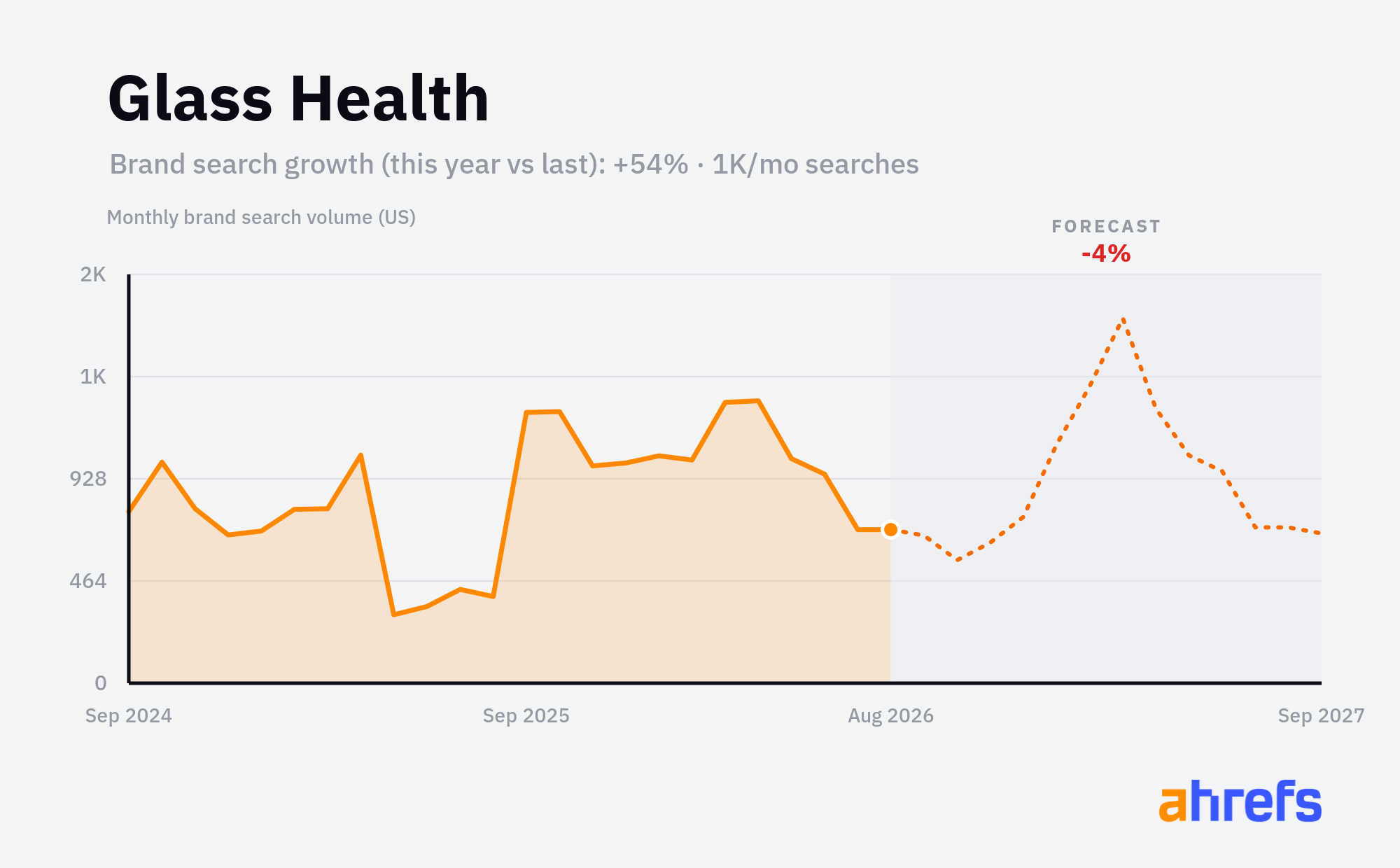
- Brand search growth (this year vs last): +54%
- Search growth forecast (next 12 months): -4%
- Brand search volume (monthly): 1K
- Organic traffic (monthly): 1.5K
- Year founded: 2021
- Location: San Francisco, CA
What they do
Glass Health is an AI clinical decision support tool built for physicians, helping clinicians generate differential diagnoses and clinical plans from patient notes.
Healthcare AI has been one of the more cautiously adopted categories, so a +54% rise in brand searches for a clinical decision tool reflects genuine uptake among physicians rather than hype from general consumers. The audience here is small by design, which is why both the traffic and search numbers are modest, but growing name recognition among practicing clinicians is a meaningful signal for a company operating in a trust-intensive vertical.
23. Pictory AI (+54%)
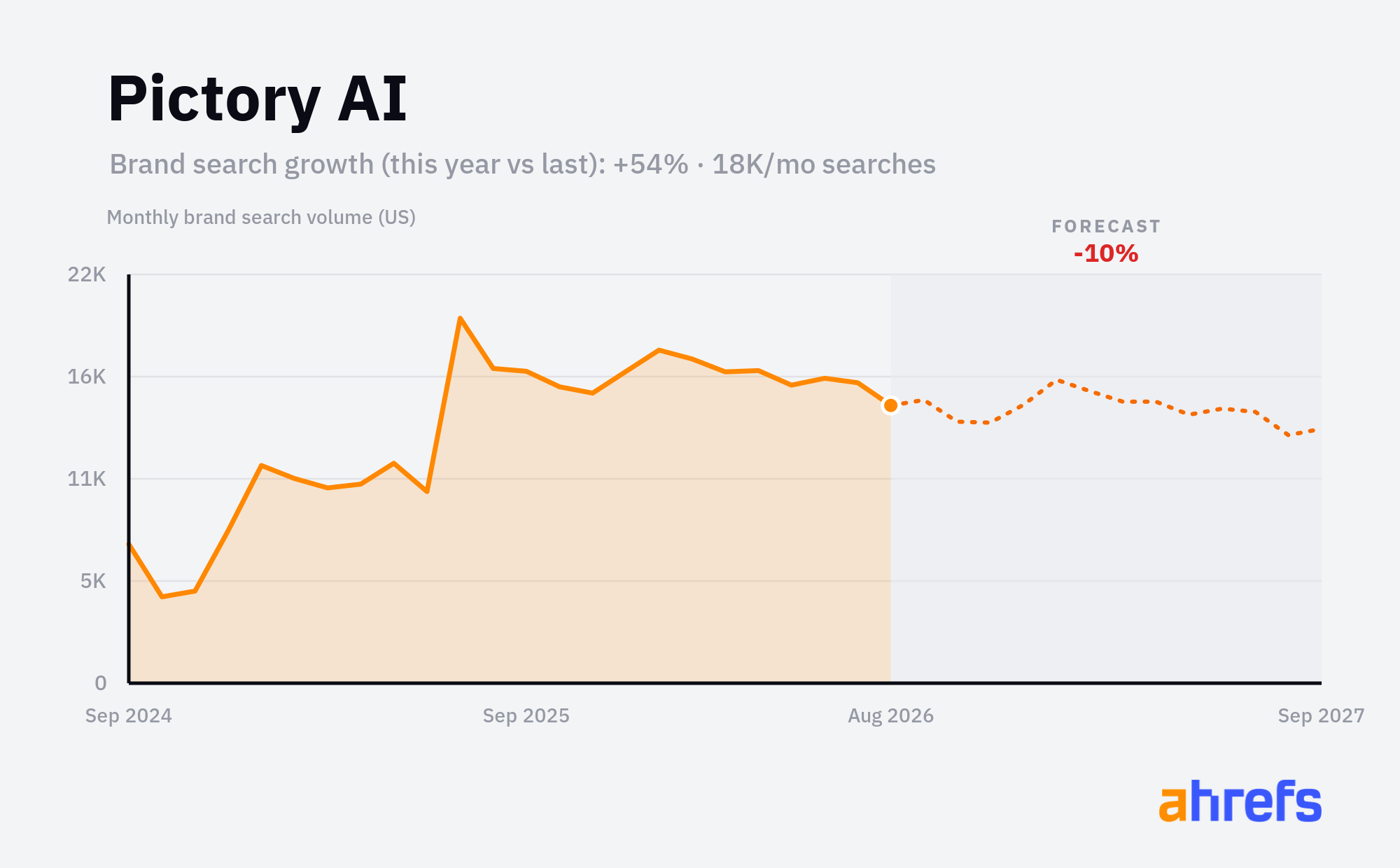
- Brand search growth (this year vs last): +54%
- Search growth forecast (next 12 months): -10%
- Brand search volume (monthly): 18K
- Organic traffic (monthly): 200K
- Year founded: 2021
- Location: Bellevue, Washington, USA
What they do
Pictory AI is an AI video creation platform that converts scripts, blog posts, and long-form articles into short branded videos, used primarily by content marketers and social media teams.
Pictory AI raised $2.1M in a seed round in January 2022, led by FUSE, with Voyager Capital and several angels participating.
Pictory has been around since 2021 and has built a solid base of ~20K monthly brand searches and ~190K organic visitors, so the +54% growth this year represents a genuine acceleration rather than a brand starting from zero. The negative forecast is worth noting given how competitive AI video has become, but the core product clearly has an audience that keeps coming back and sending new users its way.
24. Read AI (+52%)
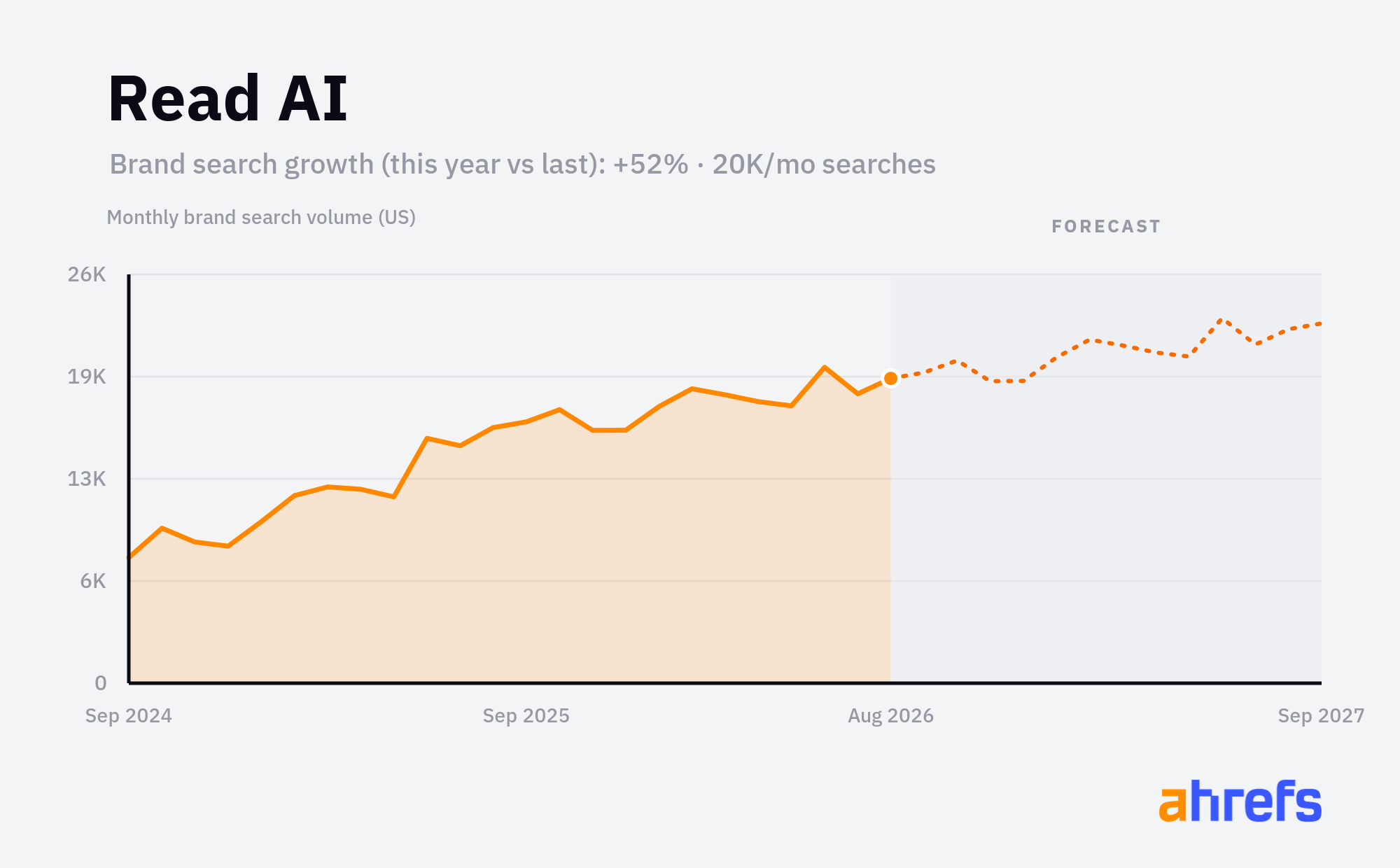
- Brand search growth (this year vs last): +52%
- Search growth forecast (next 12 months): n/a
- Brand search volume (monthly): 20K
- Organic traffic (monthly): 91K
- Year founded: 2021
- Location: Seattle, USA
What they do
Read AI is an AI meeting intelligence tool that joins calls, generates summaries and transcripts, and increasingly extends those capabilities into email and messaging, used by teams who want to reduce meeting overhead and keep everyone aligned.
Read AI has raised $81M in total, most recently a $50M Series B in October 2024 led by Smash Capital, with Madrona and Goodwater Capital participating.
The AI meeting assistant category got crowded fast, but Read AI has held its ground and kept growing, with a +52% rise in brand searches and ~20K monthly searches on a solid ~90K monthly organic traffic base. Expanding from meeting summaries into email and Slack coverage has given it a larger surface area for users to discover the product, and that product expansion seems to be reflected in the search data.
25. Hedra (+52%)
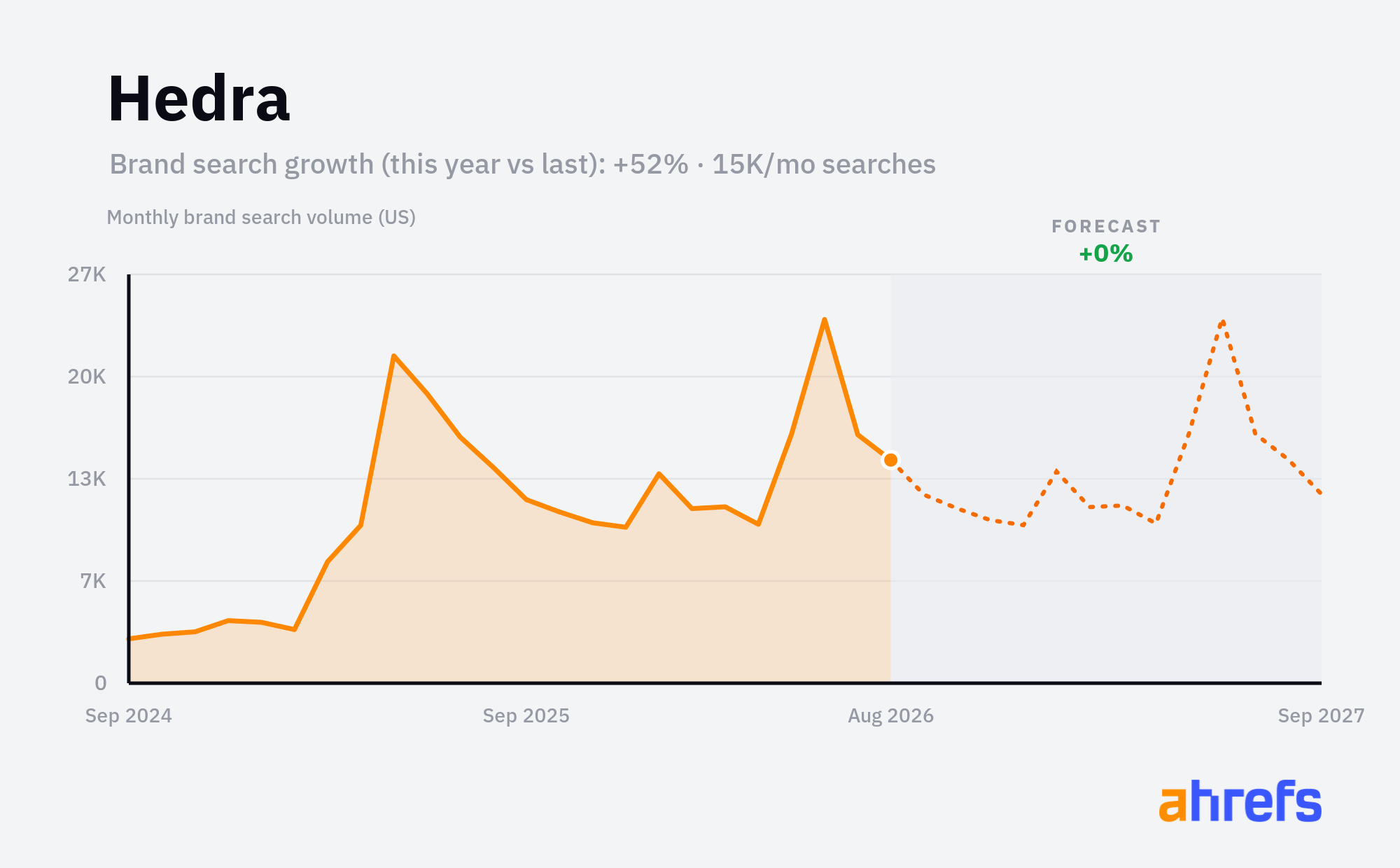
- Brand search growth (this year vs last): +52%
- Search growth forecast (next 12 months): +0%
- Brand search volume (monthly): 15K
- Organic traffic (monthly): 67K
- Year founded: 2023
- Location: San Francisco, USA
What they do
Hedra is an AI video platform that turns a still image plus a voice track or script into a talking, expressive character video, used by creators and marketing teams.
Hedra raised a $32M Series A in May 2025, led by Andreessen Horowitz's Infrastructure fund, after an earlier $10M seed from Index Ventures, Abstract Ventures, and a16z speedrun.
Hedra's Character-3 model was behind a wave of viral AI "talking baby" podcasts, and brand searches have climbed to around 15K a month since. Its forecast is flat, so the next year will show whether that attention turns into a steady base of paying creators.
The full list: fastest-growing AI companies by brand search
# | Company | Industry | Brand search growth | Monthly brand searches |
|---|---|---|---|---|
1 | AI / ML | +980% (this year vs last) Breakout | 58K | |
2 | AI / ML | +970% (this year vs last) | 7K | |
3 | AI / ML | +240% (this year vs last) | 1K | |
4 | AI / ML | +210% (this year vs last) | 20K | |
5 | No-code | +190% (this year vs last) Breakout | 72K | |
6 | Marketing | +190% (this year vs last) | 600 | |
7 | No-code | +170% (this year vs last) | 6K | |
8 | AI / ML | +160% (this year vs last) | 1.5K | |
9 | AI / ML | +140% (this year vs last) | 7.5K | |
10 | Design | +130% (this year vs last) | 1.5K | |
11 | Education | +110% (this year vs last) Breakout | 36K | |
12 | AI / ML | +100% (this year vs last) | 7.5K | |
13 | AI / ML | +94% (this year vs last) | 1.5K | |
14 | AI / ML | +92% (this year vs last) | 3.5K | |
15 | AI / ML | +85% (this year vs last) Breakout | 200K | |
16 | AI / ML | +83% (this year vs last) | 2.5K | |
17 | AI / ML | +74% (this year vs last) Breakout | 47K | |
18 | AI / ML | +62% (this year vs last) | 2K | |
19 | Design | +60% (this year vs last) Breakout | 38K | |
20 | Fintech | +59% (this year vs last) | 350 | |
21 | Fintech | +55% (this year vs last) | 38K | |
22 | AI / ML | +54% (this year vs last) | 1K | |
23 | Video | +54% (this year vs last) | 18K | |
24 | Productivity | +52% (this year vs last) | 20K | |
25 | Video | +52% (this year vs last) | 15K | |
26 | AI / ML | +48% (this year vs last) | 19K | |
27 | Design | +48% (this year vs last) | 1.5K | |
28 | Design | +46% (this year vs last) Breakout | 100K | |
29 | AI / ML | +46% (this year vs last) | 93K | |
30 | Productivity | +45% (this year vs last) | 1K | |
31 | Data infrastructure | +41% (this year vs last) | 5K | |
32 | AI / ML | +40% (this year vs last) Breakout | 38K | |
33 | Video | +39% (this year vs last) | 16K | |
34 | AI / ML | +38% (this year vs last) | 700 | |
35 | AI / ML | +35% (this year vs last) Breakout | 96K | |
36 | Data infrastructure | +31% (this year vs last) | 150K | |
37 | AI / ML | +30% (this year vs last) Breakout | 40K | |
38 | Design | +28% (this year vs last) | 26K | |
39 | AI / ML | +26% (this year vs last) | 11K | |
40 | AI / ML | +24% (this year vs last) | 14K | |
41 | Video | +24% (this year vs last) | 5.5K | |
42 | AI / ML | +21% (this year vs last) | 9K | |
43 | Dev tools | +20% (this year vs last) Breakout | 49K | |
44 | Marketing | +19% (this year vs last) | 14K | |
45 | Video | +13% (this year vs last) | 51K | |
46 | AI / ML | +11% (this year vs last) | 6.5K | |
47 | Design | +11% (this year vs last) | 8.5K | |
48 | AI / ML | +10% (this year vs last) | 5.5K | |
49 | Dev tools | +6% (this year vs last) | 47K | |
50 | Customer support | +3% (this year vs last) | 56K |
Brand search growth = growth in average monthly searches for the company name this year versus last year (last 12 months vs the prior 12 months). Monthly brand searches = current US search volume for the brand name. Data: Ahrefs · October 2026.
How to find this data in Ahrefs
You can rebuild this entire analysis yourself in Ahrefs. Here's the short version:
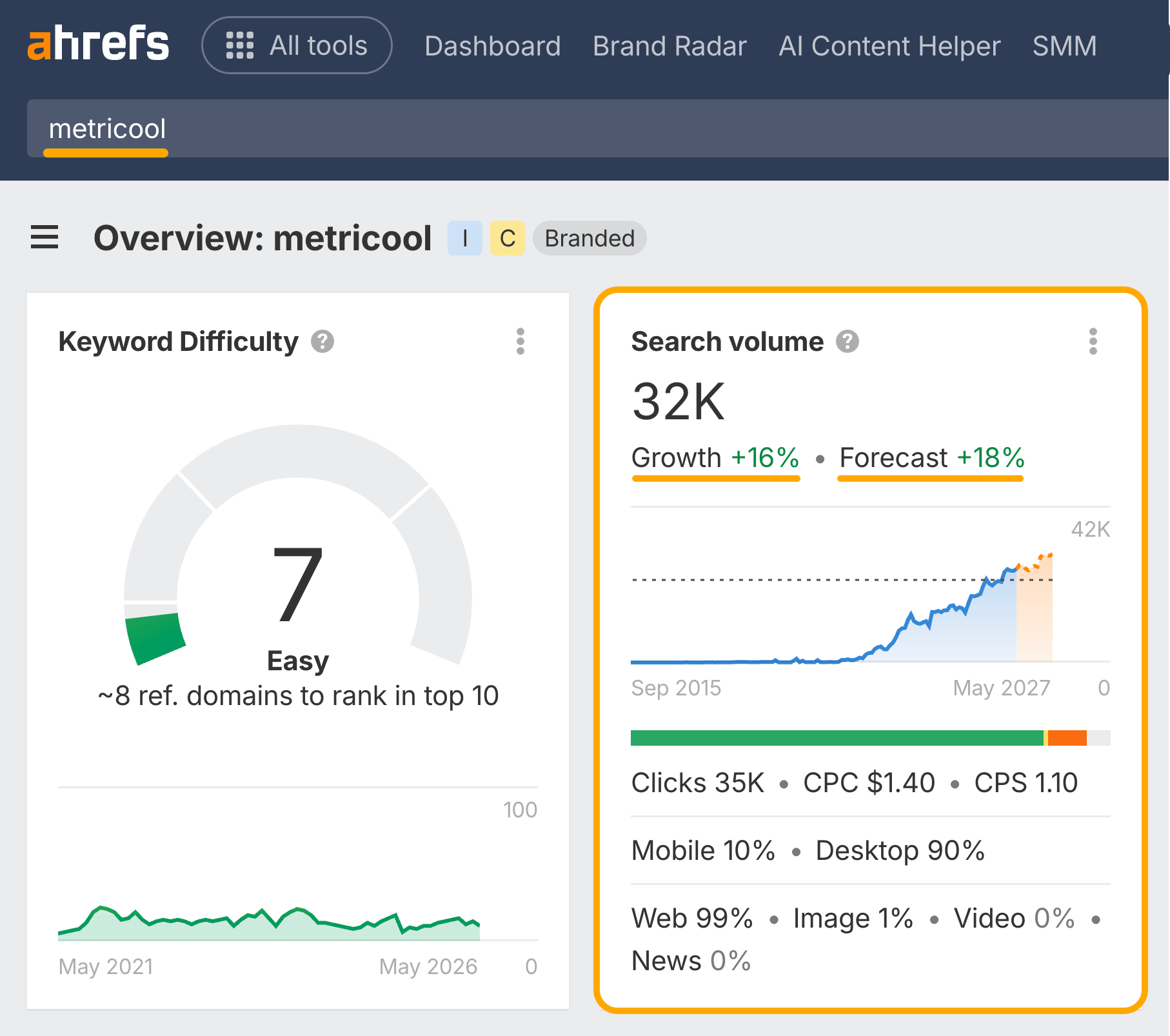
- Open Keywords Explorer, enter a company's brand name as the keyword, and look at the Volume graph. The trend over the last few years is the brand-search growth we ranked on, and the forecast line is Ahrefs' projection.
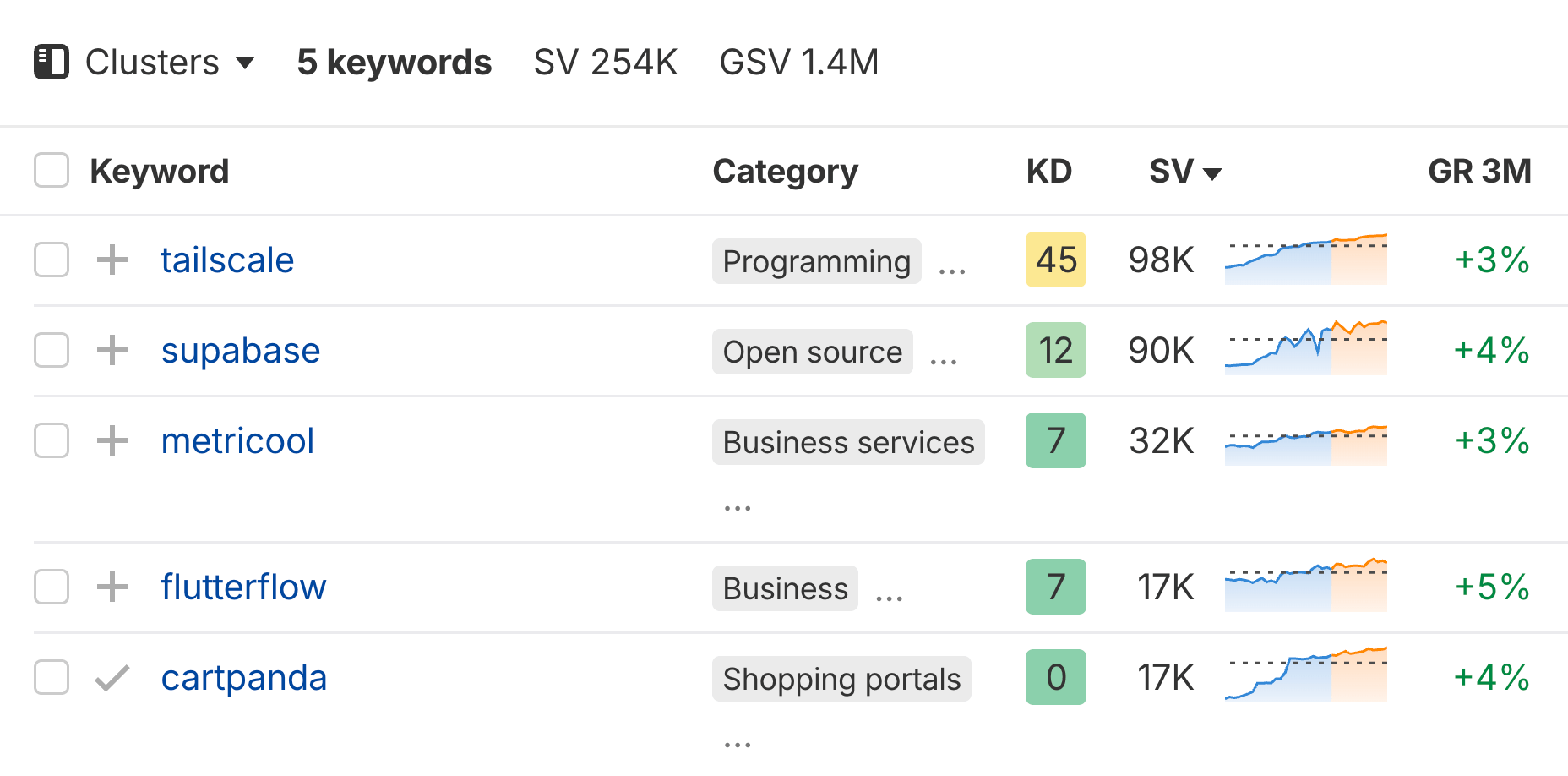
- To compare many companies at once, drop a list of brand names into Keywords Explorer and sort by Volume or by Growth to see which names are climbing fastest.
- Use Site Explorer on each company's domain to pull the Organic traffic, Referring domains, and other figures in the profiles above.
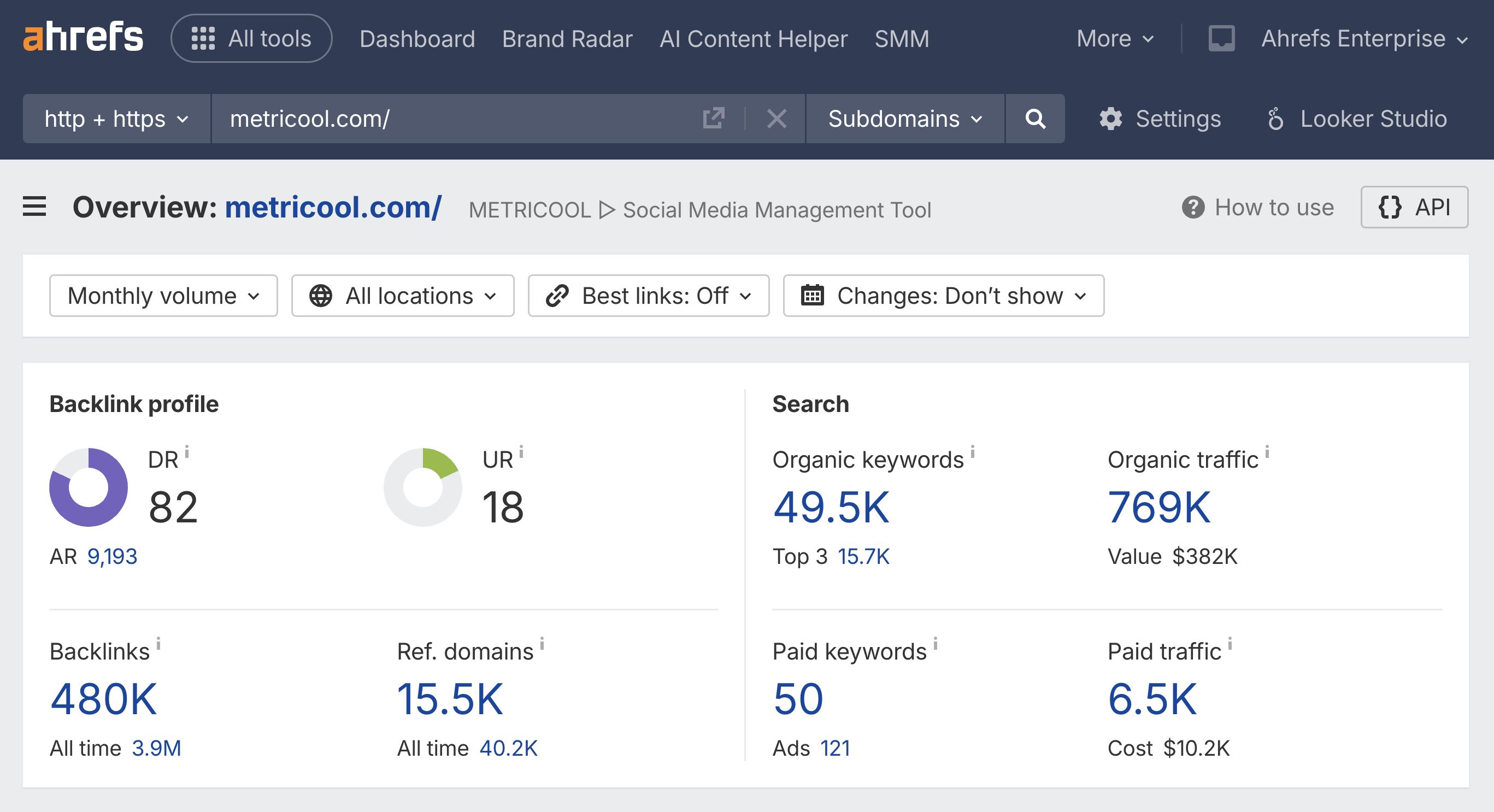
- Or skip the manual work and let Letaido run the whole pull, filtering, and ranking for any niche you choose, the same way it built this list.
Final thoughts
What stands out across this list of fastest growing AI companies is how varied the categories are: voice cloning, AI agents, inference infrastructure, clinical decision support, compliance, video creation, and app builders all appear here, and each is pulling real demand from a different audience.
The fastest growing companies on this list tend to be ones with a specific, tangible use case that's gotten meaningfully better in the last year, whether that's a $52M seed backing Fish Audio's voice marketplace or an AI agent like Genspark taking busywork off people's plates.
If you're trying to track where AI demand is actually forming rather than where the funding announcements are pointing, these brand search trends are worth keeping an eye on month to month.
Louise is a Content Marketer at Ahrefs. Over the past ten years, she has held senior content positions at SaaS brands: Pi Datametrics, BuzzSumo, and Cision. During this time, she has published hundreds of blog posts, spearheaded industry-leading research, and developed expert-led webinar programs.
Louise first learned the ropes of SEO during her time at enterprise SEO company, Pi. Within weeks of joining, she had published a piece on cannibalization that caught the attention of the biggest name in SEO at the time: Rand Fishkin. Since then, she has written on topics ranging from manipulative link building, to content syndication, and search demand forecasting. In her spare time, she has deepened her practical understanding of SEO by building websites for two local businesses.
You can read Louise's words in industry publications like Search Engine Watch, The Drum, The Telegraph, and Spin Sucks.

Keep learning


Your weekly marketing’s must-reads
Join 284K marketers for weekly news, useful reads, industry updates, and the memes you didn’t know you needed.
Explore what’s inside the newsletter →