
The 50 Fastest Growing SaaS Companies (September 2026)

Content Marketer at Ahrefs
- The 25 fastest growing SaaS companies
- 1. Vercel (+170%)
- 2. Manychat (+140%)
- 3. RevenueCat (+140%)
- 4. Renderforest (+120%)
- 5. Airwallex (+120%)
- 6. Hopin (+100%)
- 7. Metricool (+96%)
- 8. Brex (+84%)
- 9. Addepto (+82%)
- 10. ContactOut (+79%)
- 11. Infisical (+71%)
- 12. Vista Social (+68%)
- 13. NinjaOne (+68%)
- 14. CloudTalk (+62%)
- 15. Sumsub (+57%)
- 16. MoEngage (+56%)
- 17. Flagright (+56%)
- 18. Roboflow (+53%)
- 19. accessiBe (+53%)
- 20. AppTweak (+51%)
- 21. Adalo (+49%)
- 22. IPQS (+48%)
- 23. MailerLite (+45%)
- 24. Lattice (+40%)
- 25. Databricks (+39%)
- The full list: fastest-growing SaaS companies by brand search
- How to find this data in Ahrefs
- Final thoughts
We analyzed around 2,500 SaaS companies to find the fastest growing SaaS companies by one measure that's hard to fake: how many people are searching for them by name.
Venture money is pouring back into software, but it's piling up in a handful of names: a record $510 billion flowed into startups in the first half of 2026, and 43% of it went to just two AI labs, OpenAI and Anthropic.
For everyone else, you can't out-spend that kind of concentration. What you can do is build a product people come looking for by name.
So the question we set out to answer is: which software companies, across every category from dev tools to fintech to creative software to security, are actually growing demand right now?
This list was built with Letaido
This article was researched and built by Letaido, Ahrefs' AI marketing platform. Letaido pulls live Ahrefs data, runs its own analysis, and assembles findings like the ranking below, so the numbers you're about to read come straight from the same data set our tools run on.
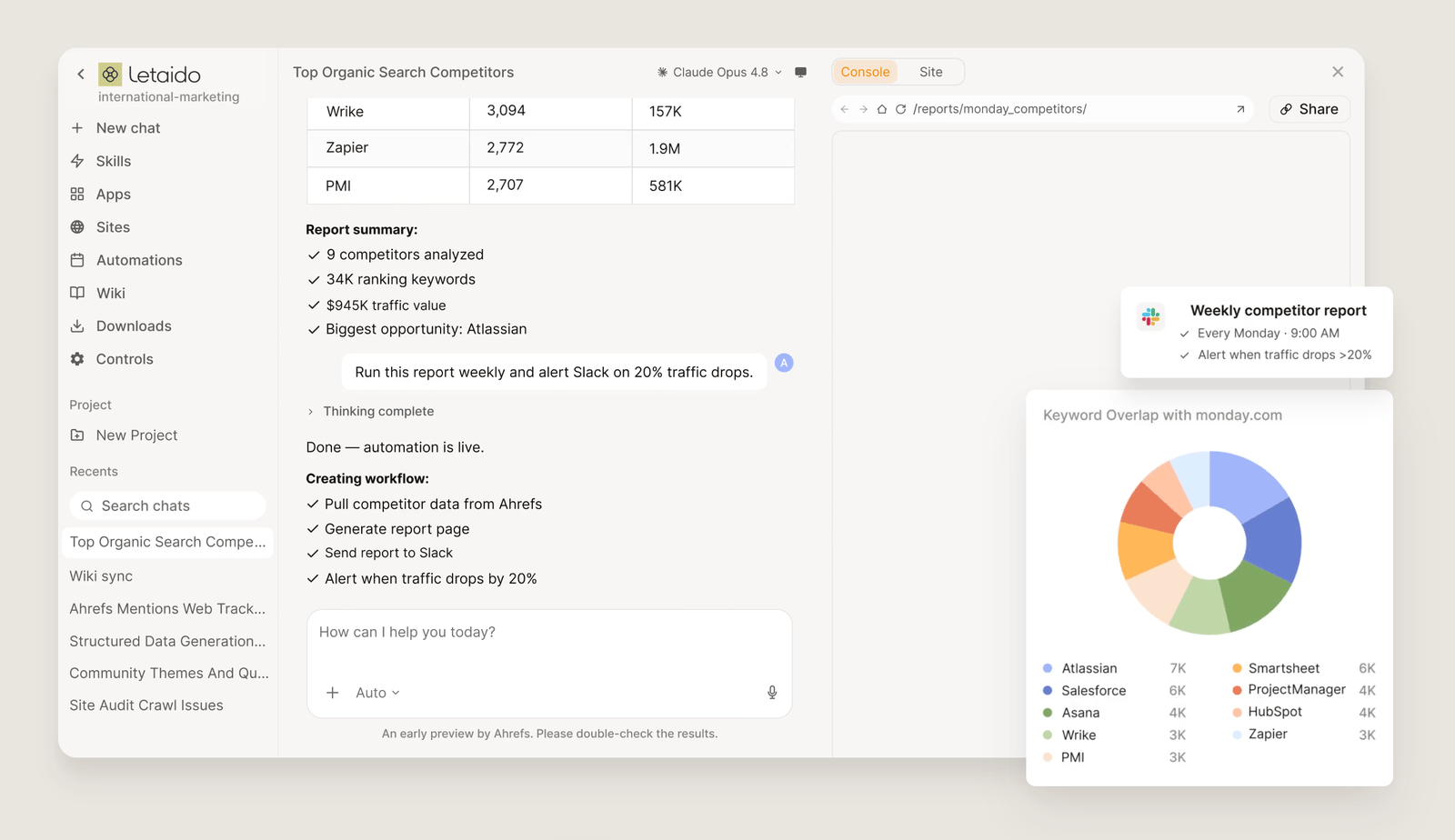
You can recreate this kind of research for your specific niche or vertical using Letaido.
Sidenote
We rank these companies by how much their brand-name search demand grew this year versus last: we compare the average monthly searches for each company name over the last 12 months against the 12 months before that. That comparison is the cleanest signal of fresh, unprompted demand, and because it rolls forward every month it surfaces companies breaking out right now rather than ones that grew years ago. All data is from Ahrefs.
The 25 fastest growing SaaS companies
Here are the 25 software companies whose brand-name search demand has grown the fastest, ordered from highest growth to lowest, with the numbers, a chart, and a short read on what's driving each one.
1. Vercel (+170%)
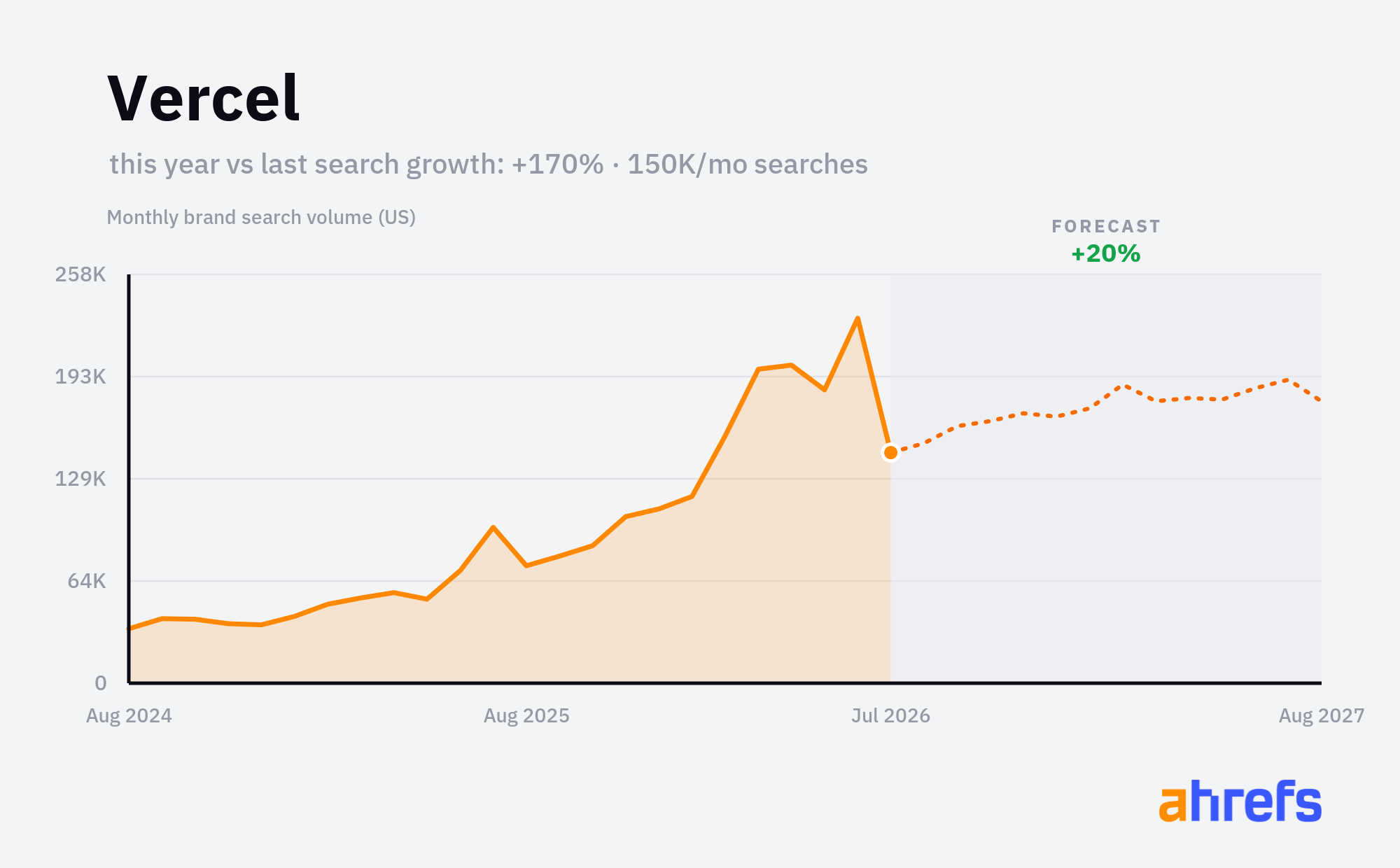
- Brand search growth (this year vs last): +170%
- Search growth forecast (next 12 months): +20%
- Brand search volume (monthly): 150K
- Organic traffic (monthly): 1.1M
- Year founded: 2015
- Location: San Francisco, California
What they do
Vercel is a cloud platform for frontend developers, used by teams at companies like Under Armour, Nintendo, The Washington Post, and Zapier to deploy and scale web applications built on frameworks like Next.js.
Vercel is the fastest growing company on the whole list, and +170% is the kind of number that raises eyebrows even in a strong year for developer tools. Some of that is the Next.js ecosystem pulling in more teams, some of it is Vercel's push into AI-native web infrastructure, but the core story is a platform that developers are actively recommending to each other rather than just encountering through ads.
2. Manychat (+140%)
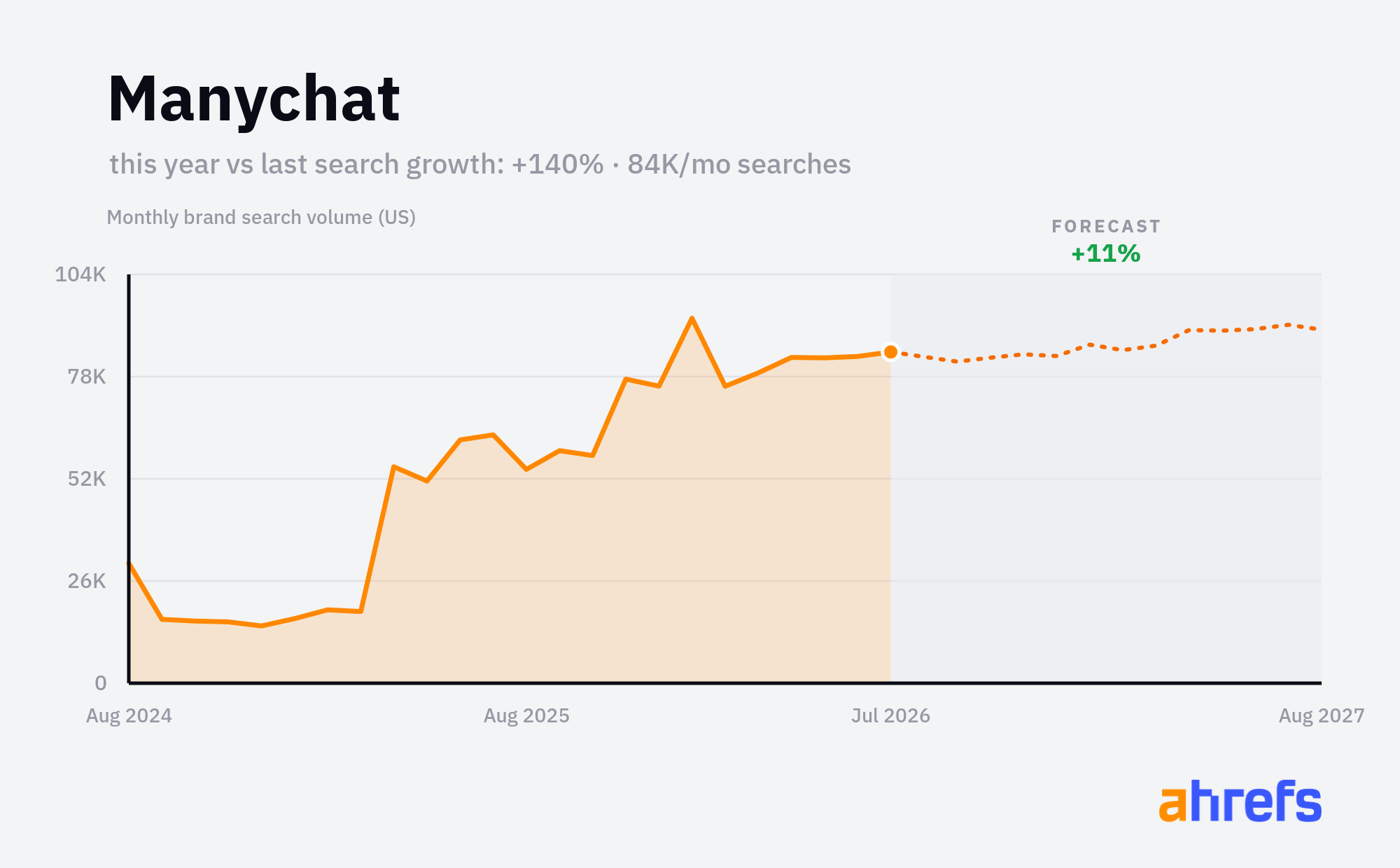
- Brand search growth (this year vs last): +140%
- Search growth forecast (next 12 months): +11%
- Brand search volume (monthly): 84K
- Organic traffic (monthly): 750K
- Year founded: 2016
- Location: Austin, TX
What they do
Manychat is a chat marketing platform that lets businesses automate conversations on Instagram, WhatsApp, Facebook Messenger, and Telegram, used by over a million brands across 170 countries.
In April 2025, Manychat raised a $140 million Series B led by Summit Partners, bringing total disclosed funding to $163 million.
Messaging-based marketing has been building momentum for a few years, but the combination of Instagram DM automation becoming mainstream and a wave of small creators discovering they can run entire sales flows from a single conversation has pushed Manychat's search demand to ~80K monthly searches, up +140% on the year before. When the channel itself grows, the tooling for it tends to grow faster.
3. RevenueCat (+140%)
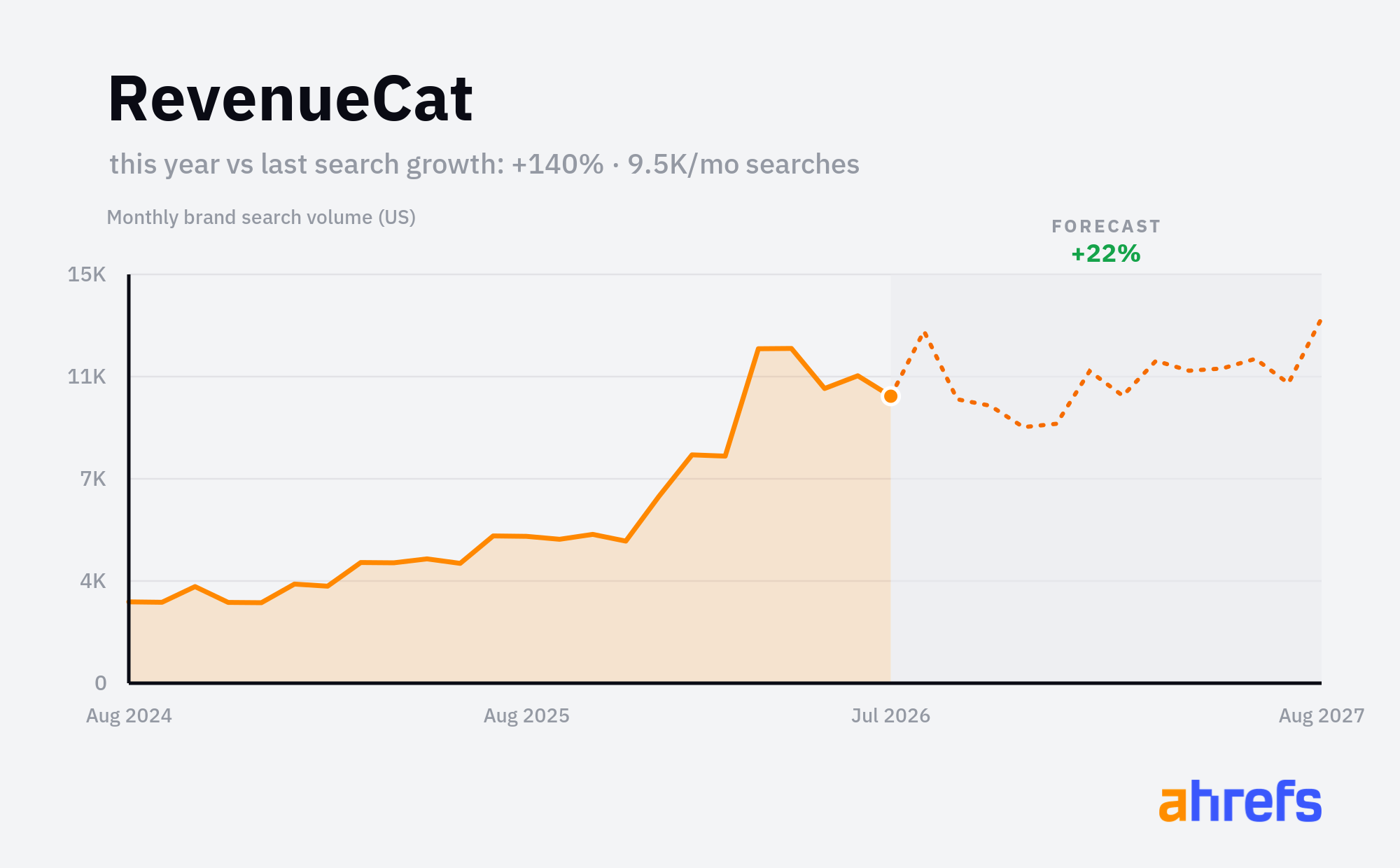
- Brand search growth (this year vs last): +140%
- Search growth forecast (next 12 months): +22%
- Brand search volume (monthly): 9.5K
- Organic traffic (monthly): 64.5K
- Year founded: 2017
- Location: San Francisco, California
What they do
RevenueCat is a subscription management and analytics platform for mobile app developers, handling in-app purchase infrastructure across iOS, Android, and the web so teams can track and grow subscription revenue without building the plumbing themselves.
The subscription app economy has matured to the point where developers are no longer willing to roll their own billing logic, and RevenueCat has become the default choice for that infrastructure layer. The +140% search growth reflects a growing cohort of indie developers and funded app teams alike searching for a reliable way to handle monetization, a category that quietly becomes more valuable every time a new app goes subscription-first.
4. Renderforest (+120%)
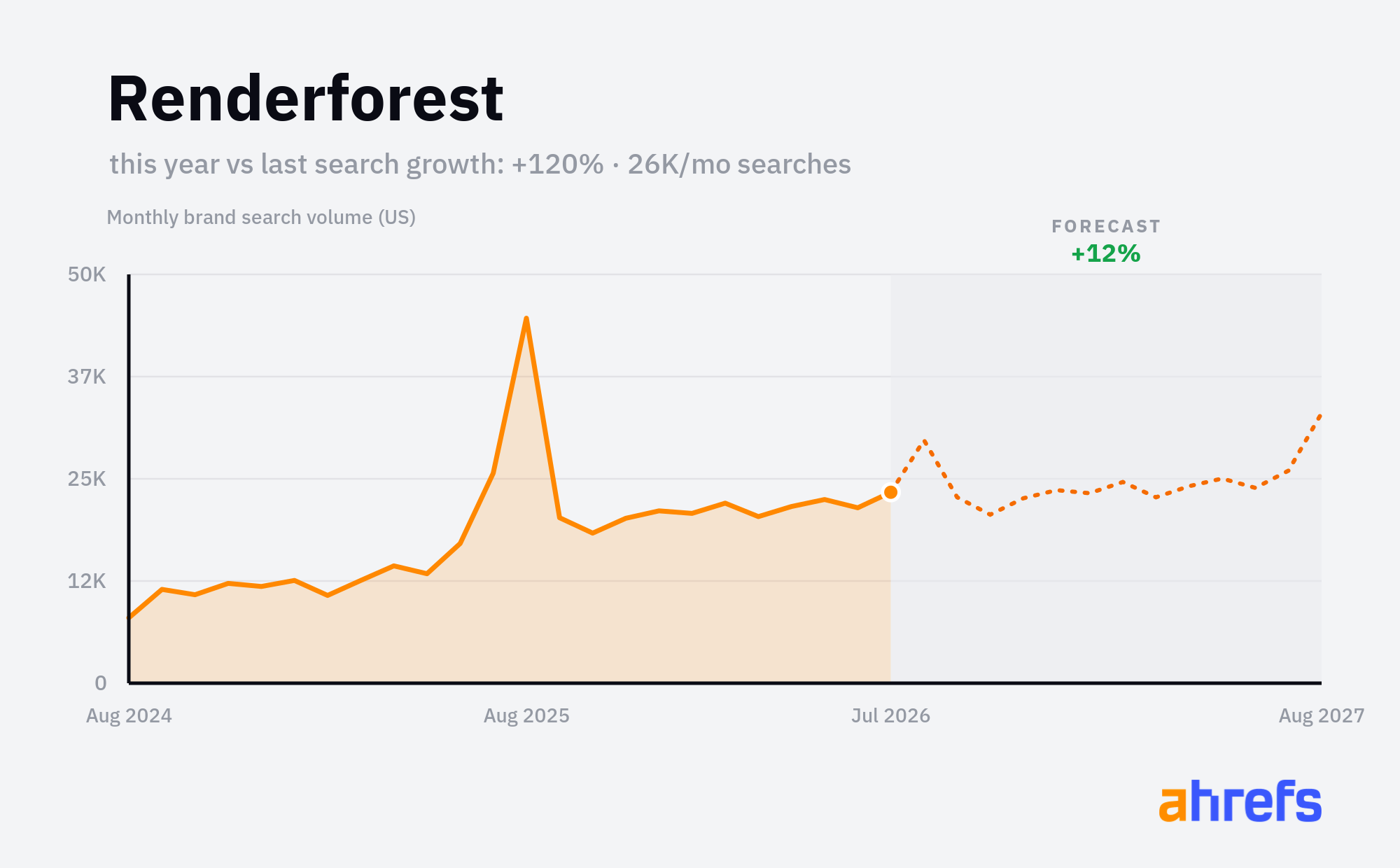
- Brand search growth (this year vs last): +120%
- Search growth forecast (next 12 months): +12%
- Brand search volume (monthly): 26K
- Organic traffic (monthly): 1.2M
- Year founded: 2013
- Location: Yerevan, Yerevan
What they do
Renderforest is an online branding and creative platform based in Armenia, used by individuals and small businesses to produce videos, logos, graphic designs, mockups, and websites through template-driven tools that don't require design experience.
Renderforest is one of the highest-traffic sites on the list, pulling over 1.2M organic visits a month, and its +120% brand search growth suggests a lot of new users are finding it and then coming back by name. The creative tools market has gotten crowded, but there's clearly an audience for a platform positioned below the complexity of professional design software and above the limitations of simple drag-and-drop builders.
5. Airwallex (+120%)
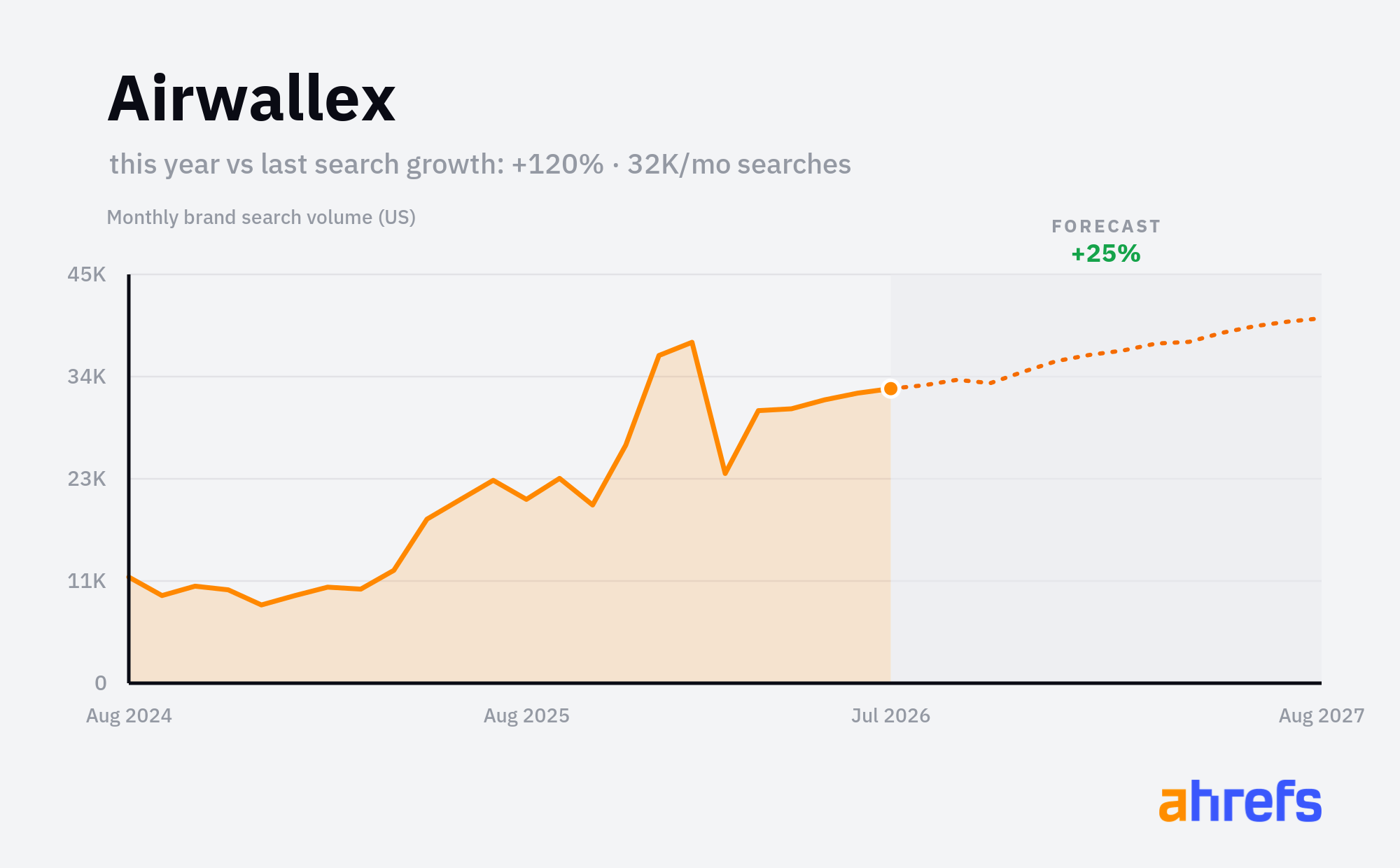
- Brand search growth (this year vs last): +120%
- Search growth forecast (next 12 months): +25%
- Brand search volume (monthly): 32K
- Organic traffic (monthly): 350K
- Year founded: 2015
- Location: Singapore, Singapore
What they do
Airwallex is a global financial platform used by businesses to manage cross-border payments, foreign exchange, and multi-currency accounts, with a suite of card, banking, and payment API products aimed at companies operating across multiple markets.
In June 2026, Airwallex closed a $320 million Series H led by Addition, with Baillie Gifford, QED Investors, T. Rowe Price, and others participating, bringing total funding to $1.8 billion at an $11 billion valuation.
The global payments space is enormous, but Airwallex has carved out a real position among mid-market companies that need proper multi-currency infrastructure rather than a bolted-on solution. The +120% brand search growth tracks with its geographic expansion, including a push into South Korea after acquiring Paynuri earlier this year, bringing more businesses into its orbit across new markets.
6. Hopin (+100%)
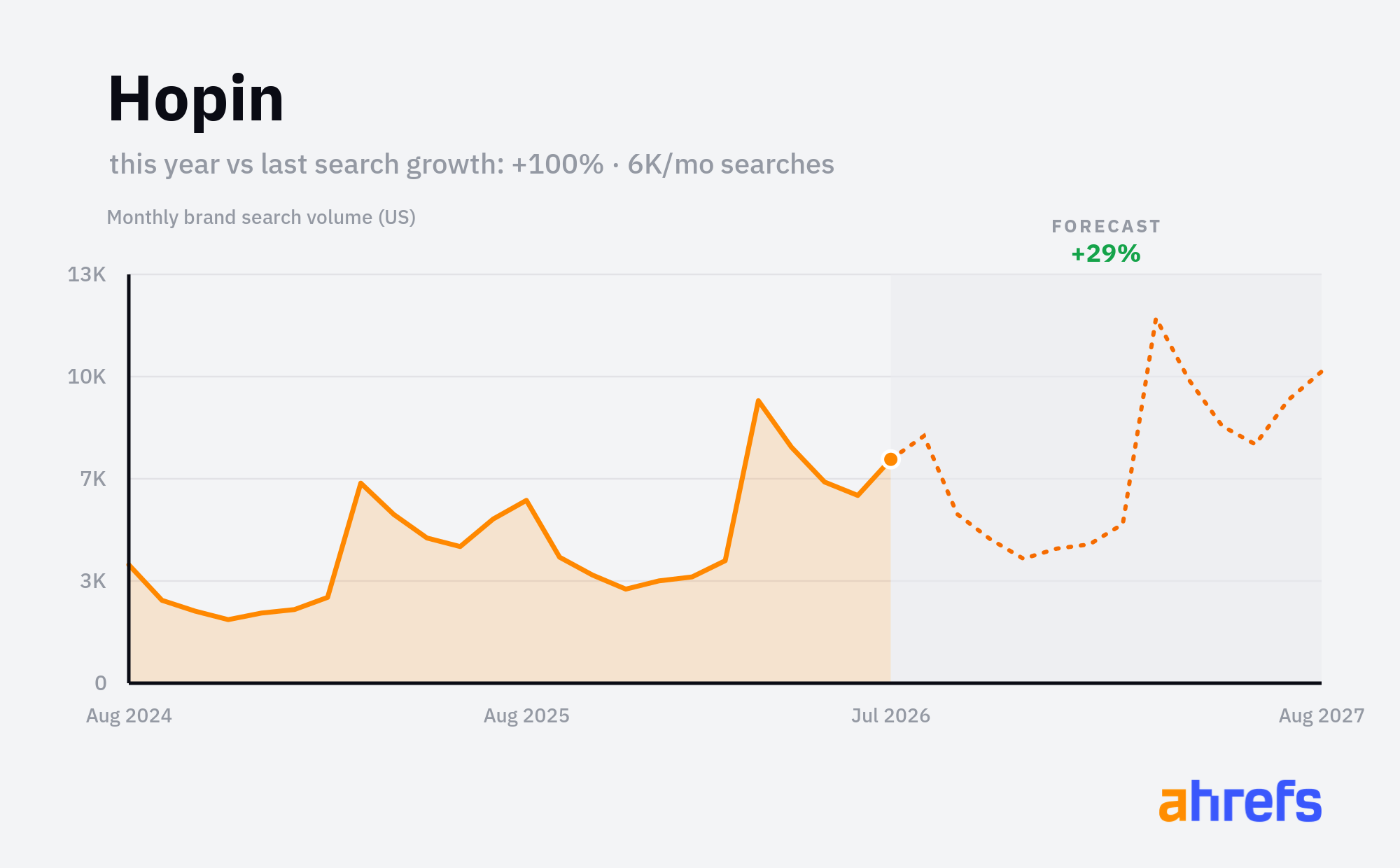
- Brand search growth (this year vs last): +100%
- Search growth forecast (next 12 months): +29%
- Brand search volume (monthly): 6K
- Organic traffic (monthly): 4.5K
- Year founded: 2019
- Location: London
What they do
Hopin is an events and streaming technology company whose product portfolio includes StreamYard, Session, and Streamable, used by businesses and creators to host live events, produce video streams, and share video content online.
Hopin had a famously turbulent post-pandemic trajectory, losing most of its valuation as in-person events returned, but its reorientation around streaming products like StreamYard has given the brand a second wind. It's one of the lower-traffic sites here, but the +100% search growth and a +29% forecast suggest that the pivot to creator-friendly streaming tools is genuinely pulling new audiences in.
7. Metricool (+96%)
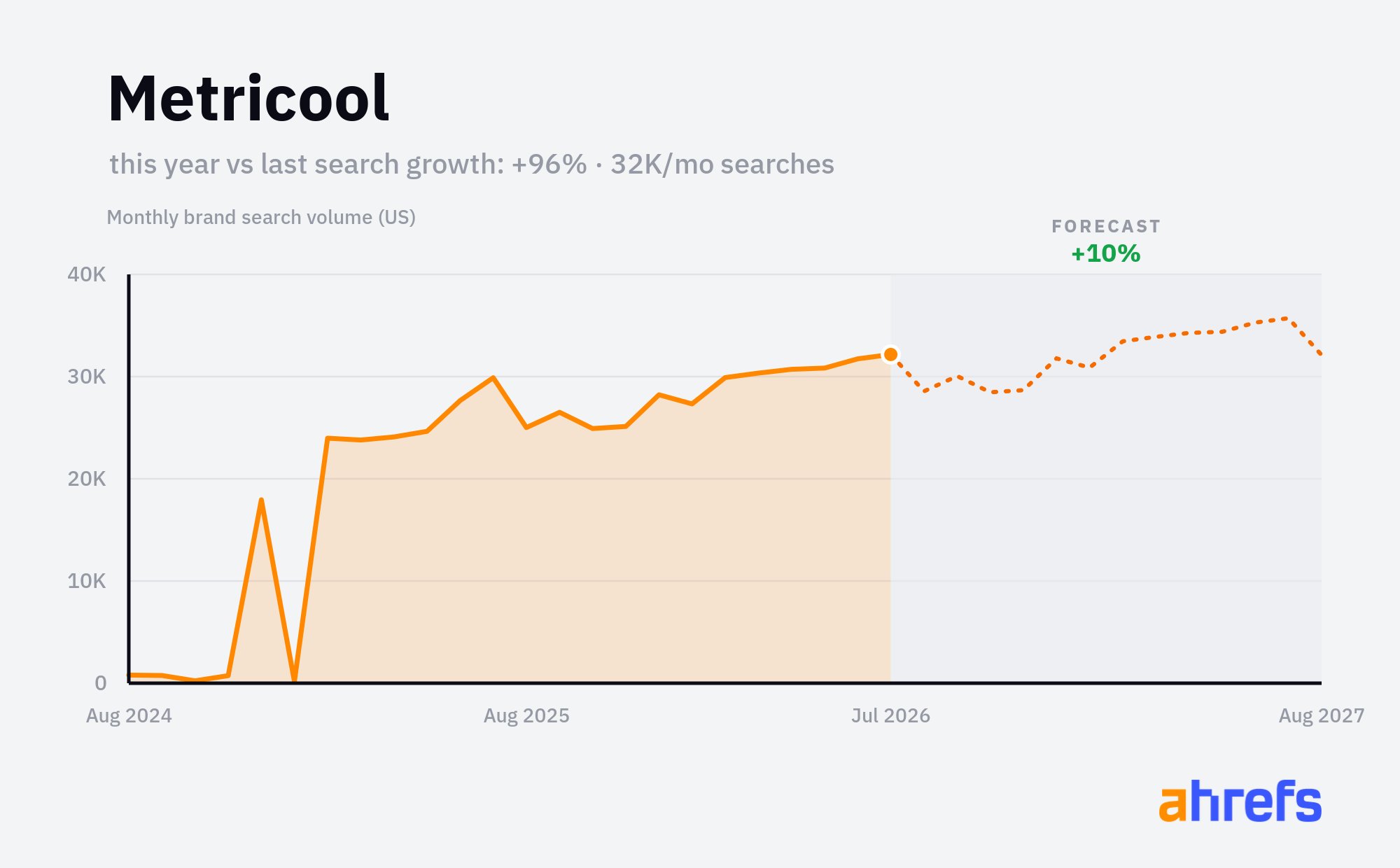
- Brand search growth (this year vs last): +96%
- Search growth forecast (next 12 months): +10%
- Brand search volume (monthly): 32K
- Organic traffic (monthly): 600K
- Year founded: 2015
- Location: Madrid, Spain
What they do
Metricool is a social media management and analytics platform used by freelancers, agencies, and brands to plan, schedule, and analyze content across multiple channels, including paid ad performance tracking.
In October 2022, Metricool raised around €5 million in a Series A led by Axon Partners Group.
Spanish-founded and still headquartered in Madrid, Metricool has quietly built an audience of over a million users without the marketing budgets its larger US-based competitors operate with. The +96% brand search growth is a sign of word-of-mouth working overtime, particularly among agencies and creators who discover it through a peer recommendation and then start searching for it by name.
8. Brex (+84%)
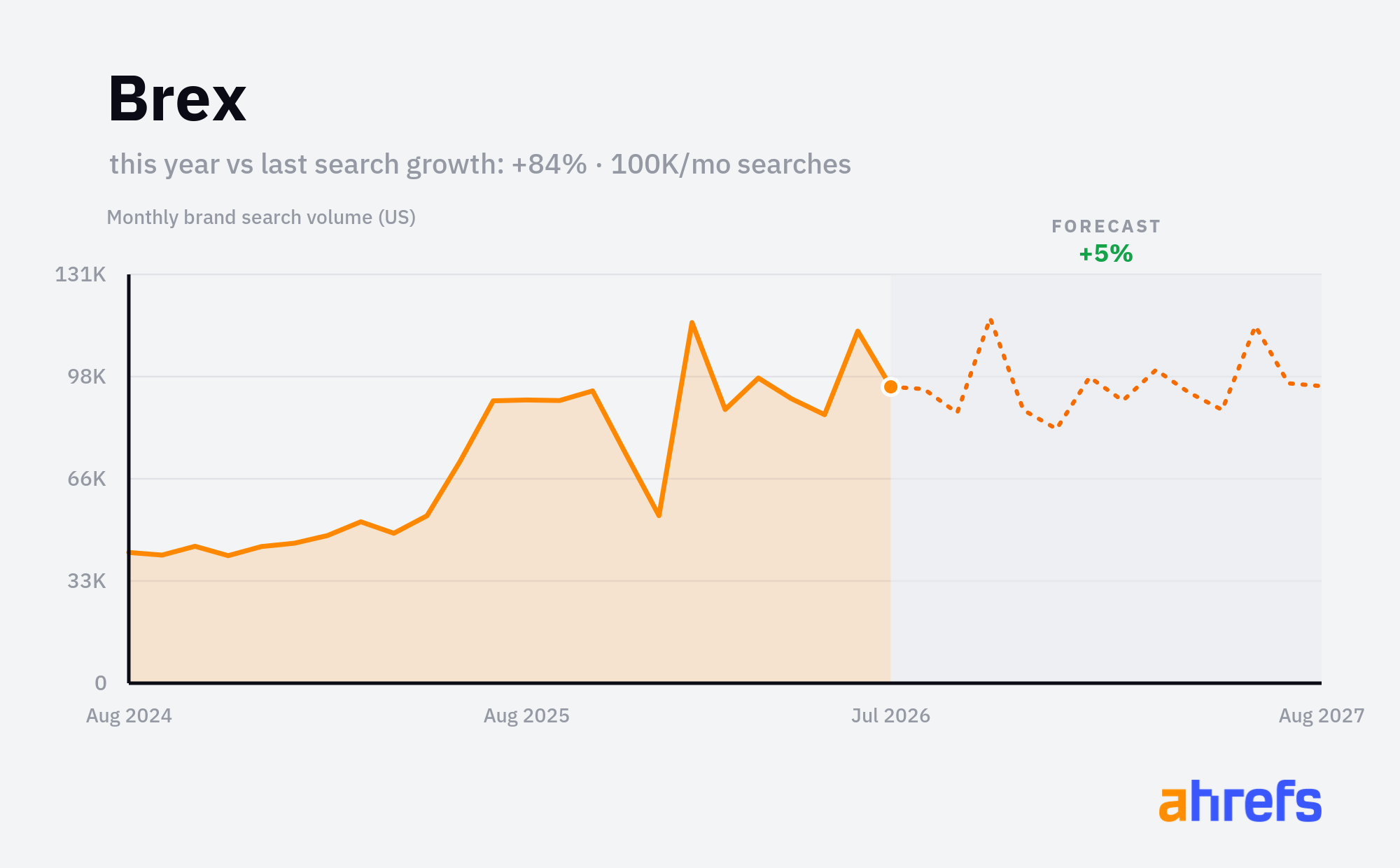
- Brand search growth (this year vs last): +84%
- Search growth forecast (next 12 months): +5%
- Brand search volume (monthly): 100K
- Organic traffic (monthly): 300K
- Year founded: 2017
- Location: San Francisco, USA
What they do
Brex is a corporate card and spend management platform built for startups and growing businesses, offering credit cards, expense tracking, and financial software in a single product aimed at companies that move fast and need real-time visibility into their spending.
Brex raised a $425 million Series D led by Tiger Global. In January 2026, Capital One announced it would acquire Brex in a deal reportedly worth $5.15 billion, per Reuters.
The Capital One acquisition announcement in January generated a wave of attention that almost certainly contributed to the brand search spike, as founders, CFOs, and fintech watchers all looked up what was happening. Whether that translates into sustained demand for the Brex product under new ownership is a different question, but the ~100K monthly searches tell you the brand is firmly on the radar.
9. Addepto (+82%)
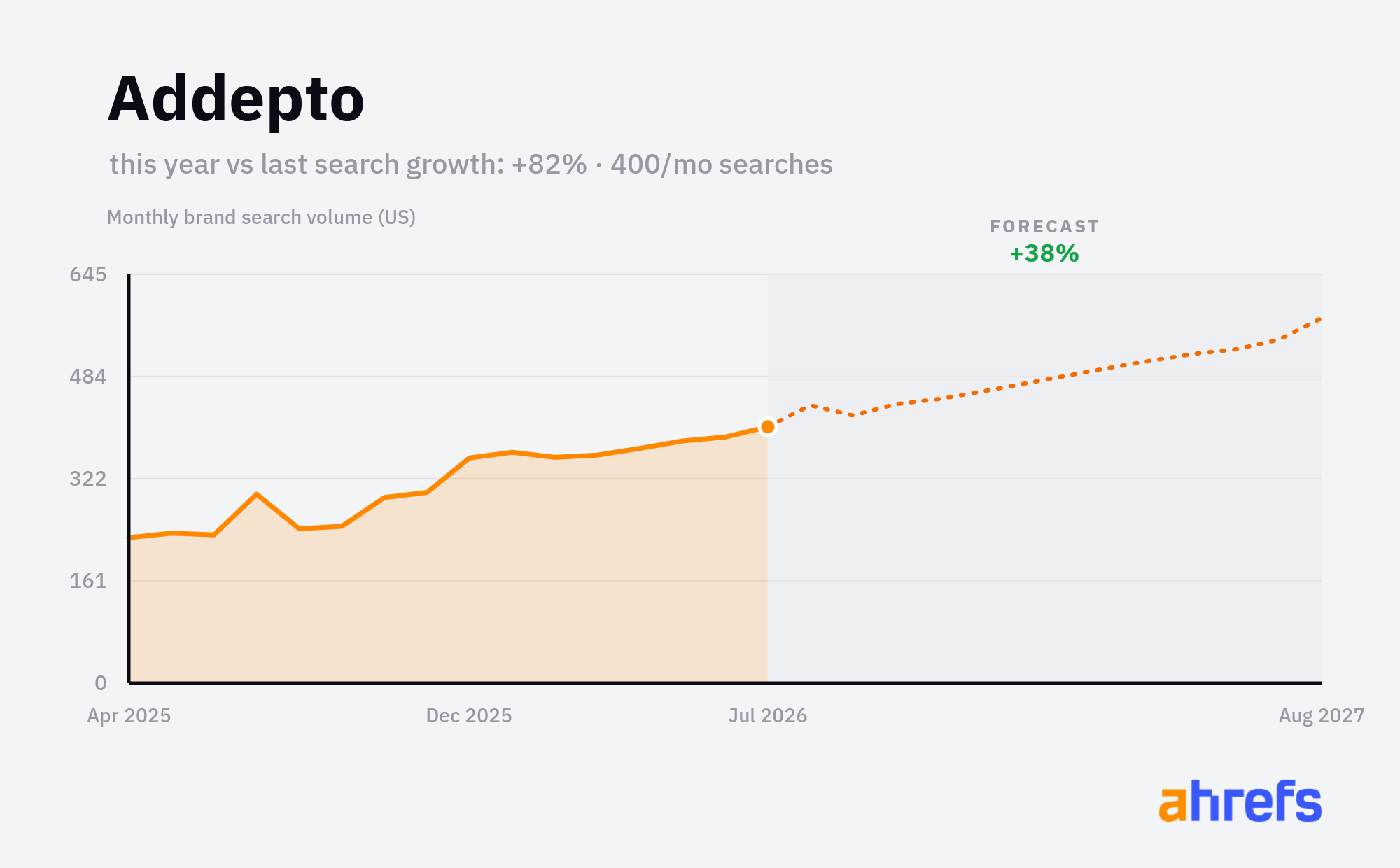
- Brand search growth (this year vs last): +82%
- Search growth forecast (next 12 months): +38%
- Brand search volume (monthly): 400
- Organic traffic (monthly): 5K
- Year founded: 2018
- Location: Warsaw, Mazowieckie
What they do
Addepto is a Warsaw-based AI and data consulting firm that works with large enterprises on projects spanning AI strategy, generative AI implementation, data engineering, and MLOps.
Addepto is one of the smallest brands on the list by monthly search volume, sitting at around 400 searches a month, which makes the +82% growth rate worth reading carefully: this is a consulting firm in a category, enterprise AI services, where client budgets have opened up considerably over the last couple of years, and the demand signal is growing from a very small base. The +38% forward forecast is the most interesting number here.
10. ContactOut (+79%)
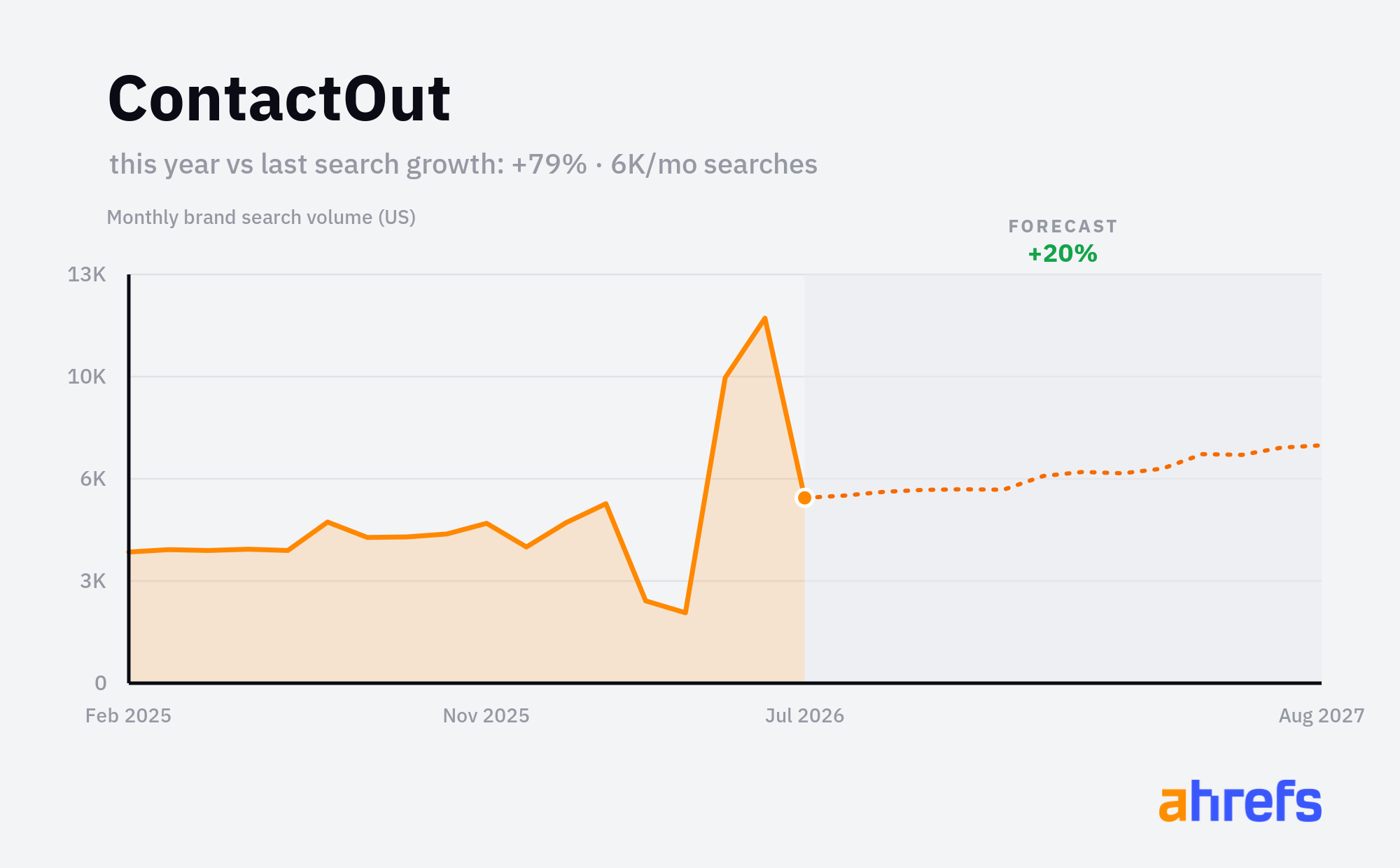
- Brand search growth (this year vs last): +79%
- Search growth forecast (next 12 months): +20%
- Brand search volume (monthly): 6K
- Organic traffic (monthly): 150K
- Year founded: 2015
- Location: San Francisco
What they do
ContactOut is a contact data intelligence platform used by sales, marketing, and recruitment teams to find verified email addresses and phone numbers for professionals, with a Chrome extension that surfaces data directly within LinkedIn.
ContactOut raised a seed round in December 2015, and participated in the 500 Accelerator and Startmate programs, per PitchBook and Tracxn. Beyond early-stage funding, no further disclosed rounds are on record.
B2B prospecting and sales intelligence is a crowded space, but ContactOut has built a strong position by being tightly integrated into recruiter and sales workflows via LinkedIn. The +79% brand search growth and ~150K monthly organic visitors suggest the platform is getting more word-of-mouth than its funding profile would lead you to expect, a useful sign that the product itself is doing the work.
11. Infisical (+71%)
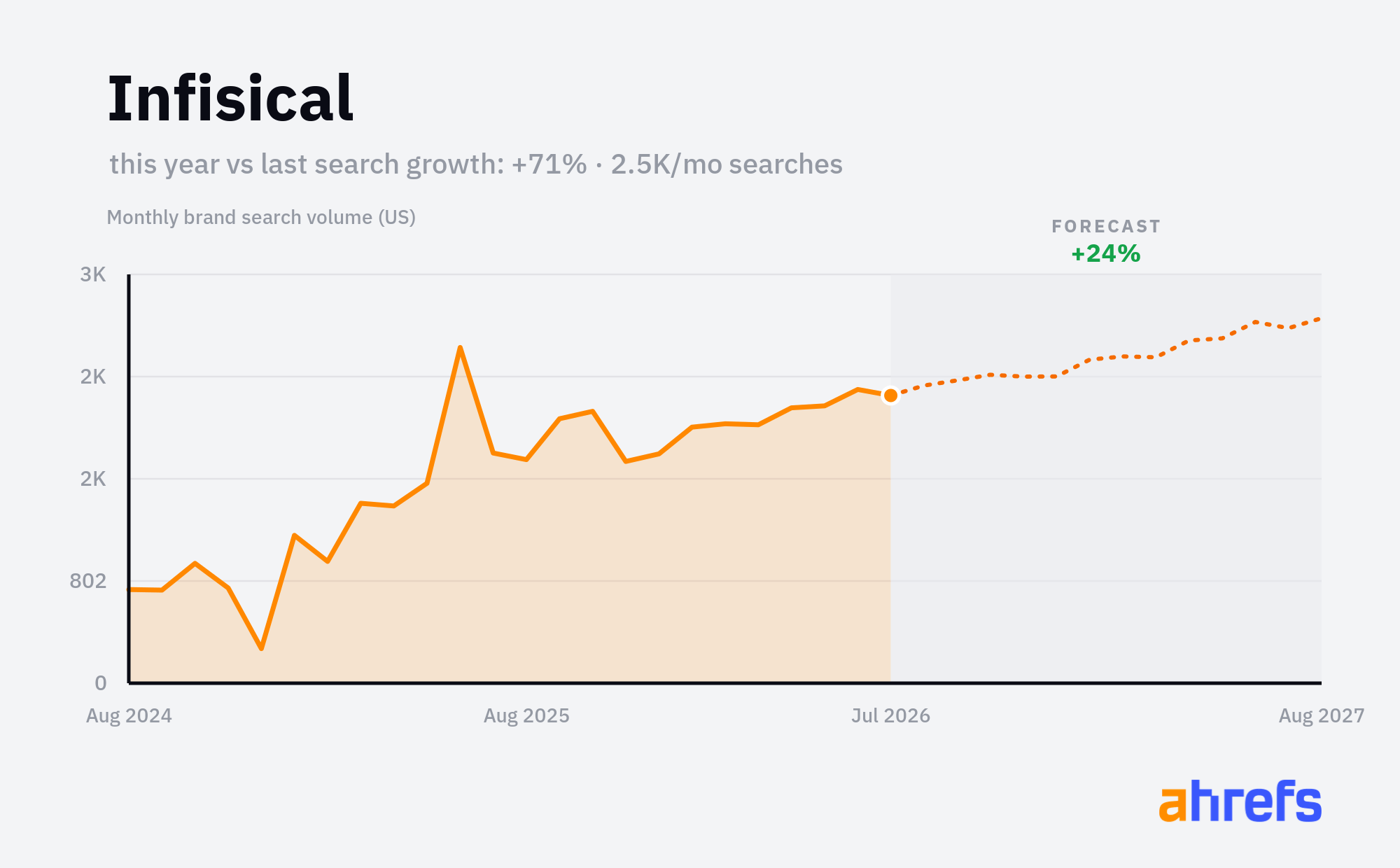
- Brand search growth (this year vs last): +71%
- Search growth forecast (next 12 months): +24%
- Brand search volume (monthly): 2.5K
- Organic traffic (monthly): 12.5K
- Year founded: 2022
- Location: San Francisco
What they do
Infisical is an open-source secrets management platform used by developer teams to store, sync, and control access to environment variables and API keys across their infrastructure.
In June 2025, Infisical raised a $16 million Series A led by Elad Gil, with Y Combinator, Gradient Ventures (Google's AI fund), and founders of Datadog and Samsara among the participants.
Founded in 2022, Infisical is one of the youngest companies on the list, and it's building its audience in a category, secrets management, that most developers know they need to handle properly but historically avoided setting up correctly. The open-source model has clearly helped: developers discover it through GitHub, build with it, and then search for it by name when recommending it to others, which is exactly the kind of organic loop that sustains a +71% growth rate at this stage.
12. Vista Social (+68%)
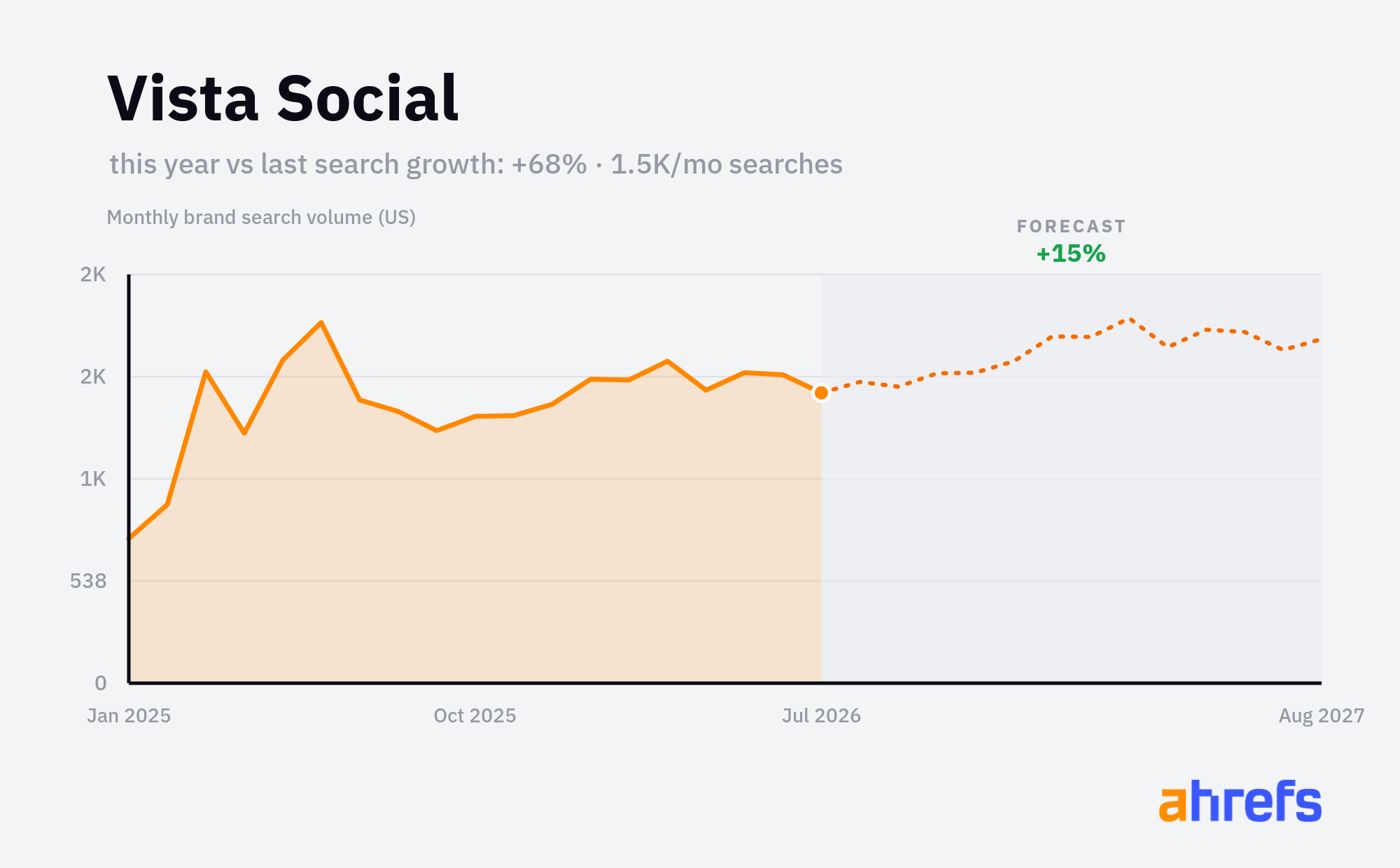
- Brand search growth (this year vs last): +68%
- Search growth forecast (next 12 months): +15%
- Brand search volume (monthly): 1.5K
- Organic traffic (monthly): 17K
- Year founded: 2022
- Location: New York, New York
What they do
Vista Social is a social media management platform used by brands, agencies, and freelancers to schedule content, manage engagement, and run analytics across multiple social channels from a single dashboard.
Vista Social is one of the youngest companies on the list, founded in 2022, which makes a +68% brand search growth rate in this window genuinely impressive for a tool competing in a market with well-resourced incumbents. The fact that it's growing on search without disclosed outside funding suggests the product itself is earning referrals, likely from agency users looking for a credible alternative at a friendlier price point.
13. NinjaOne (+68%)
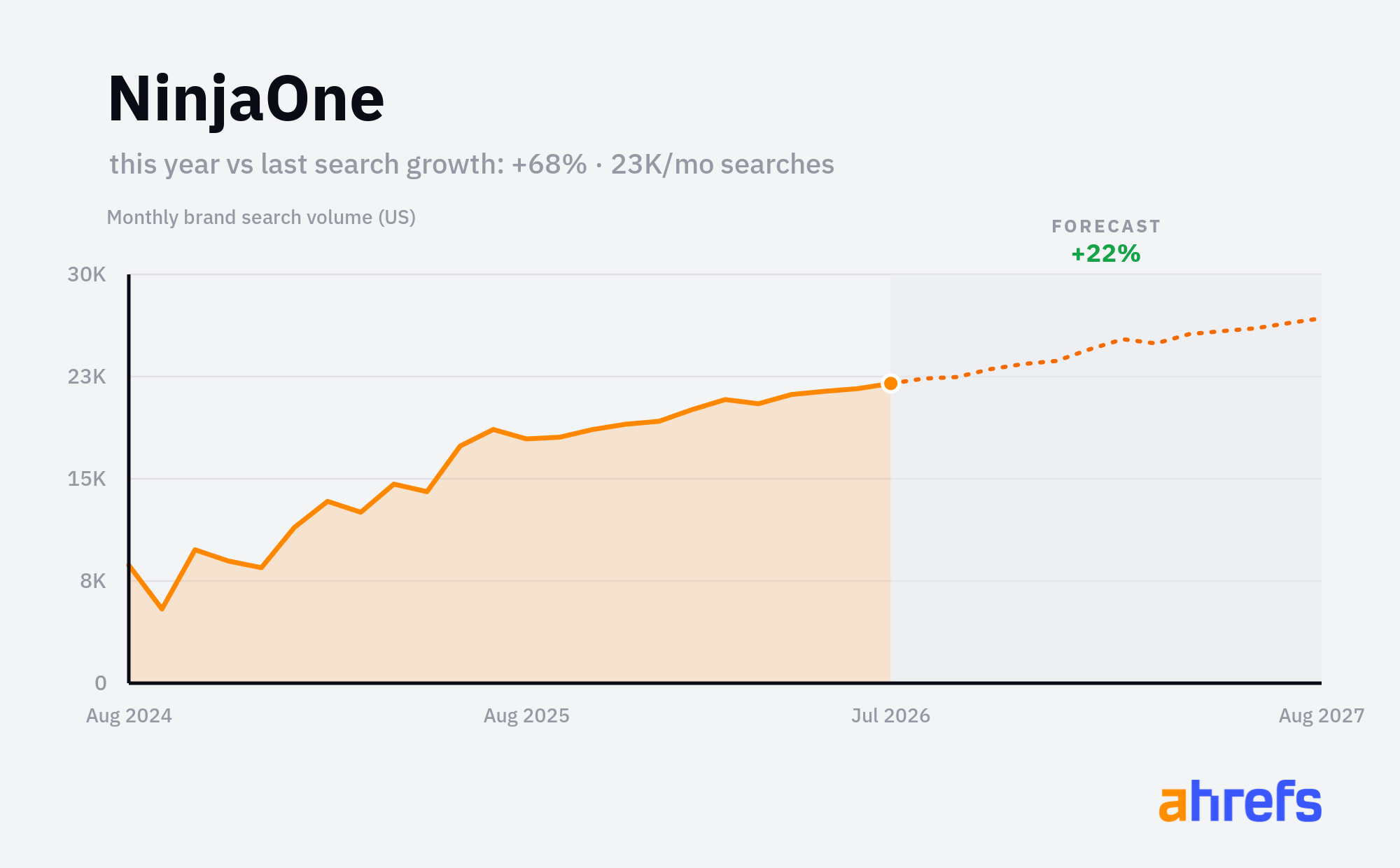
- Brand search growth (this year vs last): +68%
- Search growth forecast (next 12 months): +22%
- Brand search volume (monthly): 23K
- Organic traffic (monthly): 250K
- Year founded: 2013
- Location: Austin, Texas
What they do
NinjaOne is an IT management platform used by over 17,000 IT teams and managed service providers to monitor, patch, and manage endpoints across their organizations.
In February 2025, NinjaOne raised a $500 million Series C extension led by ICONIQ Growth and CapitalG, doubling the company's valuation.
IT endpoint management is a market where most buying decisions start with a Google search and a comparison shortlist, so brand search is a meaningful proxy for pipeline. NinjaOne's +68% growth, against a base of ~20K monthly searches and nearly 240K monthly organic visitors, points to a product that's winning the word-of-mouth battle in the MSP and IT admin community, a group that takes recommendations seriously and switches vendors slowly.
14. CloudTalk (+62%)
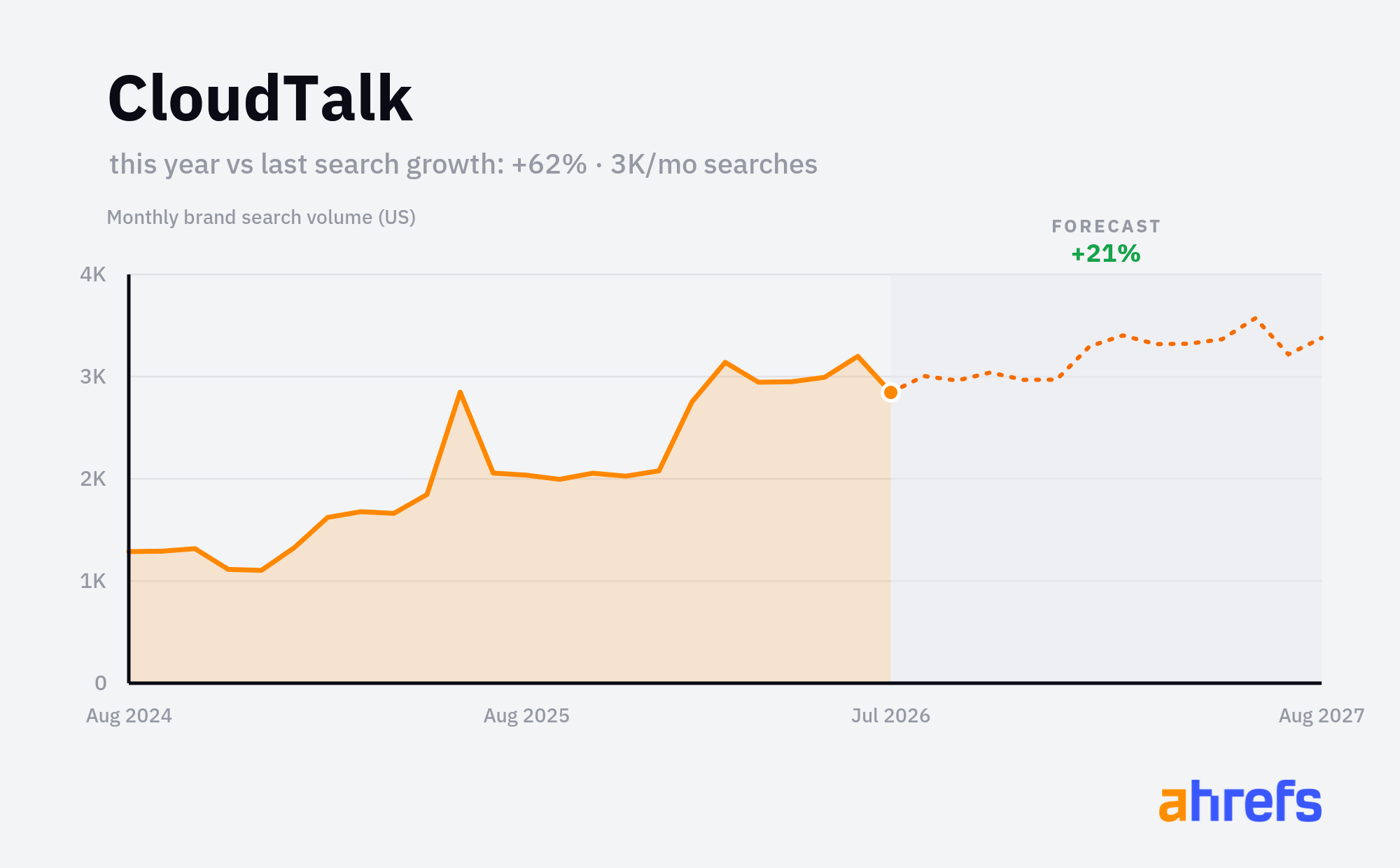
- Brand search growth (this year vs last): +62%
- Search growth forecast (next 12 months): +21%
- Brand search volume (monthly): 3K
- Organic traffic (monthly): 66K
- Year founded: 2016
- Location: New York City, New York
What they do
CloudTalk is a cloud-based business calling platform used by sales and customer support teams to manage calls, run AI-powered analytics, and integrate phone communications with their existing CRM and helpdesk tools.
The business calling software category has been reshaped by AI features, and CloudTalk has moved quickly to position its platform around AI-powered call analytics and automated workflows rather than just reliable dial-out. That product direction, combined with a more accessible price point for smaller sales teams, appears to be pulling in a growing cohort of buyers who are searching for it by name after seeing it recommended in sales communities.
15. Sumsub (+57%)
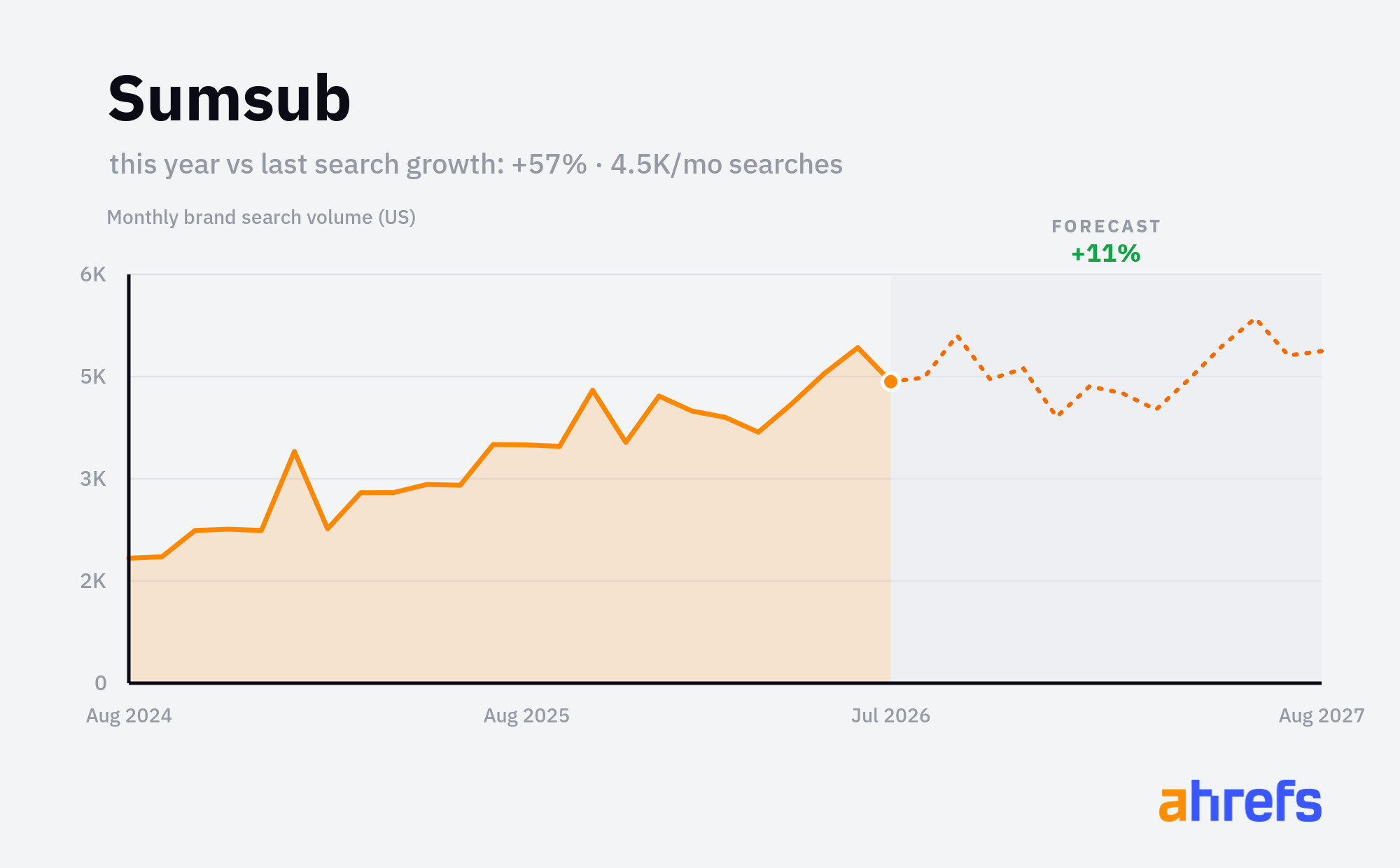
- Brand search growth (this year vs last): +57%
- Search growth forecast (next 12 months): +11%
- Brand search volume (monthly): 4.5K
- Organic traffic (monthly): 90K
- Year founded: 2015
- Location: Limassol
What they do
Sumsub is an identity verification and compliance platform used by businesses in fintech, crypto, gaming, and e-commerce to handle KYC, KYB, transaction monitoring, and fraud prevention within a single workflow.
Sumsub raised $6 million in a Series A led by MetaQuotes, and subsequently raised a $30 million Series B in December 2022, per PitchBook.
Regulatory pressure on digital financial services has been building for years, and every new fintech, crypto exchange, or online gaming platform that launches needs to solve identity verification before it can operate. Sumsub's +57% brand search growth reflects a market that keeps producing new buyers, as compliance requirements in more jurisdictions pull more companies into the KYC process for the first time.
16. MoEngage (+56%)
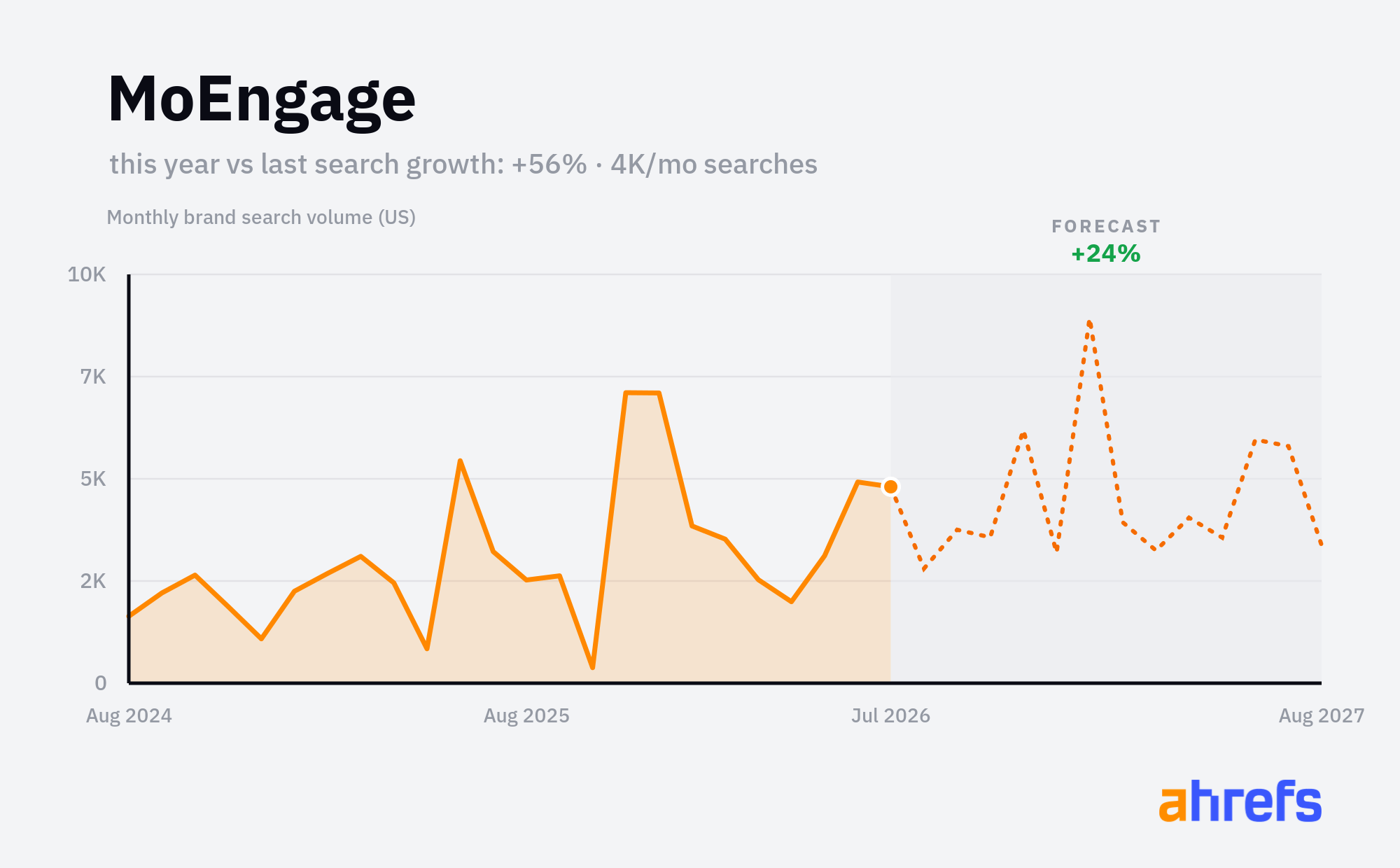
- Brand search growth (this year vs last): +56%
- Search growth forecast (next 12 months): +24%
- Brand search volume (monthly): 4K
- Organic traffic (monthly): 46.5K
- Year founded: 2014
- Location: San Francisco, California
What they do
MoEngage is a customer engagement platform used by mobile-first brands and large enterprises to run personalized marketing across push notifications, email, SMS, and in-app messaging, with analytics and journey orchestration built in.
MoEngage has been particularly strong in markets where mobile-first apps dominate consumer behavior, including South and Southeast Asia, and the combination of a larger global push and a well-timed bet on AI-driven campaign orchestration appears to be bringing new buyers to the platform. The +56% brand search growth is a decent signal that more marketing teams are actively evaluating it rather than just seeing it in a vendor grid.
17. Flagright (+56%)
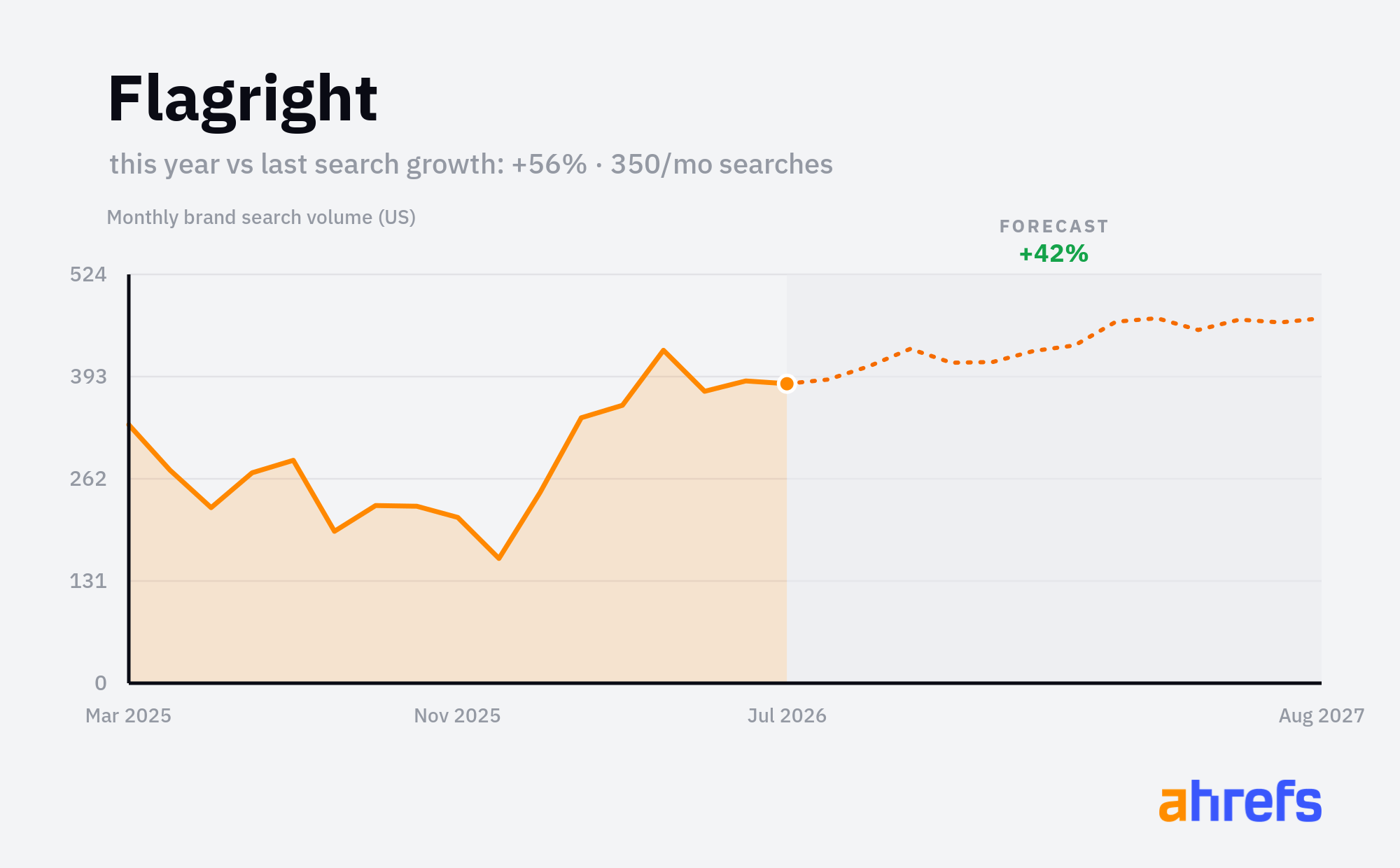
- Brand search growth (this year vs last): +56%
- Search growth forecast (next 12 months): +42%
- Brand search volume (monthly): 350
- Organic traffic (monthly): 5.5K
- Year founded: 2021
- Location: Singapore
What they do
Flagright is an AI-native AML compliance platform used by financial institutions to manage transaction monitoring, risk scoring, case management, and AML screening, with a no-code interface designed to reduce the operational burden on compliance teams.
Like Addepto, Flagright is one of the smallest brands on the list by monthly search volume, around 350 searches a month, but the +42% forward forecast makes it one of the more interesting ones to watch. Financial crime compliance is a category where switching costs are high and reputation matters enormously, so any tool accumulating this kind of search momentum from a standing start is doing something right with its ICP.
18. Roboflow (+53%)
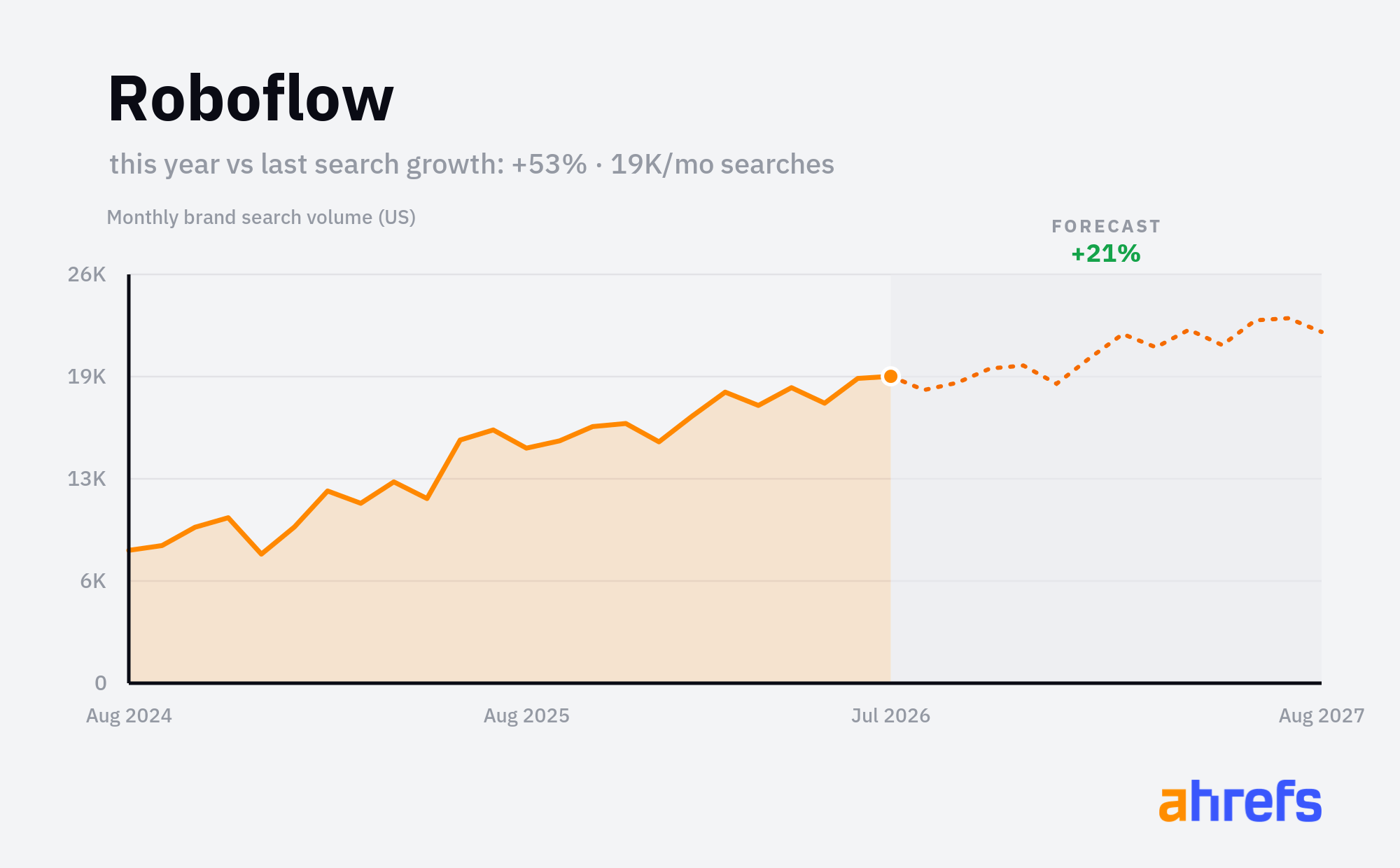
- Brand search growth (this year vs last): +53%
- Search growth forecast (next 12 months): +21%
- Brand search volume (monthly): 19K
- Organic traffic (monthly): 250K
- Year founded: 2019
- Location: Des Moines, United States
What they do
Roboflow is a computer vision development platform used by over 500,000 developers to manage image datasets, annotate training data, train models, and deploy vision AI applications via API or to edge devices.
In November 2024, Roboflow announced a $40 million Series B led by GV (Google Ventures), with Craft Ventures and Y Combinator also participating.
Computer vision has moved from a specialist discipline to something a much broader population of developers is actively experimenting with, and Roboflow has positioned itself as the toolchain that makes that practical. The ~20K monthly brand searches and +53% growth reflect a platform that's pulled in a wide developer audience, partly through genuinely useful free-tier access and partly through the kind of educational content that gets shared in ML communities.
19. accessiBe (+53%)
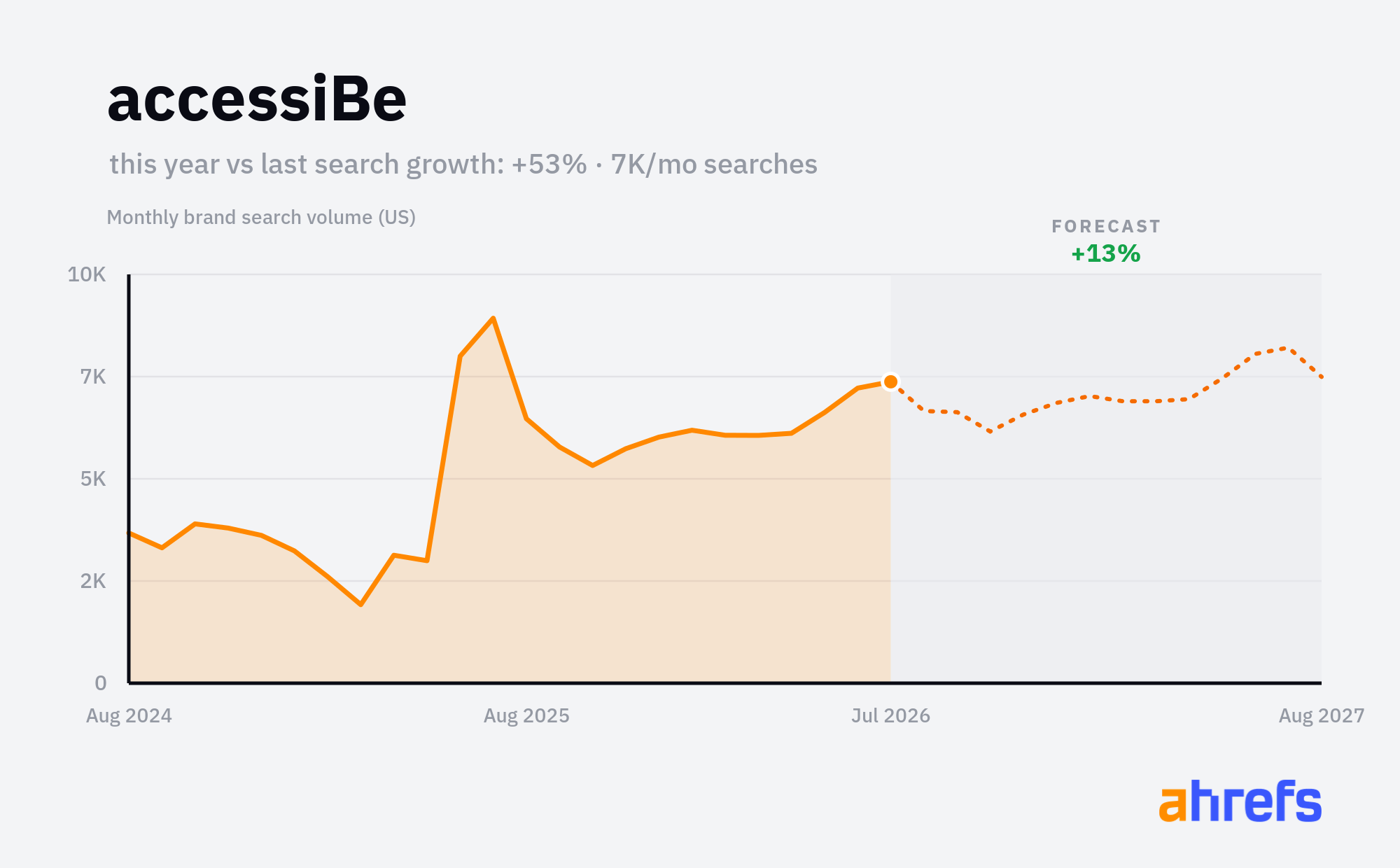
- Brand search growth (this year vs last): +53%
- Search growth forecast (next 12 months): +13%
- Brand search volume (monthly): 7K
- Organic traffic (monthly): 22K
- Year founded: 2018
- Location: Tel Aviv, Tel Aviv
What they do
accessiBe is a web accessibility platform used by businesses of all sizes to test and remediate their websites for ADA and WCAG compliance, with AI-powered tools that automate parts of the remediation process.
Web accessibility compliance has shifted from a nice-to-have to something legal and procurement teams are actively asking about, which has pulled a new wave of buyers into the category. accessiBe's +53% brand search growth likely reflects both that expanding market and the attention generated by a January 2025 FTC settlement that, regardless of context, put the name in front of a lot of people searching for accessibility tools.
20. AppTweak (+51%)
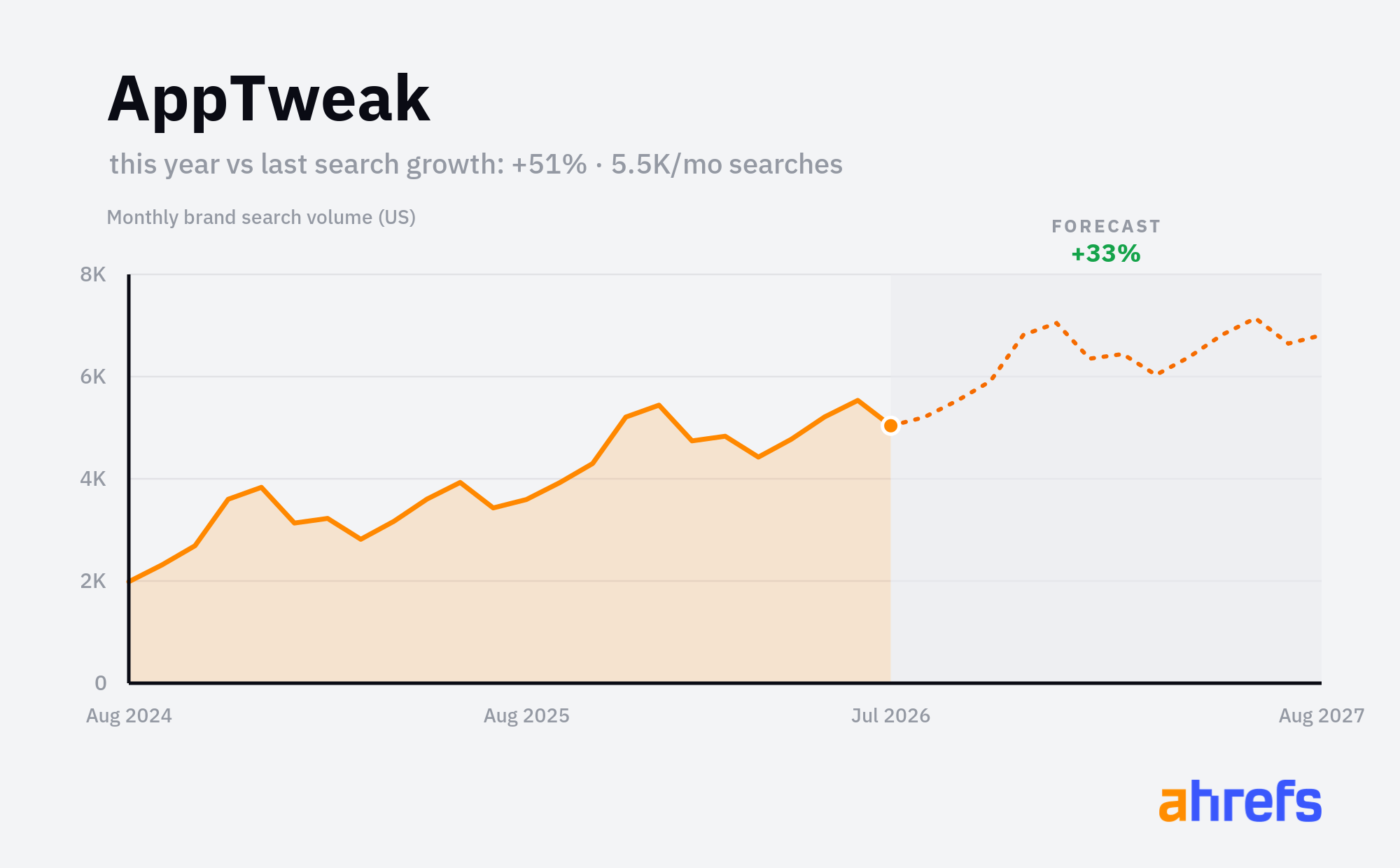
- Brand search growth (this year vs last): +51%
- Search growth forecast (next 12 months): +33%
- Brand search volume (monthly): 5.5K
- Organic traffic (monthly): 25K
- Year founded: 2014
- Location: Brussels, Brussels Region
What they do
AppTweak is an app store intelligence and marketing platform used by mobile app teams to optimize organic discoverability, manage Apple Search Ads campaigns, monitor reviews, and analyze competitors across the App Store and Google Play.
In April 2021, AppTweak raised $22 million in a Series B led by Groupe Rossel.
App store optimization has matured into a proper discipline with real budget behind it, and AppTweak has built a strong reputation among the app marketers who take it seriously. The +51% brand search growth and a +33% forward forecast suggest the platform is pulling in a growing number of teams who've moved past basic ASO and want proper competitive intelligence, which is a narrower audience but one that tends to be sticky once converted.
21. Adalo (+49%)
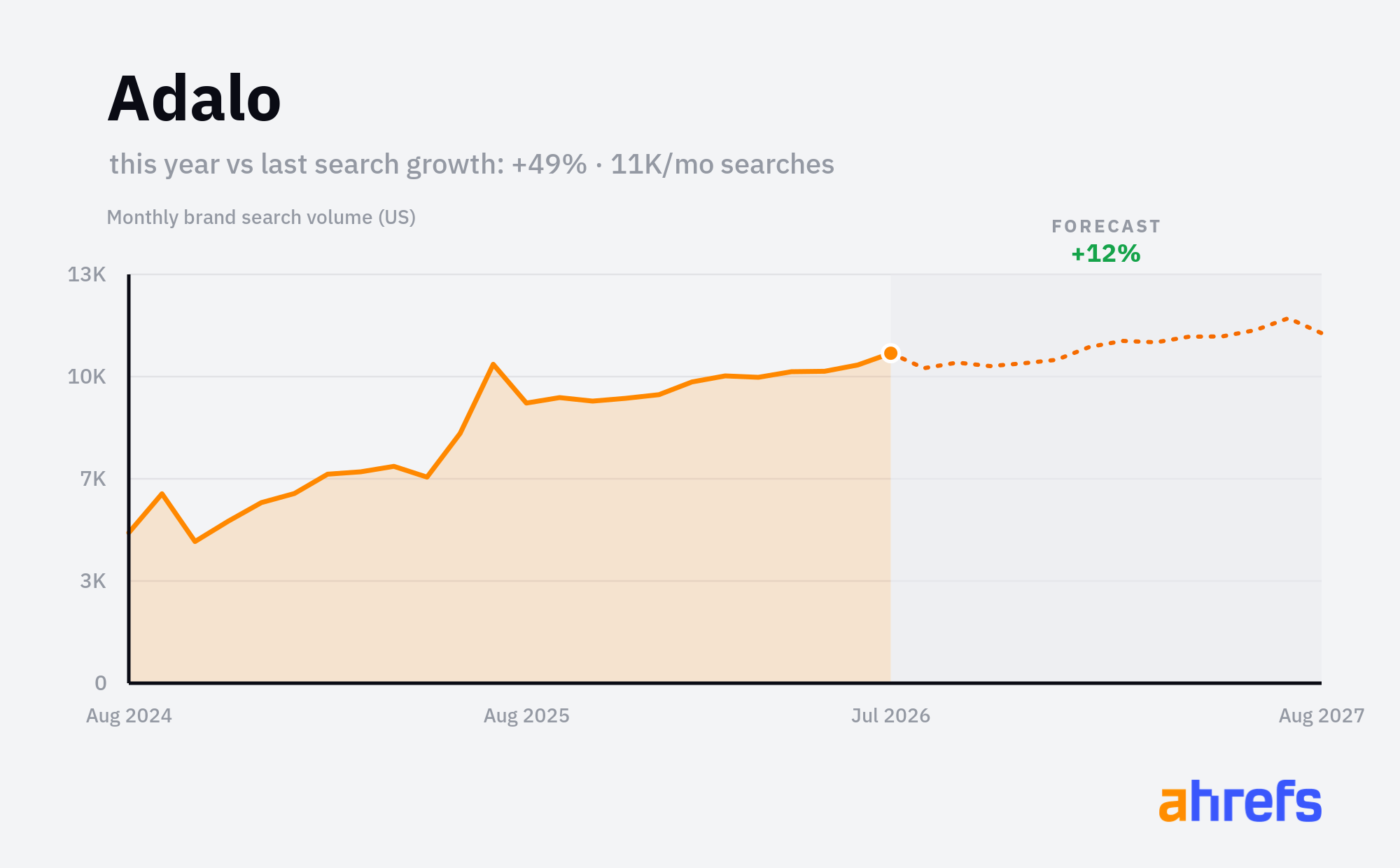
- Brand search growth (this year vs last): +49%
- Search growth forecast (next 12 months): +12%
- Brand search volume (monthly): 11K
- Organic traffic (monthly): 69.5K
- Year founded: 2018
- Location: St. Louis, Missouri
What they do
Adalo is a no-code app builder that lets non-technical users design and publish native web and mobile apps through a visual interface, without writing code.
In May 2021, Adalo raised $8 million in a Series A led by Tiger Global Management, with Wade Foster, Jason Warner, and others also participating.
The no-code market has gotten crowded with better-funded competitors, but Adalo's +49% brand search growth suggests it's still pulling in a meaningful new audience, likely entrepreneurs and small teams who want to build and ship a native mobile app without the cost of a developer. The ~10K monthly brand searches and ~70K organic visitors point to a platform with a healthy discovery engine despite operating in a space with a lot of noise.
22. IPQS (+48%)
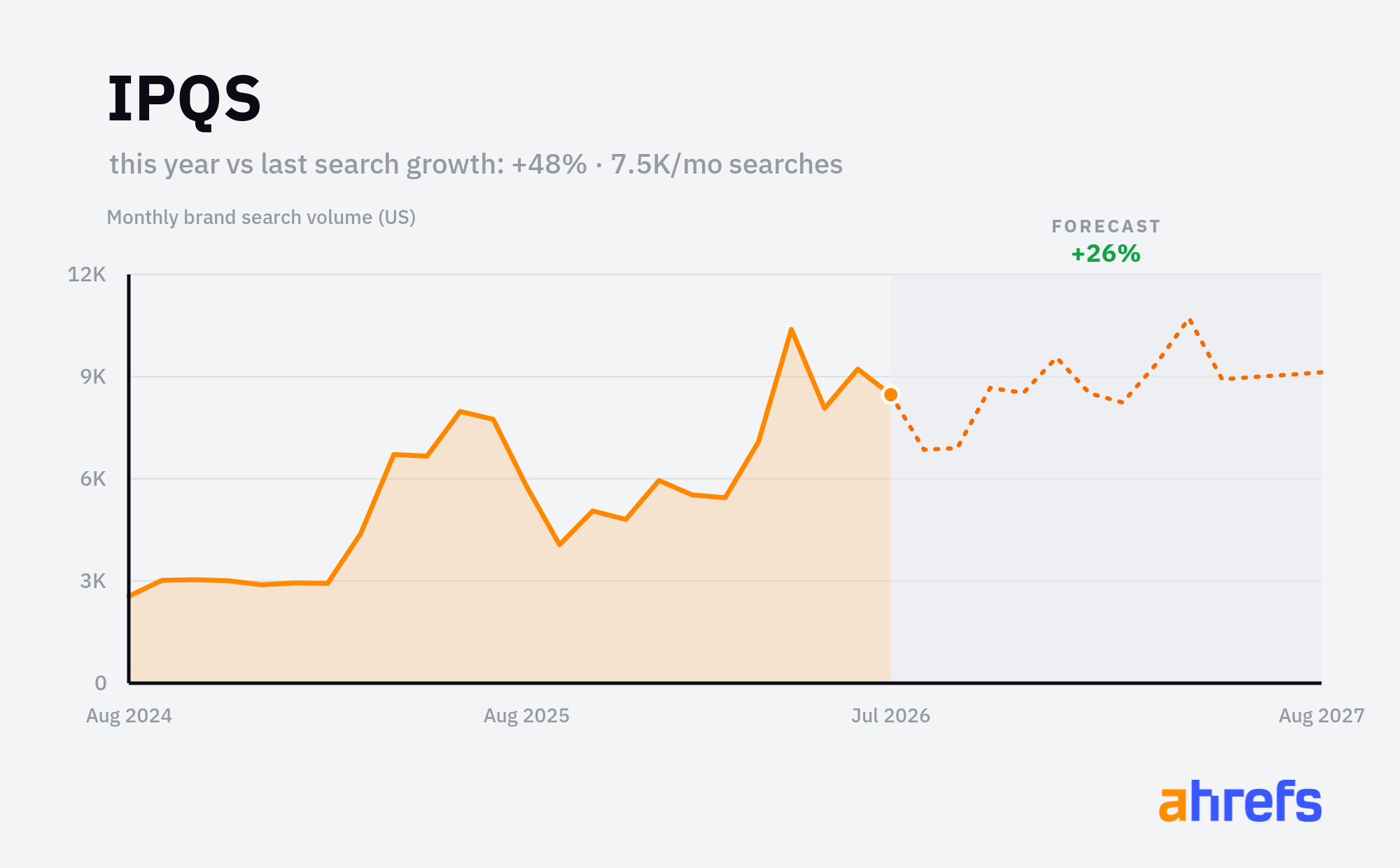
- Brand search growth (this year vs last): +48%
- Search growth forecast (next 12 months): +26%
- Brand search volume (monthly): 7.5K
- Organic traffic (monthly): 200K
- Year founded: 2011
- Location: Las Vegas, NV
What they do
IPQS is a fraud detection and cyberthreat intelligence platform used by over 3,500 businesses, including many Fortune 500 companies, to detect bots, prevent click fraud, validate email and phone data, and assess IP risk in real time.
IPQS has not raised any institutional funding, per Tracxn.
Founded in 2011, IPQS is one of the most established companies on this list of fastest growing companies, which makes its +48% brand search growth all the more worth noting. Growing at that rate after 15 years in operation, entirely without outside capital, and into a market increasingly crowded with well-funded fraud detection platforms, points to a product that's earned its audience through accuracy and reliability rather than marketing spend.
23. MailerLite (+45%)
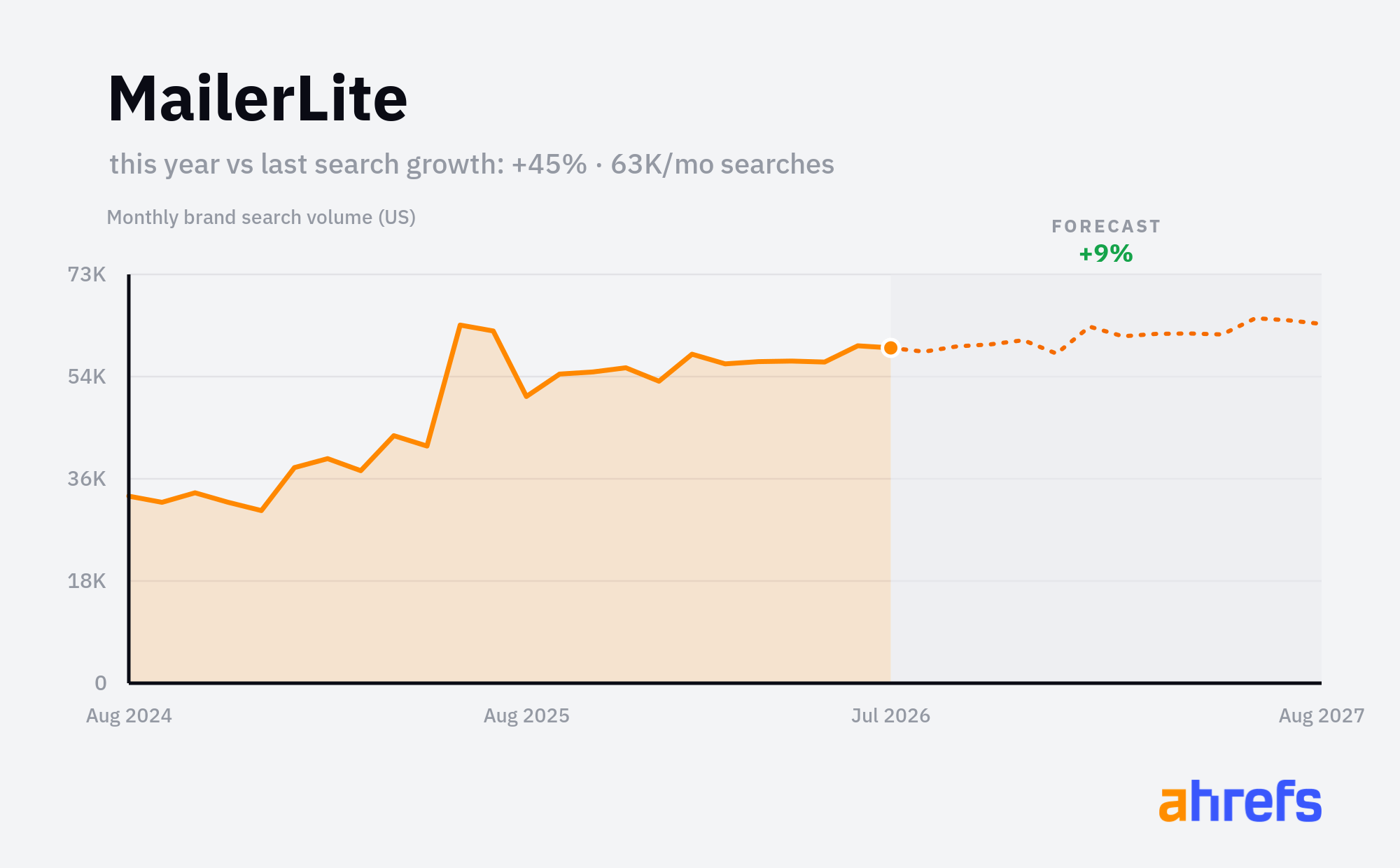
- Brand search growth (this year vs last): +45%
- Search growth forecast (next 12 months): +9%
- Brand search volume (monthly): 63K
- Organic traffic (monthly): 350K
- Year founded: 2010
- Location: San Francisco, California
What they do
MailerLite is an email marketing platform used by small businesses, creators, and agencies to build and send campaigns, manage subscriber lists, create landing pages, and run automations, with a strong reputation for simplicity and a competitive free tier.
MailerLite grew without institutional venture funding and was acquired by Vercom in April 2022 for approximately $90 million.
MailerLite is another of the most established companies on this list, founded in 2010, and its +45% brand search growth against a base of ~60K monthly searches is a solid result for an email platform in a mature market. The most plausible explanation is that pricing pressure and reliability concerns in the broader email marketing space are sending users comparison shopping, and MailerLite keeps landing well in those evaluations.
24. Lattice (+40%)
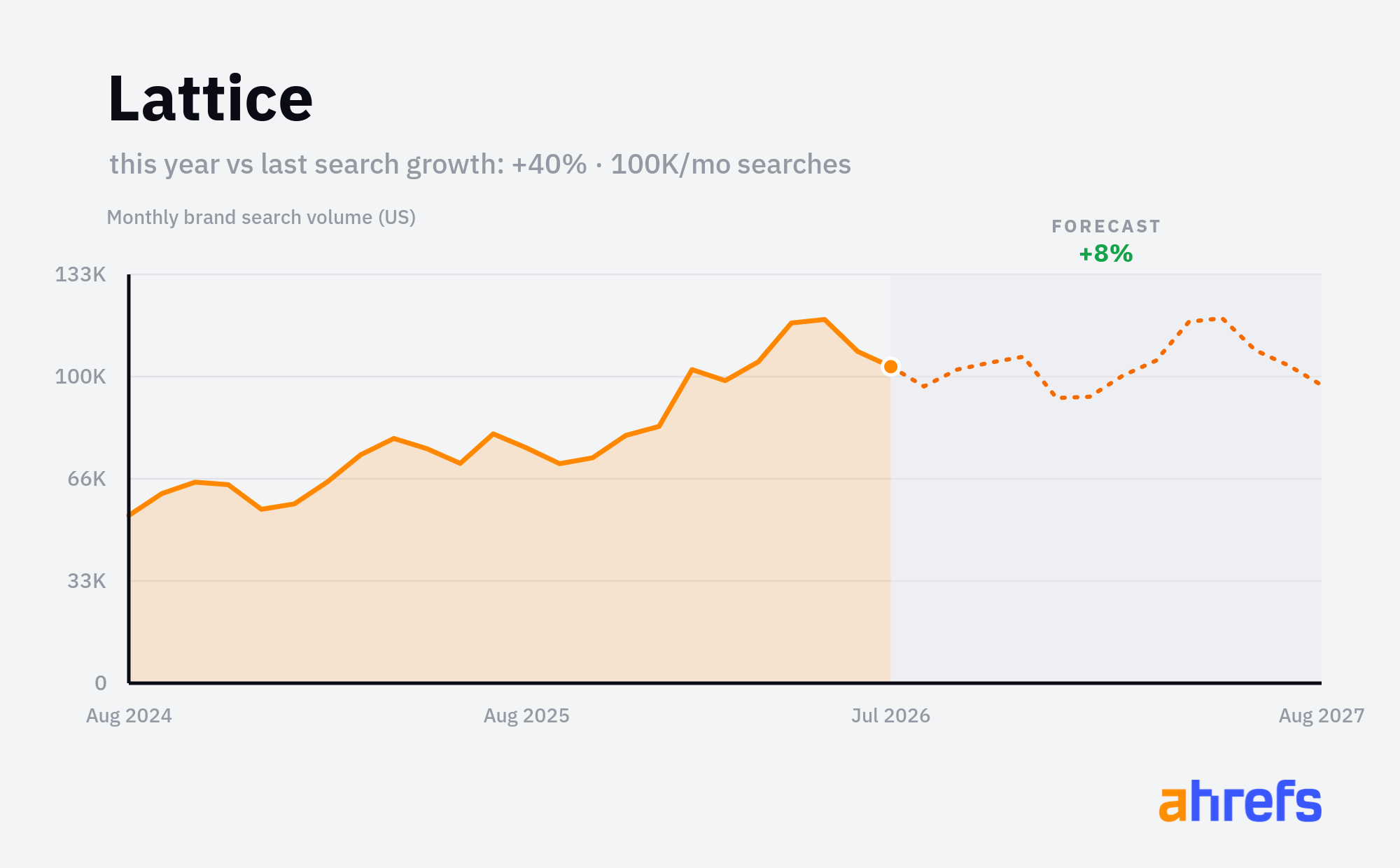
- Brand search growth (this year vs last): +40%
- Search growth forecast (next 12 months): +8%
- Brand search volume (monthly): 100K
- Organic traffic (monthly): 100K
- Year founded: 2015
- Location: San Francisco, California
What they do
Lattice is a people management platform used by HR teams and managers to run performance reviews, set goals, conduct engagement surveys, and manage compensation, with a product designed to sit at the center of how companies develop and retain their employees.
In December 2023, Lattice announced a $175 million Series F led by Thrive Capital, Elad Gil, Tiger Global, and Dragoneer, bringing total funding to over $330 million and tripling its valuation to $3 billion.
Lattice is one of the bigger brands on this list by monthly search volume, at around 110K searches a month, so a +40% growth rate on top of that existing base represents a meaningful absolute increase in demand. HR software buying tends to accelerate when companies are either growing fast or feeling pressure to improve retention, and the current environment is producing both conditions in different pockets of the market.
25. Databricks (+39%)
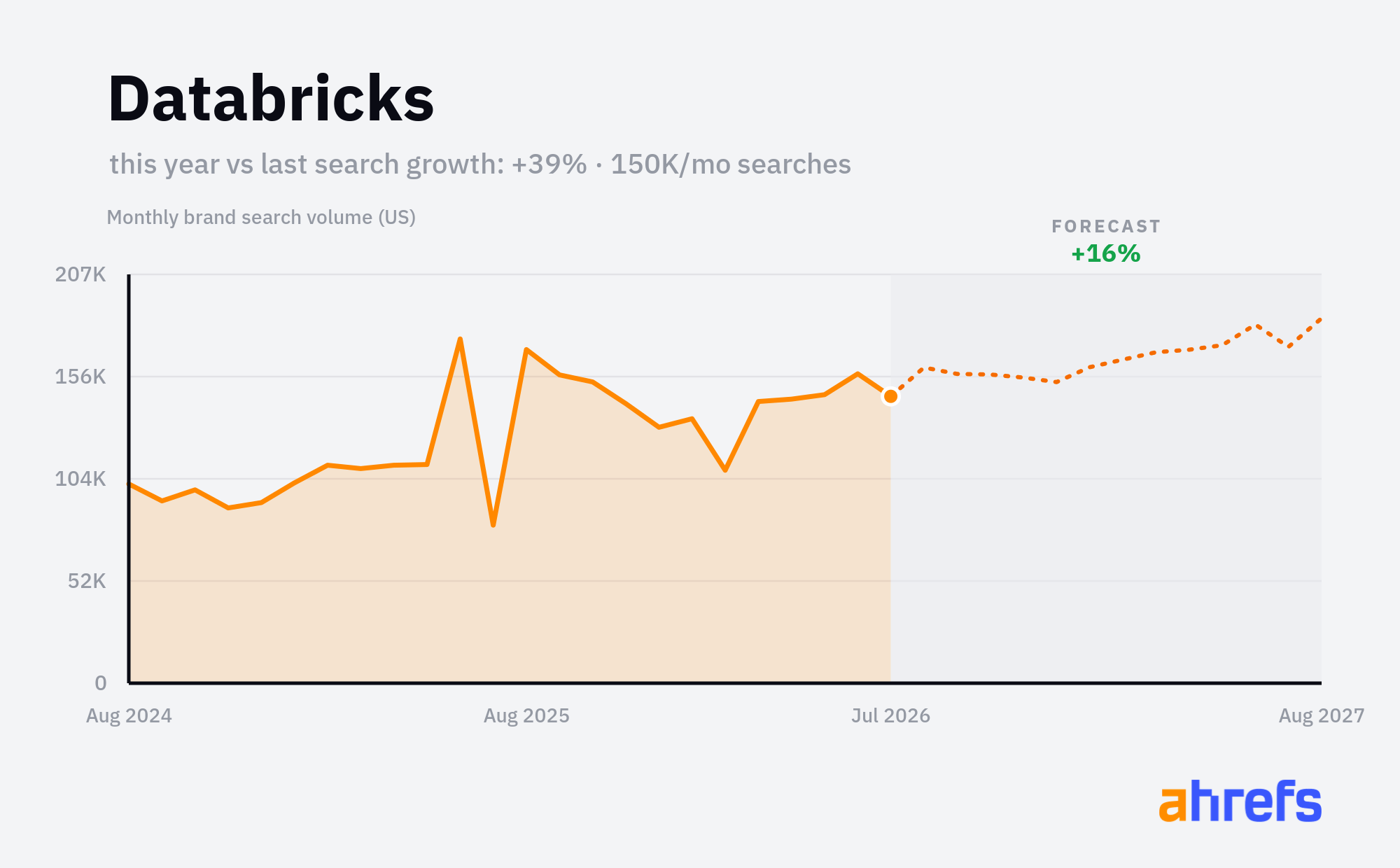
- Brand search growth (this year vs last): +39%
- Search growth forecast (next 12 months): +16%
- Brand search volume (monthly): 150K
- Organic traffic (monthly): 1.2M
- Year founded: 2013
- Location: San Francisco, California
What they do
Databricks is a name anyone working in data or AI already knows well, sitting at the center of how large organizations unify their data and run AI workloads at scale.
Most recently, Databricks raised $5 billion at a $190 billion valuation in August 2026. Before that, a 2024 financing round led by Thrive Capital brought in $10 billion, one of the largest single venture deals on record.
The surge in enterprise AI adoption has put Databricks in a powerful position, because companies scrambling to build AI on top of their own data need exactly the kind of unified data platform it provides. Founded by the original creators of Apache Spark, Delta Lake, and MLflow, it has deep technical credibility with the engineering teams making those purchasing calls, and that trust is hard for newer entrants to replicate quickly.
The full list: fastest-growing SaaS companies by brand search
# | Company | Industry | Brand search growth | Monthly brand searches |
|---|---|---|---|---|
1 | Dev tools | +170% (this year vs last) Breakout | 150K | |
2 | Marketing | +140% (this year vs last) Breakout | 84K | |
3 | Fintech | +140% (this year vs last) | 9.5K | |
4 | Design | +120% (this year vs last) | 26K | |
5 | Fintech | +120% (this year vs last) Breakout | 32K | |
6 | Video | +100% (this year vs last) | 6K | |
7 | Marketing | +96% (this year vs last) Breakout | 32K | |
8 | Fintech | +84% (this year vs last) | 100K | |
9 | AI / ML | +82% (this year vs last) | 400 | |
10 | Sales / CRM | +79% (this year vs last) | 6K | |
11 | Security | +71% (this year vs last) | 2.5K | |
12 | Marketing | +68% (this year vs last) | 1.5K | |
13 | IT management | +68% (this year vs last) | 23K | |
14 | Customer support | +62% (this year vs last) | 3K | |
15 | Security | +57% (this year vs last) | 4.5K | |
16 | Marketing | +56% (this year vs last) | 4K | |
17 | Fintech | +56% (this year vs last) | 350 | |
18 | AI / ML | +53% (this year vs last) | 19K | |
19 | Accessibility | +53% (this year vs last) | 7K | |
20 | Analytics | +51% (this year vs last) | 5.5K | |
21 | No-code | +49% (this year vs last) | 11K | |
22 | Security | +48% (this year vs last) | 7.5K | |
23 | Marketing | +45% (this year vs last) | 63K | |
24 | HR | +40% (this year vs last) | 100K | |
25 | Data infrastructure | +39% (this year vs last) | 150K | |
26 | Marketing | +36% (this year vs last) | 1.5K | |
27 | Marketing | +34% (this year vs last) Breakout | 25K | |
28 | Telecom | +34% (this year vs last) Breakout | 65K | |
29 | HR | +32% (this year vs last) | 250K | |
30 | Productivity | +32% (this year vs last) | 22K | |
31 | Sales / CRM | +32% (this year vs last) | 2.5K | |
32 | Logistics | +31% (this year vs last) | 2.5K | |
33 | Sales / CRM | +31% (this year vs last) | 3K | |
34 | Fintech | +29% (this year vs last) | 24K | |
35 | Productivity | +28% (this year vs last) | 1.5K | |
36 | No-code | +28% (this year vs last) | 94K | |
37 | Security | +27% (this year vs last) | 1K | |
38 | Education | +27% (this year vs last) | 100K | |
39 | HR | +27% (this year vs last) | 18K | |
40 | HR | +26% (this year vs last) | 71K | |
41 | Data infrastructure | +26% (this year vs last) | 700 | |
42 | HR | +25% (this year vs last) | 2.5K | |
43 | Dev tools | +25% (this year vs last) | 400 | |
44 | HR | +25% (this year vs last) | 700 | |
45 | Design | +25% (this year vs last) | 25K | |
46 | AI / ML | +25% (this year vs last) | 14K | |
47 | HR | +24% (this year vs last) | 24K | |
48 | Marketing | +23% (this year vs last) | 400 | |
49 | HR | +22% (this year vs last) | 800 | |
50 | Video | +20% (this year vs last) | 36K |
Brand search growth = growth in average monthly searches for the company name this year versus last year (last 12 months vs the prior 12 months). Monthly brand searches = current US search volume for the brand name. Data: Ahrefs · September 2026.
How to find this data in Ahrefs
You can rebuild this entire analysis yourself in Ahrefs. Here's the short version:
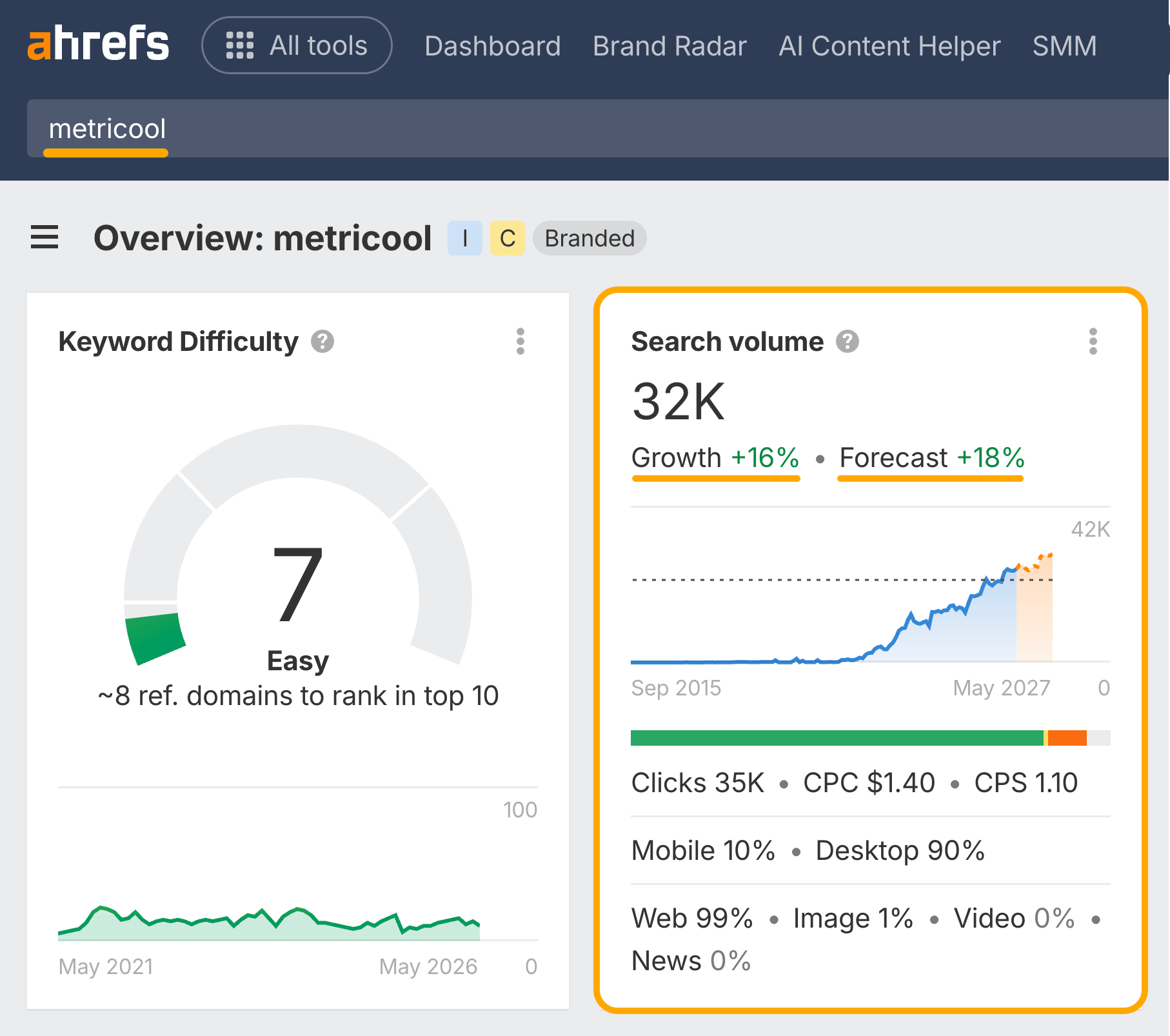
- Open Keywords Explorer, enter a company's brand name as the keyword, and look at the Volume graph. The trend over the last few years is the brand-search growth we ranked on, and the forecast line is Ahrefs' projection.
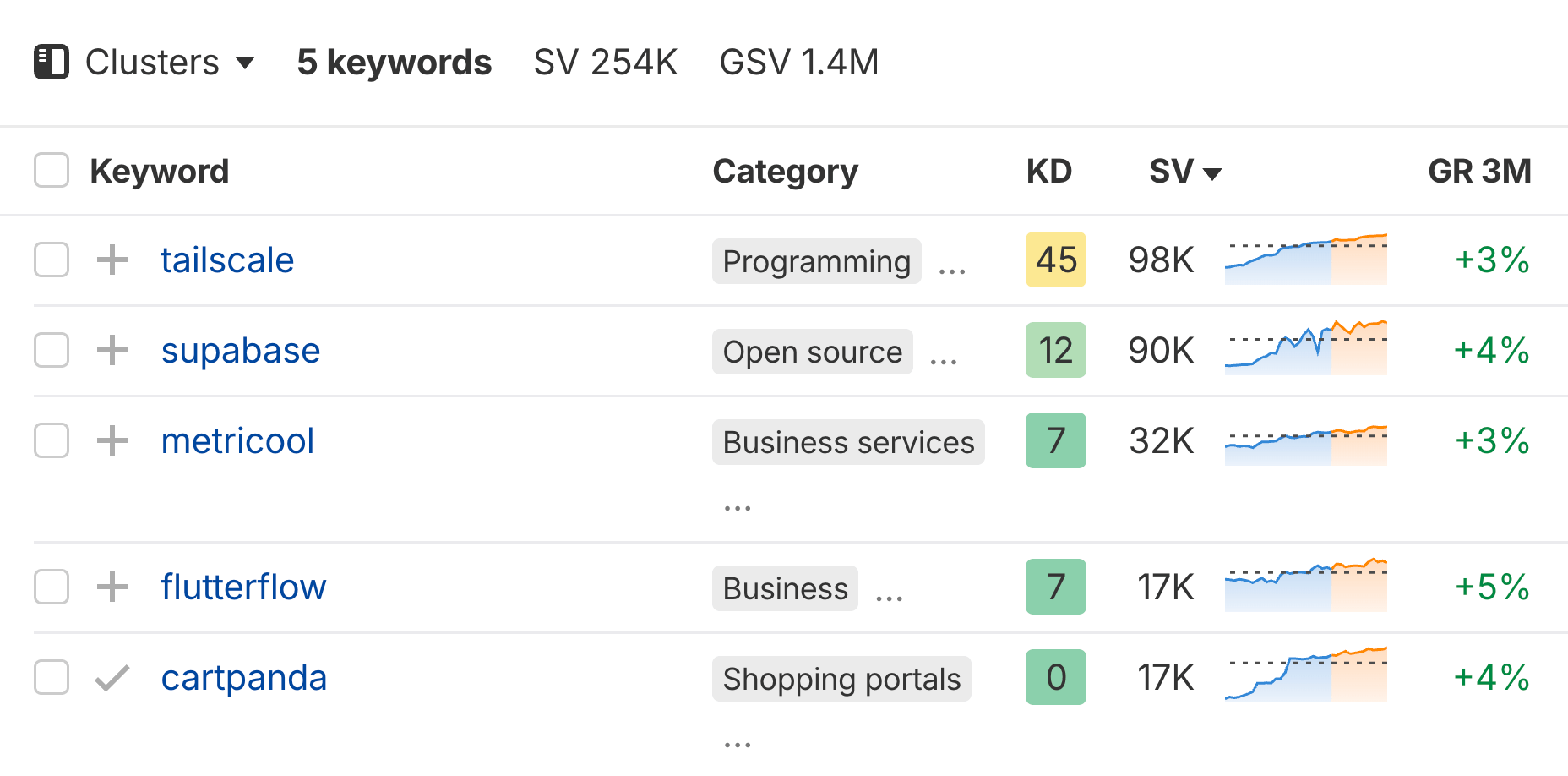
- To compare many companies at once, drop a list of brand names into Keywords Explorer and sort by Volume or by Growth to see which names are climbing fastest.
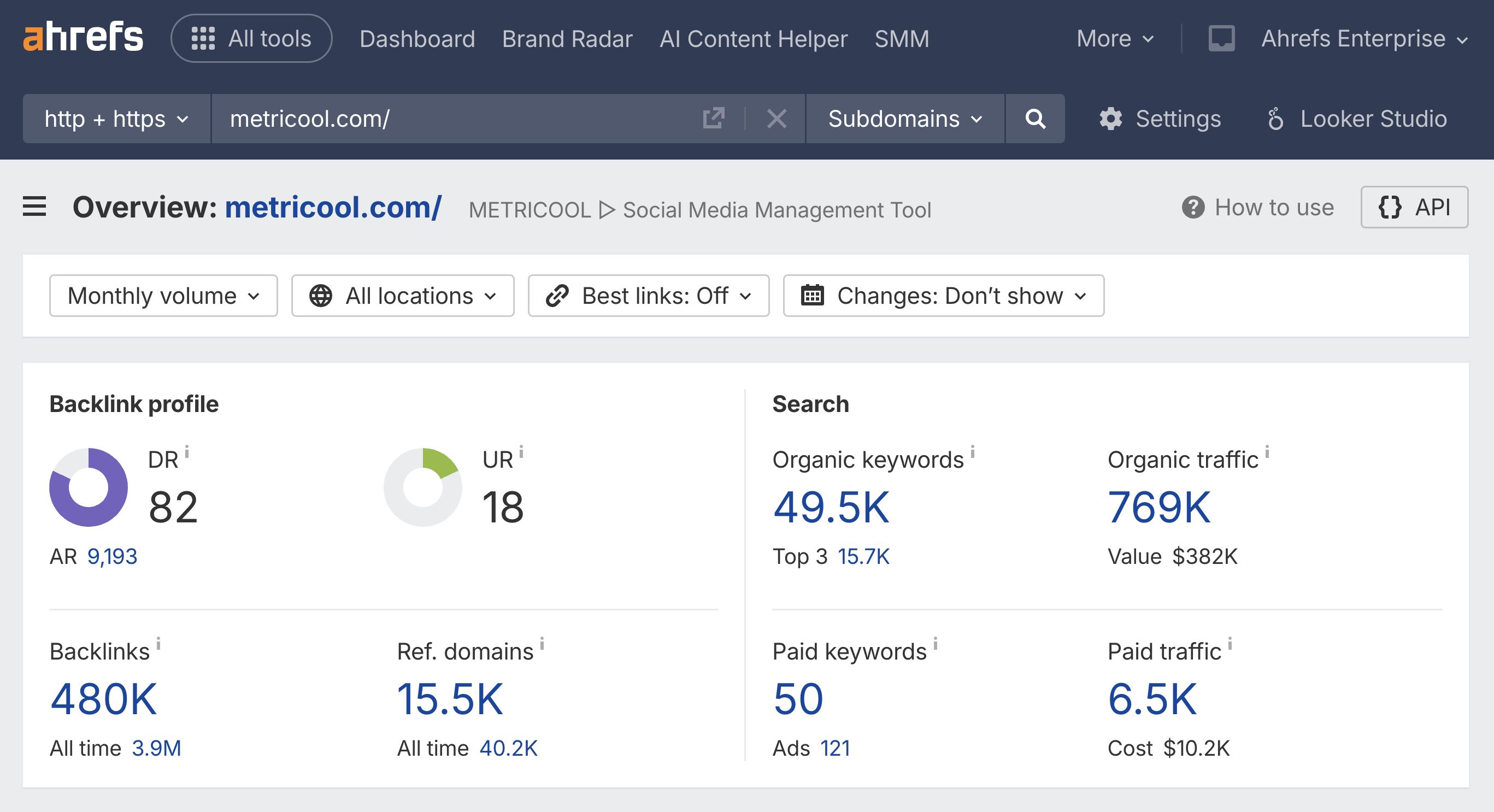
- Use Site Explorer on each company's domain to pull the Organic traffic, Referring domains, and other figures in the profiles above.
- Or skip the manual work and let Letaido run the whole pull, filtering, and ranking for any niche you choose, the same way it built this list.
Final thoughts
What stands out across this list of fastest growing SaaS companies is the range of categories represented: developer infrastructure, social media management, identity verification, no-code tools, fraud prevention, public safety, and app store intelligence all appear, which is a useful reminder that brand search growth is a signal of product traction, not a category trend.
Several of the fastest growing companies here are also among the least-funded, which tells you something about what drives search demand: it's the product earning word-of-mouth, not the marketing budget converting impressions.
If you're watching where real software demand is forming, these are the companies worth keeping an eye on.
Louise is a Content Marketer at Ahrefs. Over the past ten years, she has held senior content positions at SaaS brands: Pi Datametrics, BuzzSumo, and Cision. During this time, she has published hundreds of blog posts, spearheaded industry-leading research, and developed expert-led webinar programs.
Louise first learned the ropes of SEO during her time at enterprise SEO company, Pi. Within weeks of joining, she had published a piece on cannibalization that caught the attention of the biggest name in SEO at the time: Rand Fishkin. Since then, she has written on topics ranging from manipulative link building, to content syndication, and search demand forecasting. In her spare time, she has deepened her practical understanding of SEO by building websites for two local businesses.
You can read Louise's words in industry publications like Search Engine Watch, The Drum, The Telegraph, and Spin Sucks.
Keep learning


Your weekly marketing’s must-reads
Join 284K marketers for weekly news, useful reads, industry updates, and the memes you didn’t know you needed.
Explore what’s inside the newsletter →