
Keyword & Prompt Research for AI SEO (AEO)
This lesson will help you find the actual keywords and prompts to go after. There's a ton of overlap between SEO and AEO, and half the battle is knowing which is which and how to approach each one differently.
Step 1: Build your keyword list
This part hasn't changed much from traditional keyword research. You need two things:
Seed keywords: broad terms related to your niche
Modifiers: add-ons like "best" or "how to" that turn those seeds into real searches
A quick way to generate both is to ask your AI assistant of choice something like:
"I'm doing keyword research for [my type of site], which makes money through [my revenue model]. My target audience is [this group]. Give me 10 seed keywords that are one to two words max and five plus modifiers that will help me surface appropriate content formats I can use in my keyword research. The seeds and modifiers should not share the same words."
This gives you a solid starting list of seeds and modifiers.
To turn that into real keyword data:
Paste your seed keywords into Keywords Explorer
Go to the Matching terms report
Add your modifiers using the Include filter
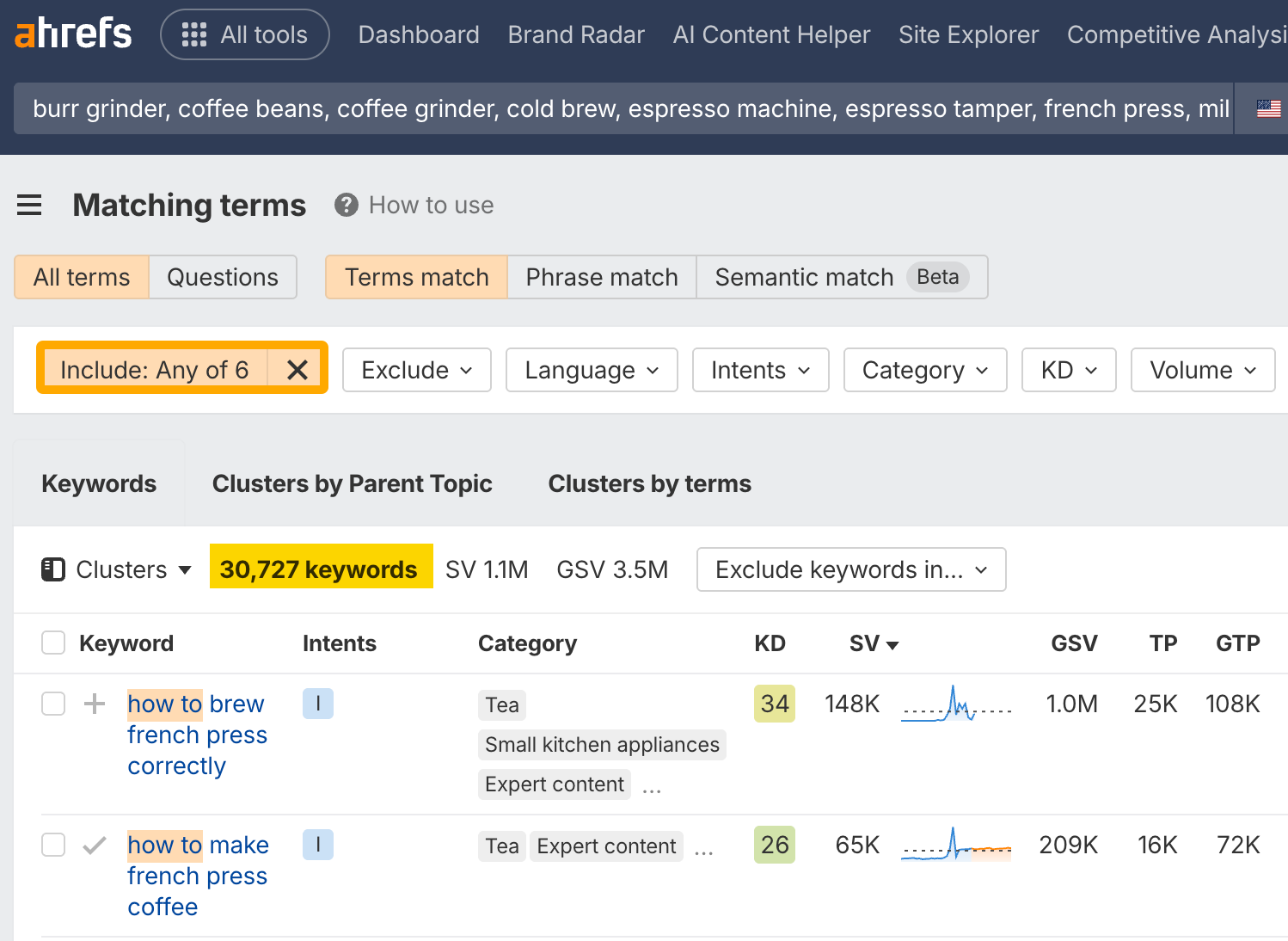
You should now have hundreds, maybe thousands, of real keyword ideas your audience is actually typing into Google.
Step 2: Vet those keywords (the BID formula)
Some keywords look enticing (high volume, high traffic potential, low difficulty) but aren't actually worth targeting. Before committing to any keyword, run it through three tests, the BID formula.
B: Business potential. Ask yourself if ranking number one for this keyword would actually help your business. "What is espresso" has solid volume and low difficulty, but the searcher isn't looking to buy anything, maybe ever. "Best espresso machine under $500" shows intent and a budget. Always choose keywords that move the needle.
I: Intent. Google the keyword and look at what's actually ranking. If every top result is an e-commerce page and you're trying to rank a blog post, it's not going to happen. The SERP tells you what searchers want, so match the intent or move on.
D: Difficulty. Choose keywords you actually have a chance at ranking for. Check the referring domains and Domain Rating of the top-ranking pages. Generally, the more links and the higher the DR, the tougher the competition. If you see a few low-DR sites in the top 10, that's usually a good sign.
If a keyword passes all three tests, you should consider targeting it, unless it fails the next filter.
Step 3: Apply the AI filter
Before committing to a keyword, ask one more question: can AI fully satisfy the user for this query? Even if a keyword passes BID, if the AI overview answers it so well that there's no reason to click through, that keyword might be a trap.
There's Ahrefs data behind this:
AI overviews appear on about 21% of all keywords
For informational queries, that rises to nearly 58% for question queries
46% of queries with seven or more words trigger an AI overview
99.9% of keywords that trigger AI overviews are informational in intent
So before committing to a keyword, Google it, look at what shows up, and put yourself in the searcher's shoes. Ask: "Am I satisfied with this answer, or do I need to click somewhere to learn more?" If the AI overview nails it, that keyword might not be worth targeting the traditional way.
Even though AI is eating clicks for many informational keywords, there's a whole category of searches it hasn't touched: free tools.
Searches like "backlink checker," "mortgage calculator," and "word counter" show no AI overview, because when someone searches for a tool, they need to actually use something, and AI can't replace that (yet).
To find these opportunities:
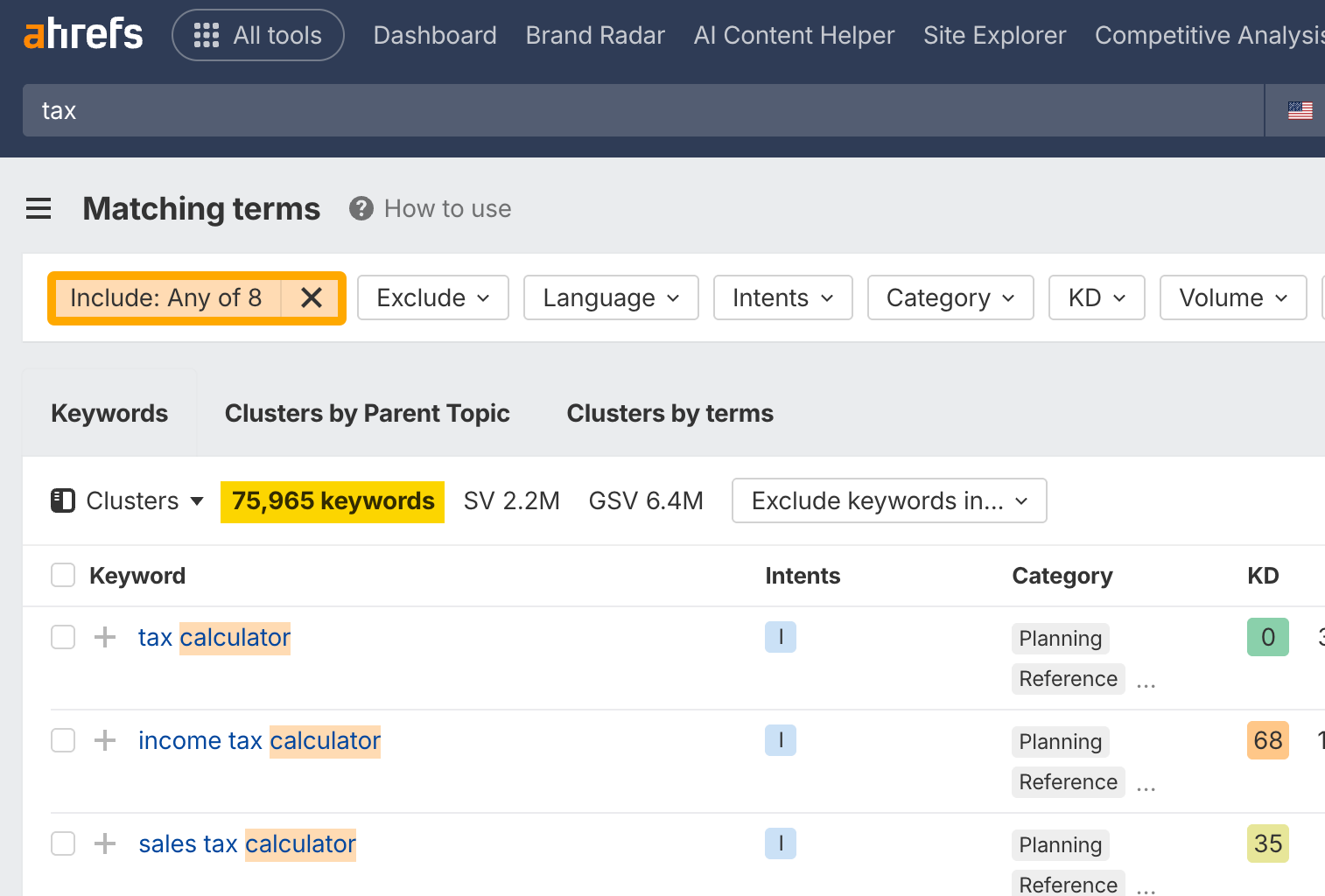
Go back to Keywords Explorer with your broad seeds.
Head to the Matching terms report.
Add modifiers like calculator, checker, generator, tool, template, finder, planner, and maker.
Step 4: Find your AI mention opportunities
Just because an AI overview nails the answer doesn't mean you ignore that keyword. It just needs to be targeted differently, which is where AEO comes in.
Instead of trying to rank and earn a click, your goal becomes getting your brand mentioned in the AI response itself.
To do that, you need to know which queries to focus on and which pages AI is pulling from. An Ahrefs research shows that 43.8% of all cited pages (across AI overviews and ChatGPT) are listicles.
These pages likely show up so often because they help AI build consensus: if your brand is mentioned across multiple lists, that's multiple sources recommending you, and AI picks up on that.
To find the queries that matter for your brand:
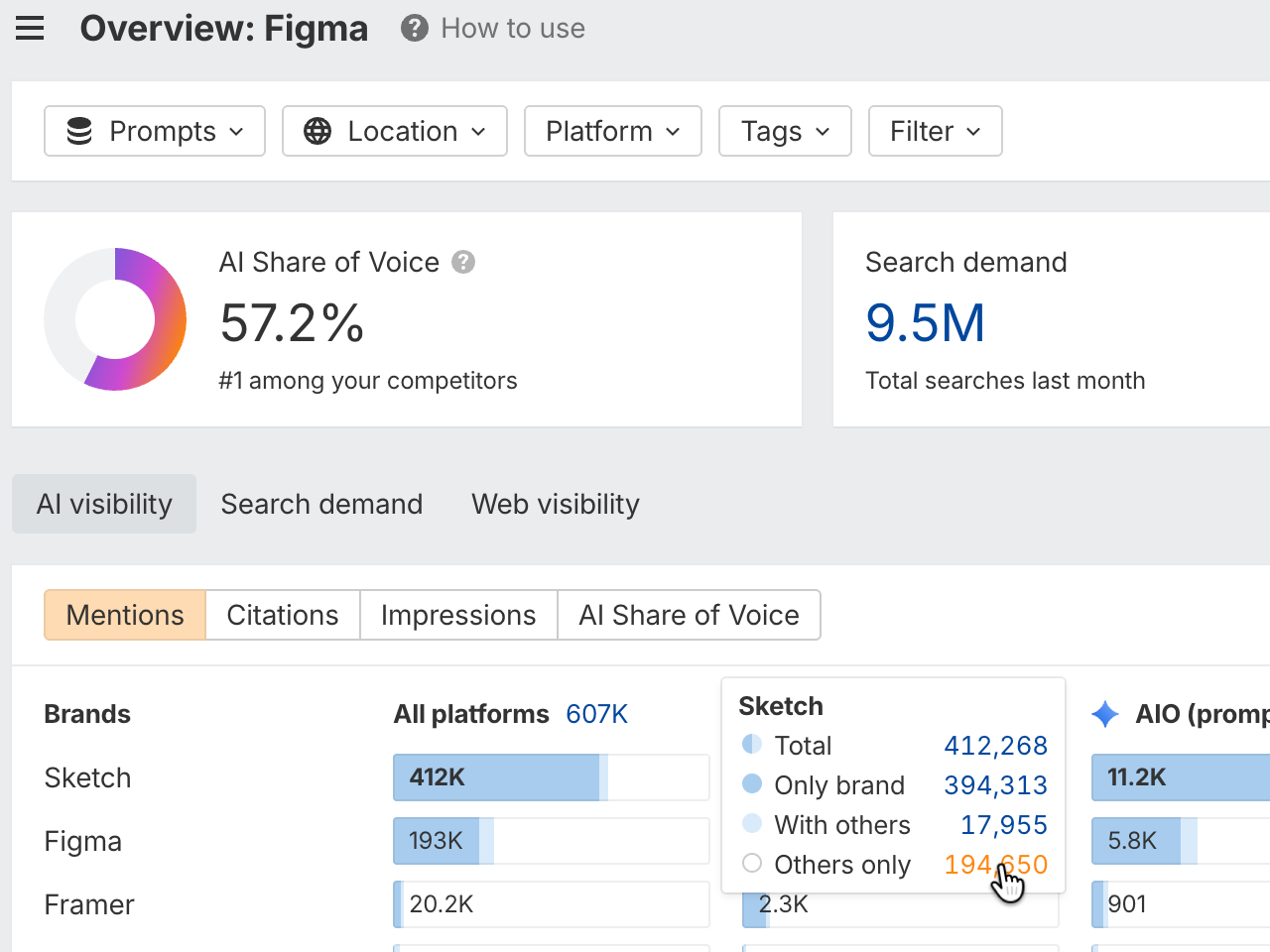
Go to Brand Radar and enter your website.
Find your brand, hover over the AI platform you want to research, and click "Others only." This shows the mention gaps where competitors are showing up but you are not.
Filter for queries containing best, top, versus, review, or alternative.
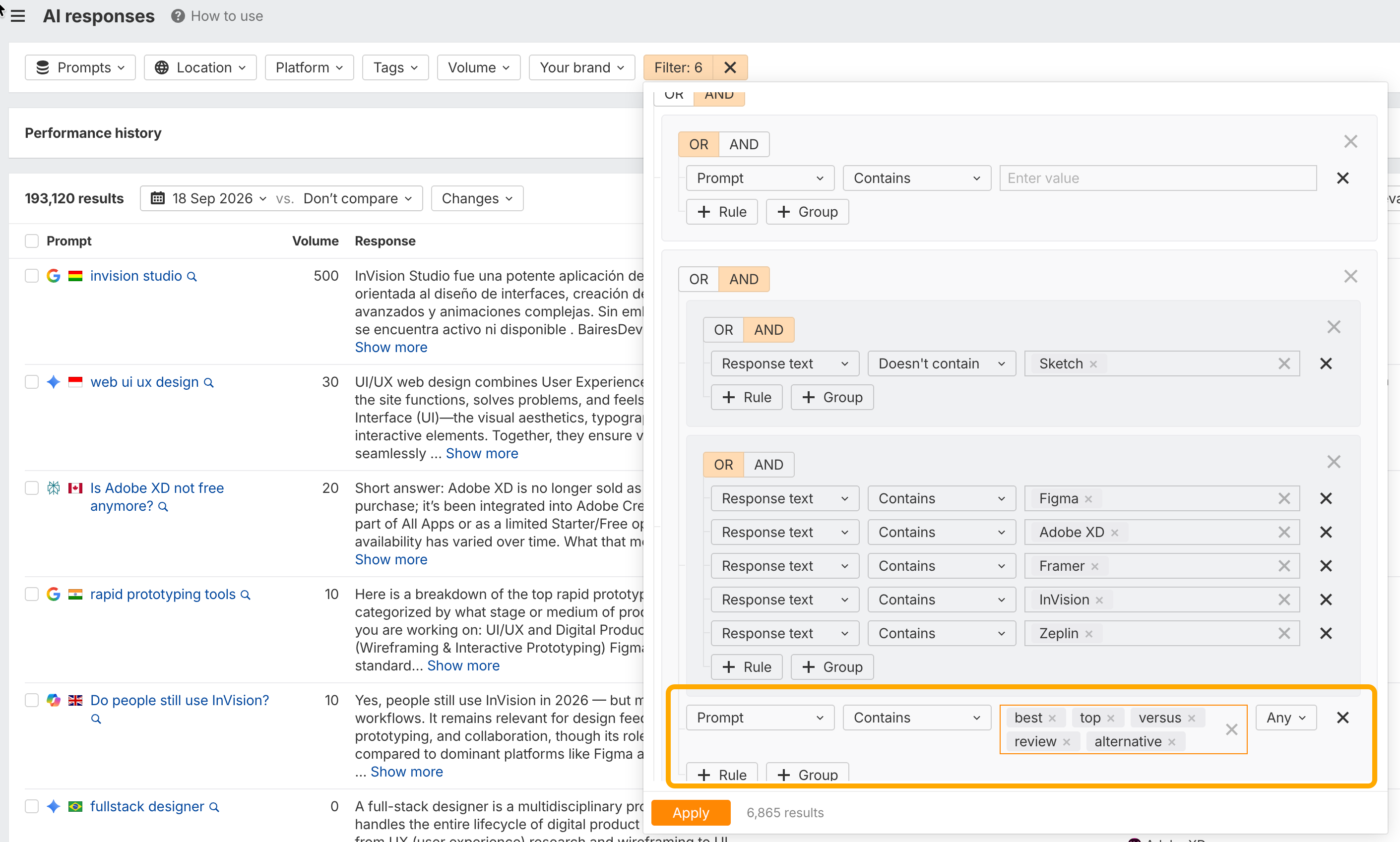
This surfaces the queries where AI is mentioning your competitors but not you, and the ones AI is most likely pulling from when looking for brands in your space. This is your short list.
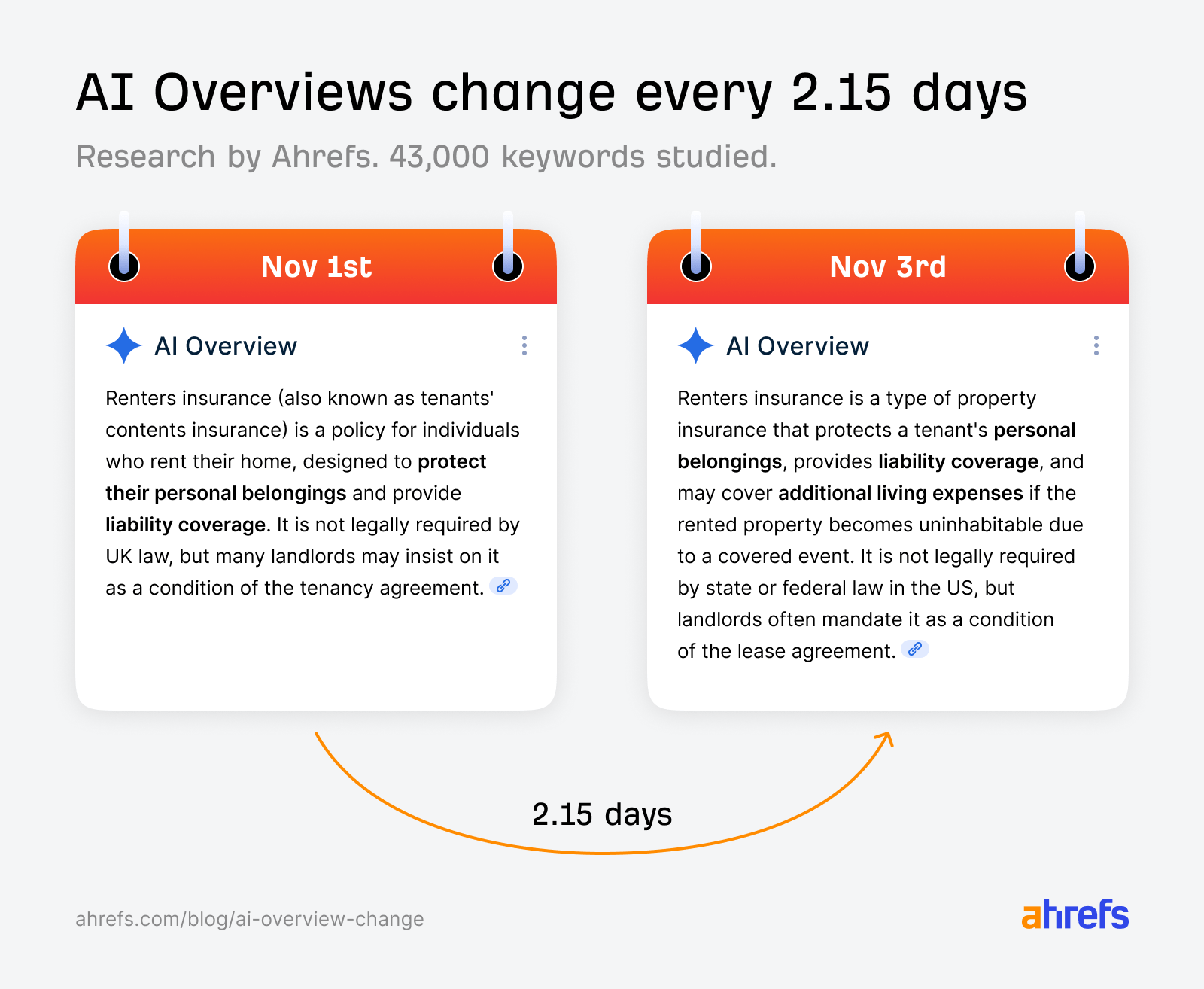
Keep in mind that over 45% of citations change when AI overviews refresh, and that happens on average every 2 days. This isn't a one-time exercise, it's worth revisiting this report regularly to catch new queries as they come in.
Step 5: Prompt research
When someone opens ChatGPT, Google AI mode, or Perplexity, they're not typing keywords, they're having conversations.
They say things like "I'm a small agency owner looking for a marketing platform, which one should I choose?" or "What's the best way to track rankings if I'm just getting started?" They use natural language with full context, and every person phrases it differently.
This means you can't approach prompt research the way you approach keyword research, where you find exact terms and go after them one by one. With AI, the same question asked 10 different ways can get 10 different answers with 10 different brands mentioned.
On top of that, AI fans each prompt out into many sub-queries behind the scenes, most of which have zero search volume and will never repeat.
If you're invisible for a topic, the fix isn't optimizing for one specific prompt, it's building visibility across the entire topic. That's exactly what's covered in module three.
Answer Engine Optimization (AEO) Course
What you'll learn
The fundamentals of how AI search works and why AEO matters
How different AI platforms decide what to cite
How to find gaps between your brand and competitors in AI search
How to do keyword and prompt research for AEO
How to create content that AI wants to cite
How to earn brand mentions across the web
How to optimize YouTube videos for AI visibility
Technical AEO best practices
How to track AI traffic and measure your progress
