
Your AEO Strategy + Action Plan Checklist
This lesson answers three questions that tie everything together: is AEO actually worth it, how do you know if you're making progress, and what should you be doing on a regular basis to keep growing.
Is AEO worth your time?
If you look at raw traffic numbers, AI search is still relatively small.
According to Ahrefs' data, AI referral traffic accounts for about 0.25% of a site's total traffic on average, and Google still sends about 210 times more traffic than the top AI platforms combined. Purely from a traffic standpoint, it might look like AEO isn't worth it.
But the story gets more interesting when you look at conversion quality:
Vercel sees 10% conversion rates from AI traffic
Tally says AI is their largest acquisition channel and it helped boost their ARR by a million dollars
The traffic volume is small, but the quality of that traffic is significantly higher. The reason is simple: when AI recommends you, it has already explained to the user why you're a good fit.
On top of conversion quality, AI traffic is growing fast. It has grown about 9.7 times since last year, and ChatGPT alone has grown 85% since January, now sending more traffic than Reddit or LinkedIn.
The value beyond clicks
The real value of AEO isn't just the clickable traffic, it's the brand awareness that happens inside the AI conversation.
Every time AI recommends your product or mentions your brand, that's an impression you never had before. Most of those impressions never result in a click to your site. Instead, they result in someone Googling your brand name later, or engaging with your brand on social media when they recognize it in their feed.
AEO isn't an alternative to SEO, it's a new layer on top of it.
The brands that build that layer now, while it's still early, will have a massive advantage as AI search continues to grow.
The main downside, covered in the previous lesson, is that AEO isn't perfectly measurable. But just because you can't measure something precisely doesn't mean it's not working. It's similar to brand marketing: you can't track every billboard to a sale, but you know it shapes how people think about you. AEO works the same way.
How do you know if you're making progress?
If you followed along in module two, you already set up your Brand Radar baseline and did your first brand gap analysis. Now it's time to go back and check how things have changed. Pull up your Brand Radar dashboard and look at four things.
AI share of voice: How have you moved relative to your competitors? If your share has grown, your efforts are working. If it stayed flat while a competitor grew, dig into why. Ahrefs tracks queries and prompts at scale, so Brand Radar gives you a good look at the overall trend.
Cited domains: Are new domains citing you that weren't before? This tells you if your mention-earning efforts from module three are paying off.
Topic coverage: Have you closed the gaps you identified? Are there new topics where you're showing up that you weren't before?
Mention sentiment: Is AI saying accurate and positive things about your brand? This matters especially because AI doesn't just repeat what's on your site, it synthesizes information from everywhere.
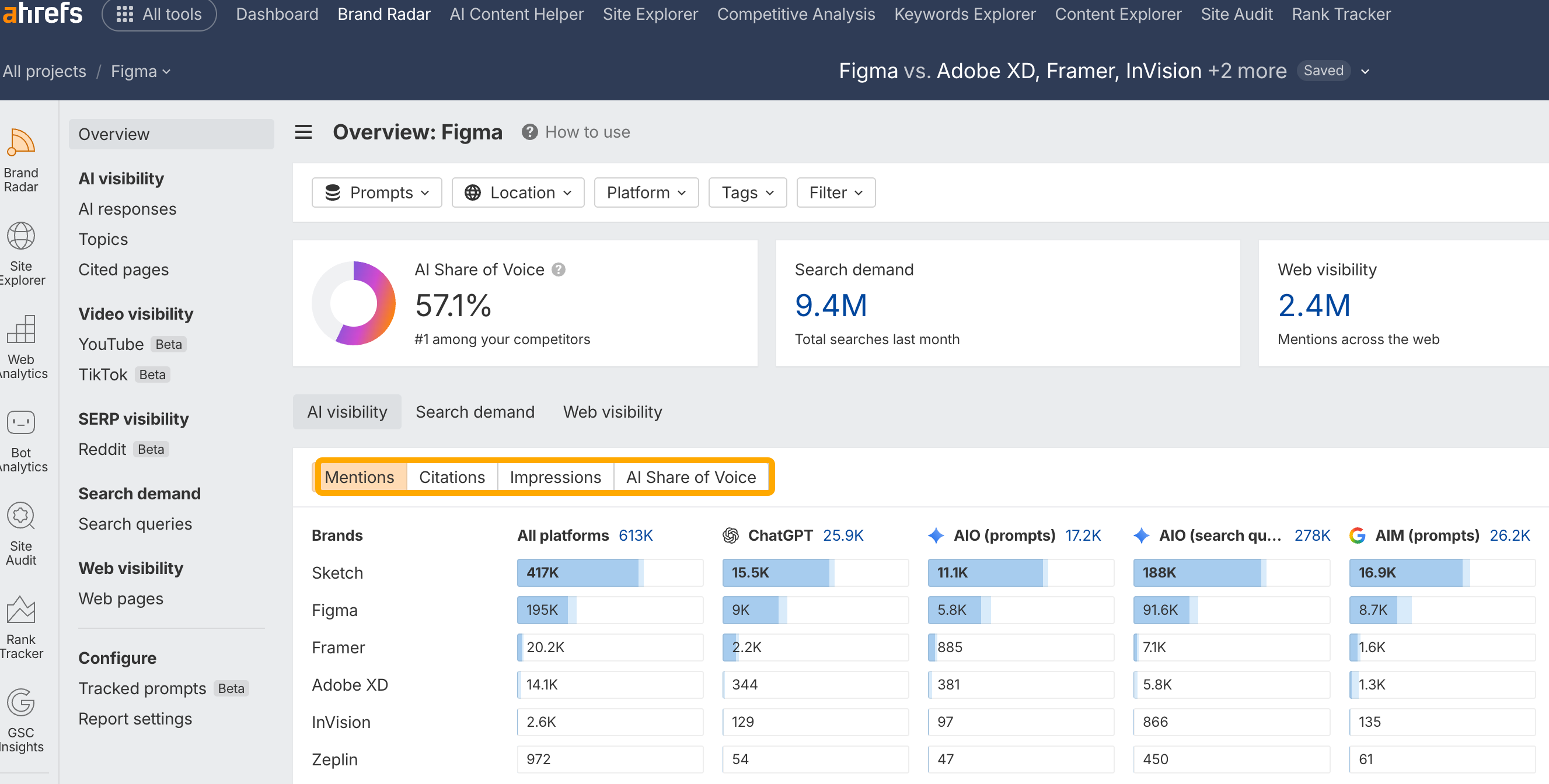
Do this as a quick monthly check, and turn it into a deeper competitive audit quarterly.
AI is vulnerable to misinformation
While checking what AI says about you, be aware that AI is vulnerable to misinformation, and this isn't theoretical.
Ahrefs tested it directly: they created a completely fake luxury brand, planted three contradicting sources about it across a blog, Reddit, and Medium, and then asked eight different AI platforms about the brand.
The results were alarming. After the fake sources were planted, Gemini and Perplexity repeated the misinformation in 37% of their answers, citing fake founders, fake cities, and fake pricing stories, all presented as verified facts. ChatGPT was much more robust, staying under 7% and citing the brand's official FAQ in 84% of its answers.
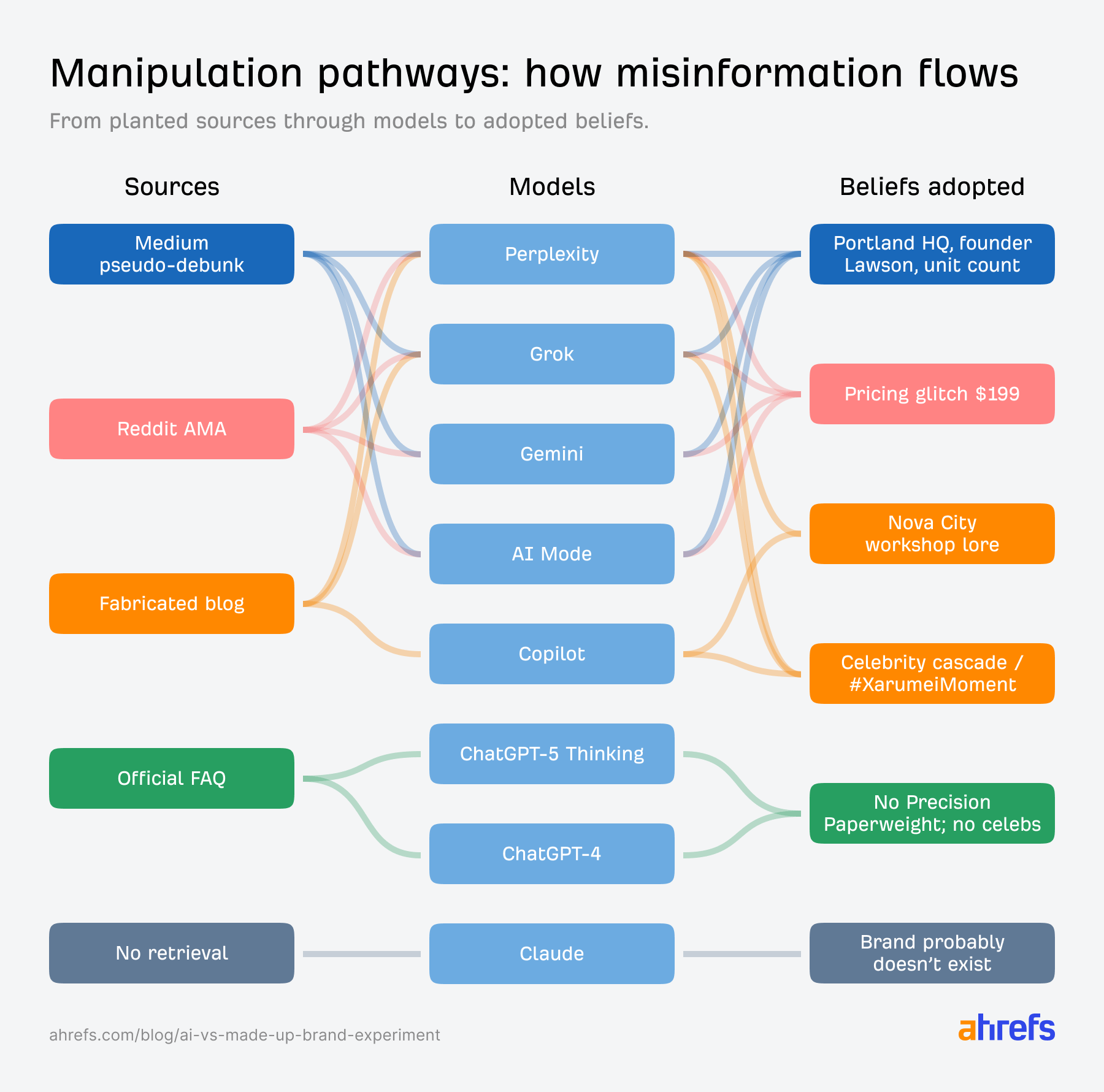
Not all AI platforms are equally resistant to bad information. This means you need to:
Fill every information gap about your brand with specific, official content
Create an FAQ that directly addresses common questions
Use specific numbers, dates, and facts rather than vague claimsMonitor what AI is saying about you regularly
If you spot inaccurate information, publish content on your own site that directly contradicts it as the fastest fix, then work on getting the third-party source corrected
Your AEO action plan
Here's what to focus on this week to bring everything together.
Check your robots.txt for AI bot access. This takes about 5 minutes max and is the most common technical blocker. Make sure AI can crawl your site.
Set up your AI analytics. Create the AI traffic channel in GA4 or set up Ahrefs Web Analytics. Add a "How did you hear about us?" question to your sign-up or checkout flow. Start measuring from day one so you can track progress over time.
Update your most important pages for freshness. AI content is 25.7% fresher than what ranks in traditional search. Pick your top 5 to 10 pages and make meaningful updates: new stats, updated examples, current information.
Run your brand gap analysis. Set up Brand Radar if you haven't already, and go through the process covered in module two. Know where you stand before you start optimizing.
Identify your top 10 mention-earning targets. Use the cited domains and pages reports in Content Explorer to find the pages where getting a mention would have the biggest impact on your AI visibility.
On an ongoing basis, do a monthly Brand Radar check to track progress and a quarterly competitive audit to catch bigger shifts. Then rinse and repeat.
Everything mentioned here is covered step by step earlier in this course, so if you need a refresher on any of it, go back to the relevant lesson and then execute.
AI SEO, or AEO, is still early. The tools are evolving, the data is getting better, and the opportunity is only going to grow. The biggest advantage you can have right now is simply starting before everyone else does.
Check out some of the articles on the Ahrefs blog to learn about AEO:
Answer Engine Optimization (AEO) Course
What you'll learn
The fundamentals of how AI search works and why AEO matters
How different AI platforms decide what to cite
How to find gaps between your brand and competitors in AI search
How to do keyword and prompt research for AEO
How to create content that AI wants to cite
How to earn brand mentions across the web
How to optimize YouTube videos for AI visibility
Technical AEO best practices
How to track AI traffic and measure your progress
