
While ChatGPT has nearly a fifth of Google’s query volume, people use the platforms in different ways.
I wanted to see how ChatGPT compared to Google, not just on the total number of searches, but also searches where they compete with Google, how much traffic they send to websites, and the CTR differences in the systems.
Let’s dig in.
- 65% of ChatGPT usage qualifies as search, but this can be lower depending on how you define search.
- For every search-like query in ChatGPT, there are 8.33 searches in Google.
- Google sends 190x more traffic to websites than ChatGPT.
- ChatGPT’s CTR is 96% lower than Google’s CTR.
The data shows two different business models: Google connects people to websites, ChatGPT keeps them in conversation. If AI search is the future of search, website traffic is in trouble.
| Platform | Daily Searches/Prompts | Annual Total |
|---|---|---|
| 13.7 billion | 5+ trillion | |
| ChatGPT | 2.5 billion | ~912 billion |
Google processes over 5 trillion searches annually (source: Google Internal Data, January 2025).
ChatGPT handles 18 billion messages weekly as of July 2025, which equals approximately 2.5 billion prompts per day.
Not every ChatGPT prompt is a search query. According to research from OpenAI and Harvard, which analyzed 1.5 million conversations, 24% is pure search and 51.6% is asking intent. Asking intent includes interactions where users seek advice, perspective, or information to improve judgment, rather than delegating task completion.
I’ve seen some studies that used those numbers for comparison, but I don’t agree with them. Google does more than just search. There are tools for calculations, translation, and more which are included in other categories in the study. Even things like coding help are categorized differently, but devs have been searching issues on Google (and Stack Overflow) for many years.
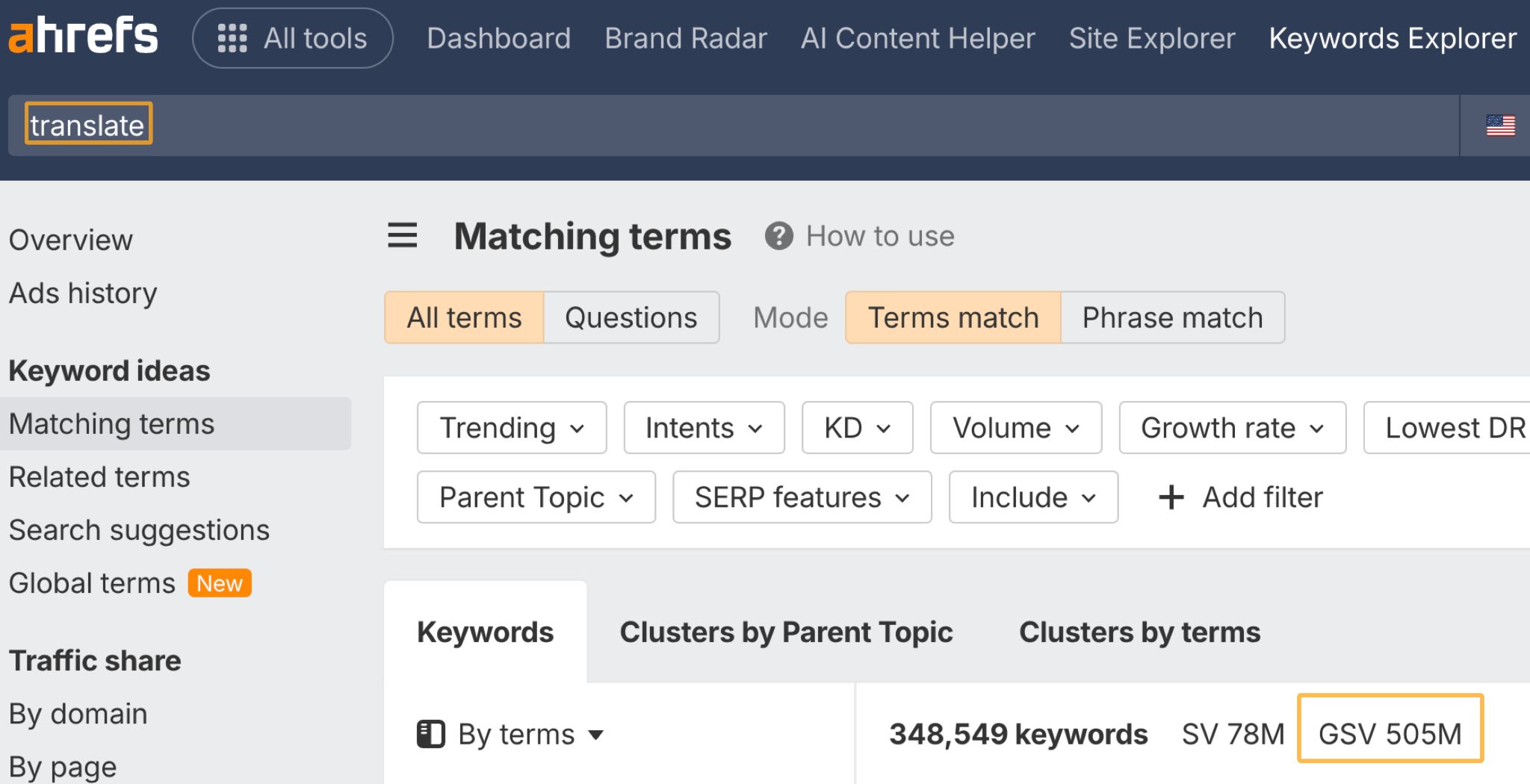
For example, we see hundreds of millions of searches every month for people looking to translate things on Google.
Looking at their examples, I would classify 65% of the searches on ChatGPT as things that were traditionally searched on Google. This is higher than what the researchers classified, but I have more access to data on what people search than they did.
| Category | % of ChatGPT Usage | ChatGPT Daily Volume | % of Google’s Volume |
|---|---|---|---|
| Pure Search (facts, products, recipes) | 24.0% | 600 million | 4.38% |
| Asking Intent (search + advice) | 51.6% | 1.29 billion | 9.42% |
| My Search Classification (things people traditionally searched on Google) | 65.0% | 1.625 billion | 11.86% |
ChatGPT gets ~12% of the search volume of Google for things people have traditionally searched for on Google. For some comparison, it’s estimated that Bing gets 1.2 billion searches a day. ChatGPT has surpassed Bing in search!
If you haven’t seen it yet, Ahrefs built https://chatgpt-vs-google.com/ with data from Ahrefs Web Analytics across 76,000 websites.
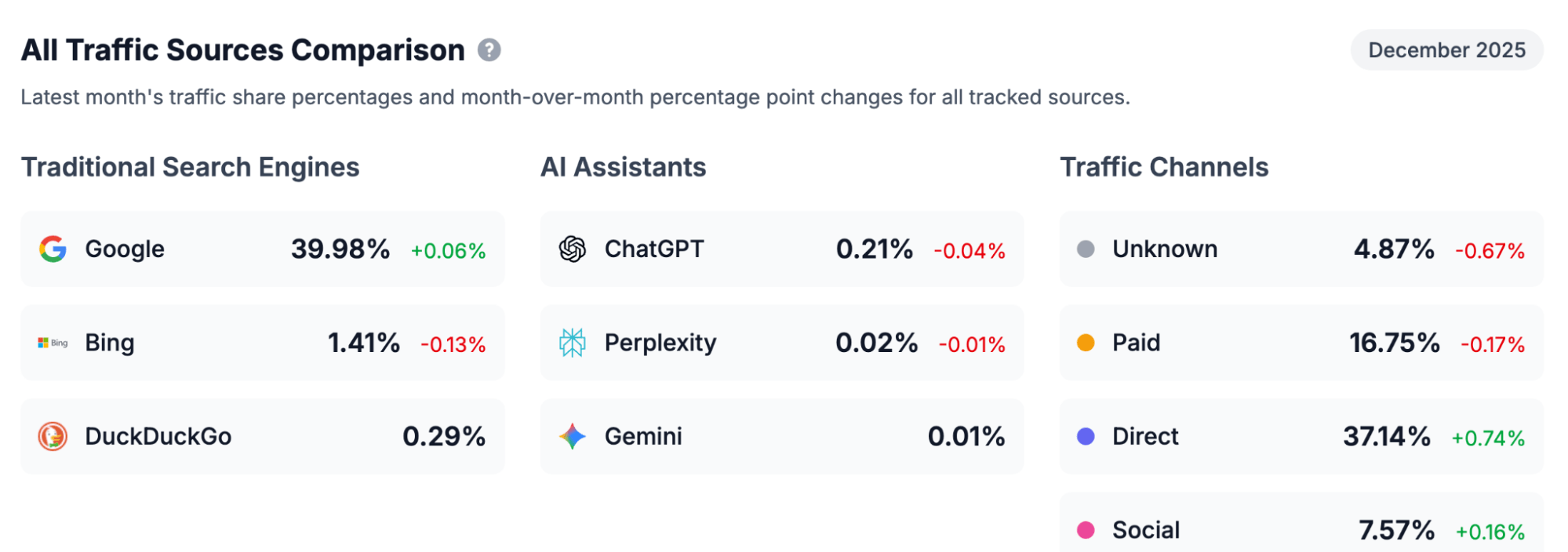
If we look at the traffic coming to websites, Google sends 190x more traffic to websites than ChatGPT. Google makes up nearly 40% of traffic to websites and ChatGPT just 0.21%.
This is where the platforms diverge completely.
I ran the numbers for the different classifications, but again I believe that my search classification is more accurate than those from the paper. I came up with ChatGPT having a 96% lower CTR than Google.
Calculation method: Estimated CTR = (Traffic Share % / Daily Queries in billions) × 10
| Platform/Category | Daily Queries | Traffic Share | Estimated CTR | CTR vs Google |
|---|---|---|---|---|
| 13.7 billion | 39.98% | 29.2% | Baseline | |
| ChatGPT (Pure Search) | 600 million | 0.21% | 3.5% | 88% lower |
| ChatGPT (Asking Intent) | 1.29 billion | 0.21% | 1.6% | 94% lower |
| ChatGPT (My Search Classification) | 1.625 billion | 0.21% | 1.3% | 96% lower |
| ChatGPT (All Usage) | 2.5 billion | 0.21% | 0.84% | 97% lower |
Final thoughts
Google remains the dominant search engine with 5.5x more daily activity. ChatGPT made headway into search in a short amount of time. They’ve passed longtime search rivals like Bing.
However, I’m not sure if website owners will accept the drop in traffic or if they will eventually push back on AI search.