
Long-tail vs. Short-tail Keywords: What’s the Difference?

SEO & Marketing Educator at Ahrefs
The difference between long-tail and short-tail keywords comes down to popularity. Many people search for short-tail keywords, while few search for long-tail keywords.
Because of that, long-tail keywords are generally easier to rank for and tend to attract searchers with more specific intent. This has made targeting them a widely adopted SEO tactic.
So should you follow suit and prioritize long-tail keywords at all times?
But first, why are they called that?
It’s not about how many words they contain or how specific they are.
Short- and long-tail keywords got their respective names from the position on the “search demand” curve.
If we take all search queries that people have performed in Google in the course of a month and order them by their search volumes, it’ll look somewhat like this:
As you can see, long-tail keywords are literally in the “long tail” of this graph. It’s because they are less popular (but not “worse”) variations of the short-tail keywords/head terms on the “fat head” of the curve.
By the way, there are two types of long-tail keywords you should know.
Supporting long-tail keywords
Supporting long-tail keywords are less popular variations of more popular search queries. They are basically broader topics in disguise.
To illustrate, while some people will search for “bedroom furniture chests”...
… the majority of people will look for the same thing using simply “dressers”:
As you can see, despite having dramatically different search volumes, those keywords have virtually the same Keyword Difficulty (KD) scores. That’s one of the main reasons why using supporting long-tail keywords as primary keywords may not be the best idea.
So in most cases, you should probably avoid supporting long-tail keywords and focus instead on the other type: topical long-tail keywords.
Topical long-tail keywords
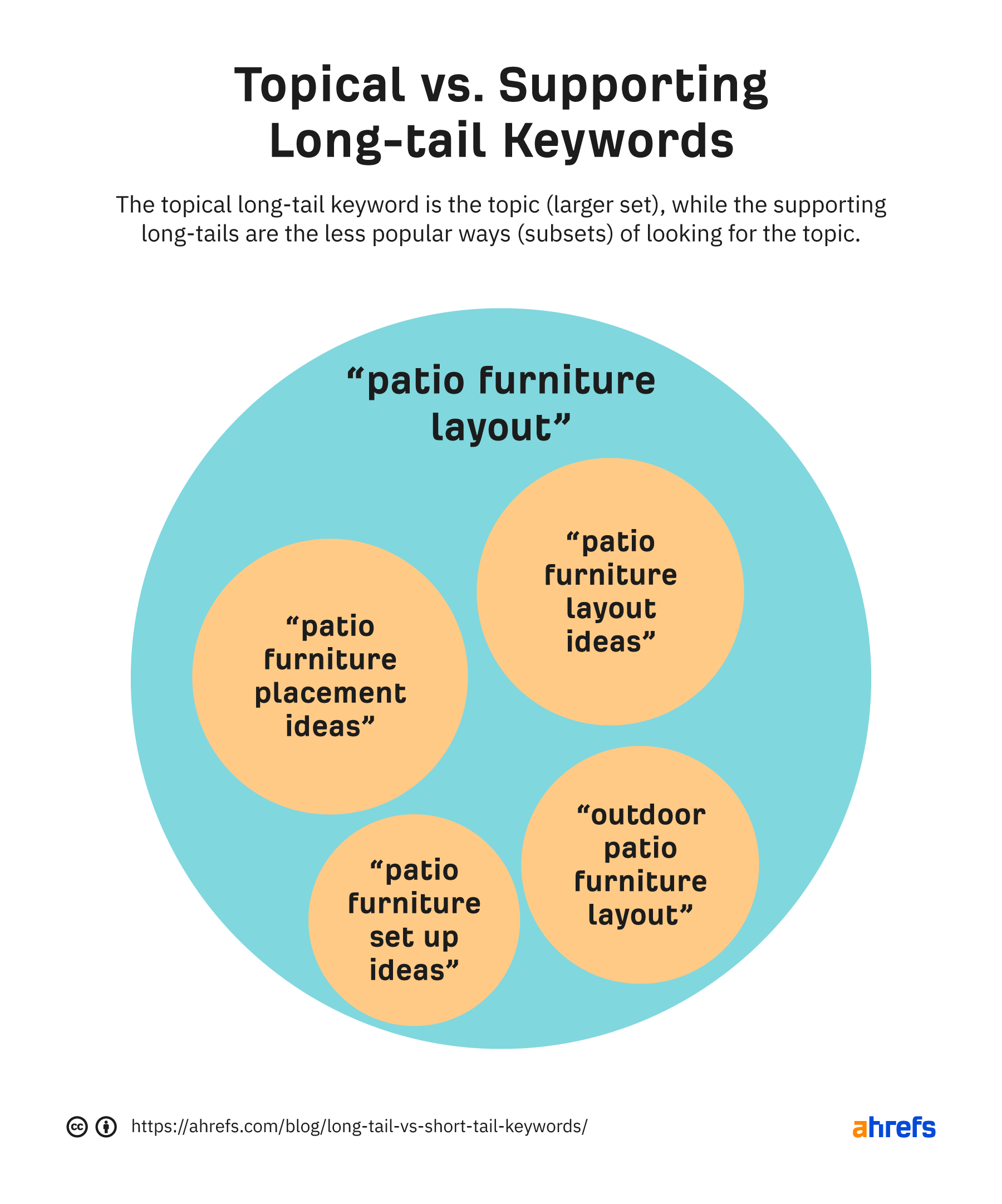
Topical long-tail keywords are the most popular way to look for a given topic. In other words, they are topics in themselves and not some other topics in disguise.
To tell if you’re dealing with topical or supporting long-tail keywords, you can do two things:
- Google the term and see what the top-ranking pages talk about
- Use the Parent Topic feature in Ahrefs’ Keywords Explorer – If the keyword is the same as the Parent Topic, you’re dealing with a topical keyword. Technically, the Parent Topic is the most popular keyword that the top-ranking page ranks for.
It’s good to know whether your keyword is topical. Because if you manage to rank for it, you’ll likely rank for the less popular supporting long-tail.
Which are better: long-tail or short-tail keywords?
Both keyword types have their pros and cons.
Short-tail keywords will have a lot of competition, but it’s not impossible to outrank pages in the top 10.
It may take years (yes) of fine-tuning your content and years of building links.
But once you finally get there:
- You’ll get serious traffic from the head term and relevant long-tail keywords.
- Chances are you’ve amassed some good backlinks if you’re ranking high for these keywords. You can then use internal links from that page to boost other pages.
As for long-tail keywords, they’re great for other reasons. In most cases:
- They’re less competitive.
- There are lots of them.
- They are usually specific; you can attract visitors with specific intent.
On the flip side, you will need to rank for a lot of them to get a large volume of traffic. But as long as these keywords are good for your business, that traffic may be very valuable.
Case in point: left-handed nail scissors. Not many searches overall. But if you’re a shop for left-handed people like Lefty’s, customers will surely expect that product.
Bottom line? I’d say if you want to be the go-to resource for your topic, you may want to target both short- and long-tail keywords (see also: topical authority). Try to target topical long-tail keywords instead of supporting long-tail keywords, though.
How to find short-tail keywords
If you take a keyword research tool like Ahrefs’ Keywords Explorer, type in something broad like “electric cars,” and sort the results by volume, you’ll get a list of keywords. The results at the top will be your short-tail keywords.
That’s it. If you don't know what words to type in the tool, try:
- Looking at the topics people talk about on social media
- Taking some online industry magazines and look at often-featured topics
- Analyzing your competitors’ keywords (more on this in the next section)
- Using a research audience tool like SparkToro
How to find long-tail keywords
Keyword research and competitive analysis tools can help you find long-tail keywords, too. You just need to set some filters. Let's look at a couple of ways to do it.
Use a keyword research tool
- Enter a broad topic
- Go to the Matching terms report
- Set the Volume and Traffic Potential filters to a maximum of 300
- Click Show results
Sidenote
If you don't see great results with these settings, set the volume and TP filters a bit higher. I don't recommend going above a few hundred, though, as the results won't be long-tails at that stage.
From there, refining your initial keyword list is a good idea. You can do that using the remaining filters inside the tool.
For example, you can use Keyword Difficulty (KD) to get only low-competition keywords, such as:
Or you can use modifier keywords, such as “for,” to let some niches emerge.
Some examples:
Of course, you can mix and match. Below is a filter that finds long-tail keywords posed as questions with low difficulty and minimum search volumes.
Examples:
Analyze competitors’ keywords
You can use a similar process to find good long-tail keywords among your competitors.
For this, use a tool like Ahrefs’ Site Explorer. You can:
- Enter any URL.
- Go to the Organic keywords report.
- Set the Volume to max 300 (Traffic Potential filter is unavailable here).
- Click Show results.
Sidenote
If you don't see great results with these settings, set the volume and TP filters a bit higher. I don't recommend going above a few hundred, though, as the results won't be long-tails at that stage.
Looking up the popular cooking website loveandlemons.com, we’ll get keywords such as:
Final thoughts
Probably the most important takeaway here is not to target keywords only because they belong to the long-tail or short-tail camp.
Instead, try this four-step process for finding keywords (we use it ourselves at Ahrefs):
- Find keywords with search traffic potential
- Make sure you create content that aligns with search intent
- Make sure the keyword has “business potential”
- Make sure you can rank for the keyword
Read all about the process in How to Choose the Right Keywords for SEO.
Got questions? Ping me on Twitter.
Mateusz Makosiewicz is a marketing researcher and educator at Ahrefs. He has been involved in marketing for over 15 years, specializing in growth marketing, content marketing, marketing strategy, and management.
Mateusz studied Advertising and Media Marketing at the University of Gdańsk. He gained his marketing experience in agencies, SaaS companies, and hardware companies where he worked in various roles, from managing advertising projects for clients to leading marketing departments.
On Ahrefs blog he writes about SEO and marketing based on experience drawn from testing probably every piece of marketing advice ever published, trial and error in startup marketing in the Silicon Valley, and tweaking growth engines like his life depended on it.

Keep learning





Your weekly marketing’s must-reads
Join 284K marketers for weekly news, useful reads, industry updates, and the memes you didn’t know you needed.
Explore what’s inside the newsletter →