
If you don’t know, that’s a problem. ChatGPT influences millions of product decisions every day—and unlike Google, it gives you zero impressions data, no Search Console, and no built-in analytics.
In this guide, I’ll show you how to monitor your brand mentions in ChatGPT: from a free manual approach you can do today, to the dedicated tools that automate it, to what to actually do with what you find.
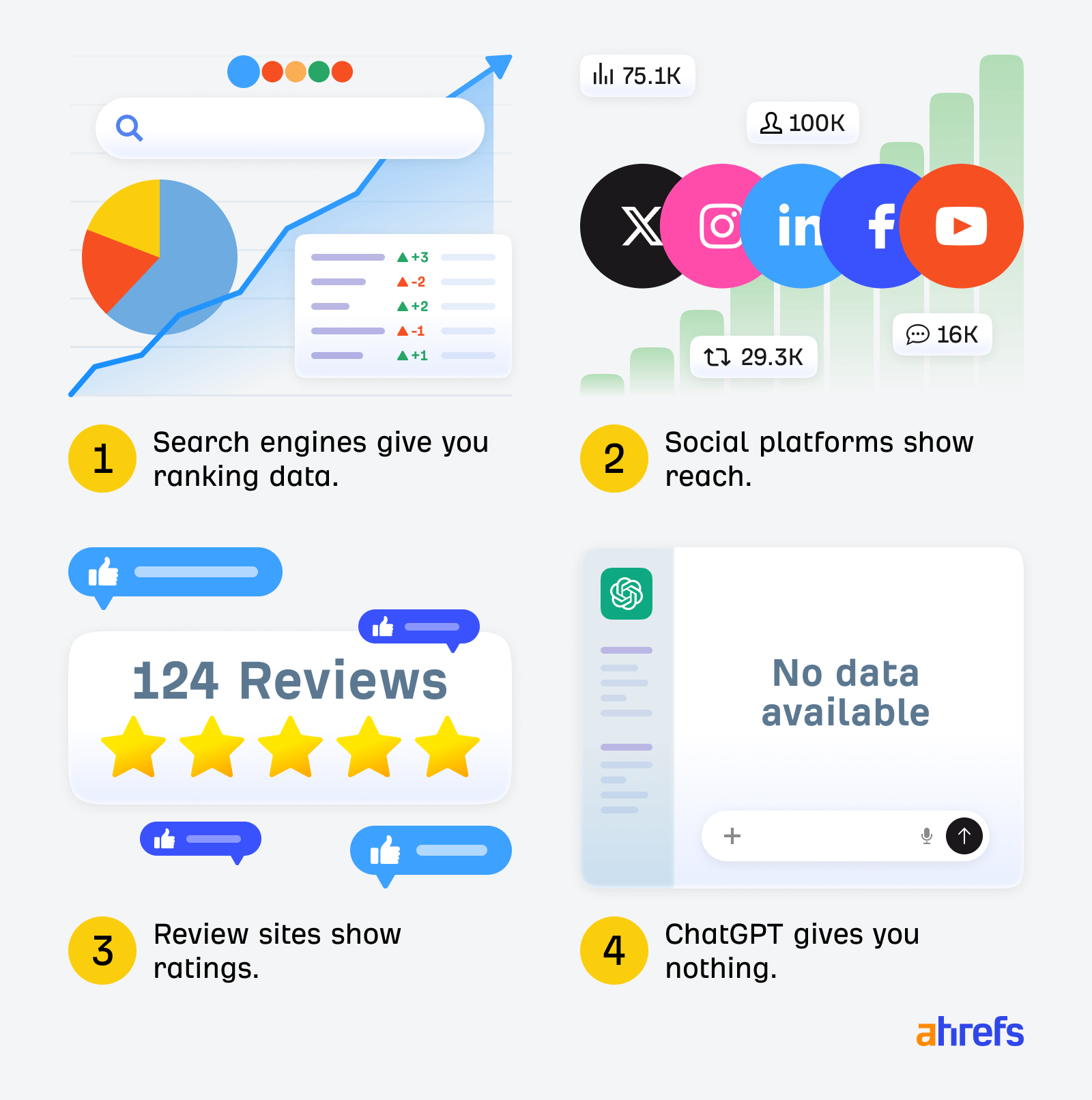
Search engines give you ranking data. Social platforms show reach. Review sites show ratings.
ChatGPT gives you nothing.
And yet, hundreds of millions of people use it for research, comparisons, and buying decisions.
This isn’t traditional search, where you can track rankings and fight your way to position one. There’s no results page to climb.
It’s also different from social listening. Social conversations play out in public, where you can monitor what’s being said and jump in if you need to. ChatGPT conversations happen out of view, and you’re not part of the exchange.
ChatGPT pulls from a mix of training data and live sources, then synthesizes an answer on the fly.
Whether your brand gets mentioned comes down to whether you’re meaningfully present in the sources it relies on.
That’s why monitoring ChatGPT mentions requires its own strategy.
Brand mentions are when your brand name appears directly in ChatGPT’s generated answer.
If someone asks “Which tool is best for Project Management?” and ChatGPT says “ClickUp and Asana are commonly used for this,” those count as inline brand mentions.
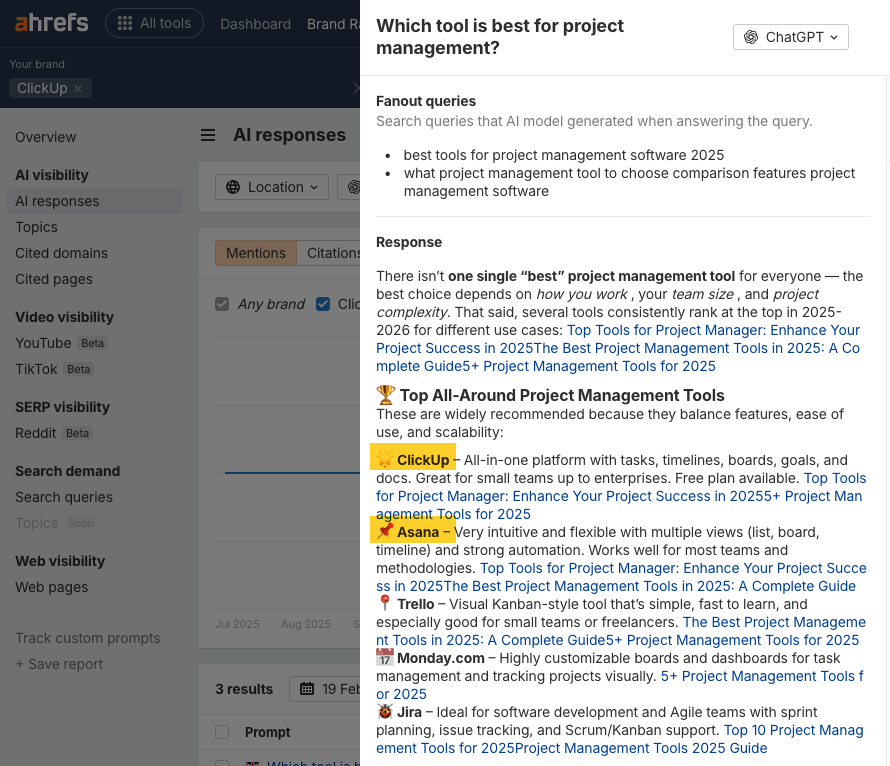
They either come from ChatGPT’s training data—the large body of text it was trained on—or external sources like Google via a process called “Retrieval Augmented Generation” or “RAG”. This is where AI models actively search Google, Bing, and other search engines to find current information.
If your brand is well-represented in authoritative sources, industry comparisons, and review content, it’s more likely to appear in ChatGPT answers.
Brand mentions are not the same as citations
When ChatGPT answers, it often retrieves search sources and cites them in its response—linking to pages that back up its answer.
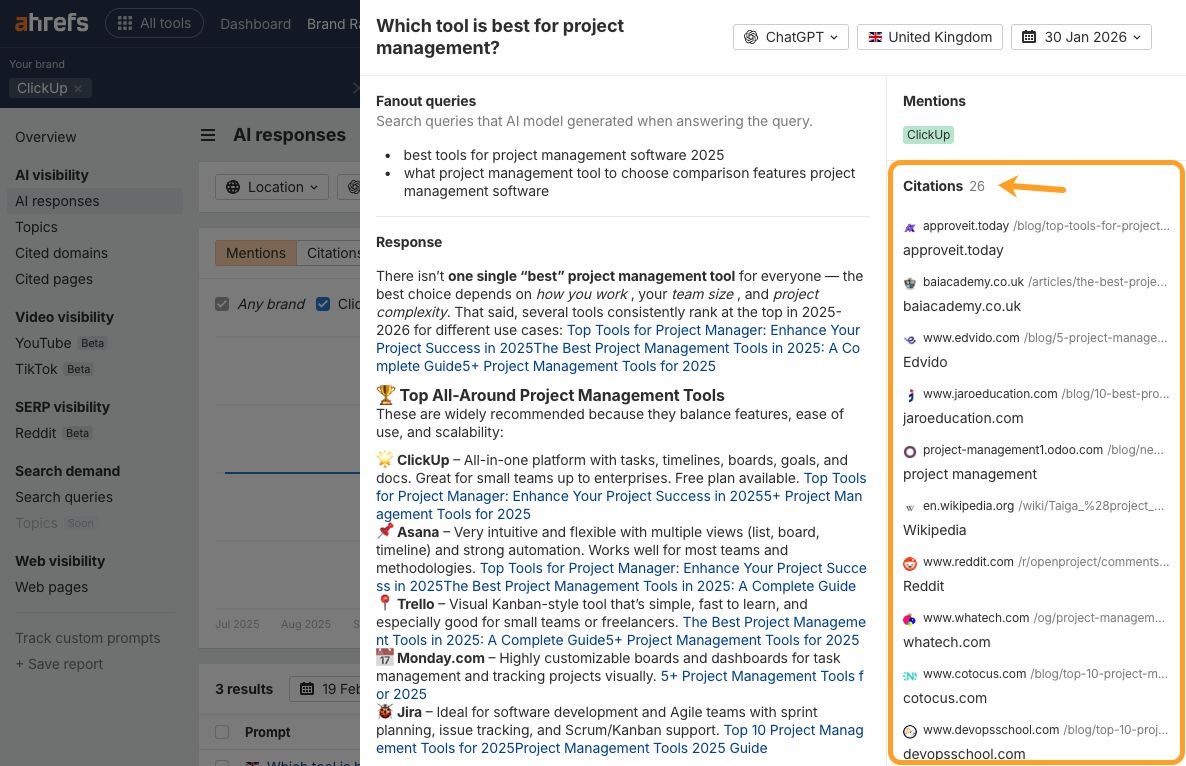
Citations are not brand mentions. This distinction matters a lot for strategy.
The fix for missing inline mentions is mostly about expanding your brand’s footprint in authoritative third-party content: industry roundups, comparison pieces, publications that feed LLM training data.
Fixing missing citations looks more like traditional SEO: keep content updated and crawlable, and publish clear, authoritative resources that front-load key insights so ChatGPT can surface your pages.
The quickest and most basic way to assess your ChatGPT brand presence costs nothing: just open ChatGPT and ask questions.
The two things you need to remember: log out and prompt in incognito mode.
Otherwise, ChatGPT may personalize responses based on your previous chats, saved memory, or custom instructions.
You also need to ask the right questions. Here are some ideas for prompt structure…
| Brand-related prompts | Category prompts |
|---|---|
| What is [Your brand] and what is it used for? | What are the best tools for [your category]? |
| What do people think about [Your brand]? | What should I look for in a [product/service type]? |
| How does [Your brand] compare to [Competitor A] and [Competitor B]? | Give me a shortlist of options for [solving X problem]. |
You can also take inspiration from the DEJAN methodology, created by Dan Petrovic, where you repeat the following two queries:
- Brand-to-Entity prompts (B→E): “List ten things that you associate with a brand called [Your brand].” This reveals the concepts and entities most strongly linked to the brand.
- Entity-to-Brand prompts (E→B): “List ten brands that you associate with [Entity/Keyword].” This identifies competitors and reveals the brands most strongly associated with a specific concept.
Once you’ve collected your responses, document them systematically: Does your brand appear at all? If it does, is the description accurate—right features, right pricing tier, right positioning? Is the tone positive, neutral, or slightly negative? And which competitors are mentioned in situations where you’re not?
One tip: run these prompts with web search both on and off.
With it off, ChatGPT draws from training data. With it on, real-time sources influence the output.
This can give you meaningfully different results—and knowing the difference helps you understand whether you have a broader branding problem (i.e. gaps or inaccuracies in training data), a content problem (i.e. gaps or inaccuracies in RAG data), or both.
For instance, with search off, Ahrefs isn’t yet recognized as an AI visibility tool. But with search on, we are…
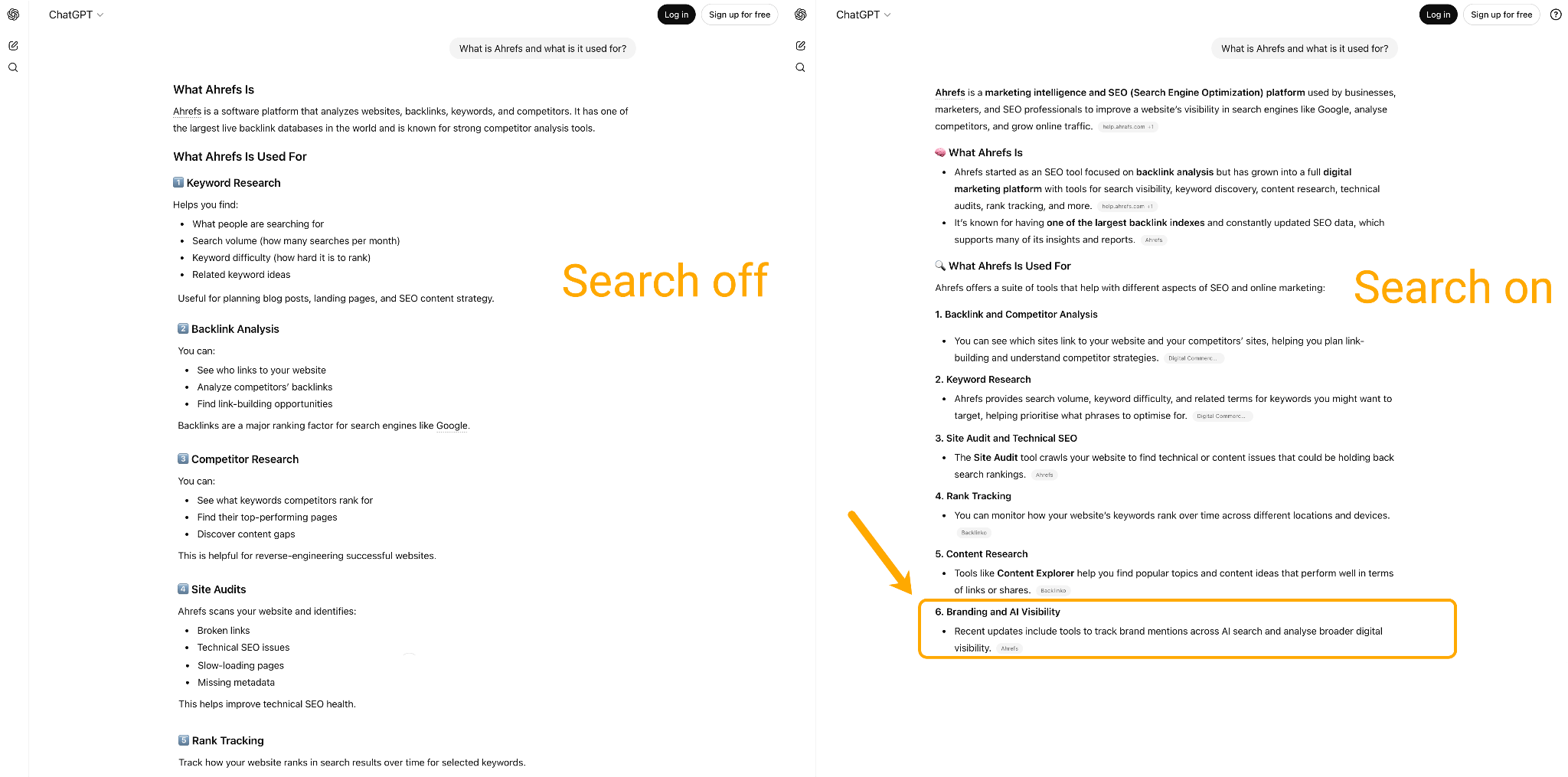
So we know we have some work to do on better associating our brand with “AI” topics and entities, before ChatGPT’s core LLM definitively recognizes Ahrefs as an AI visibility tool.
This kind of analysis shows you how your brand is represented, its strongest topic ties, and what the model’s training data inherently “knows” about you, beyond what search results add.
The drawbacks
The obvious limitation here is scale. You should aim to track as many times as possible during your chosen time period.
ChatGPT responses aren’t deterministic—run the same prompt twice and you’ll get totally different answers; wording, mentions, and citations are all in near-constant flux.
Meaning the more responses you collect, the more reliable your average mention visibility will be.
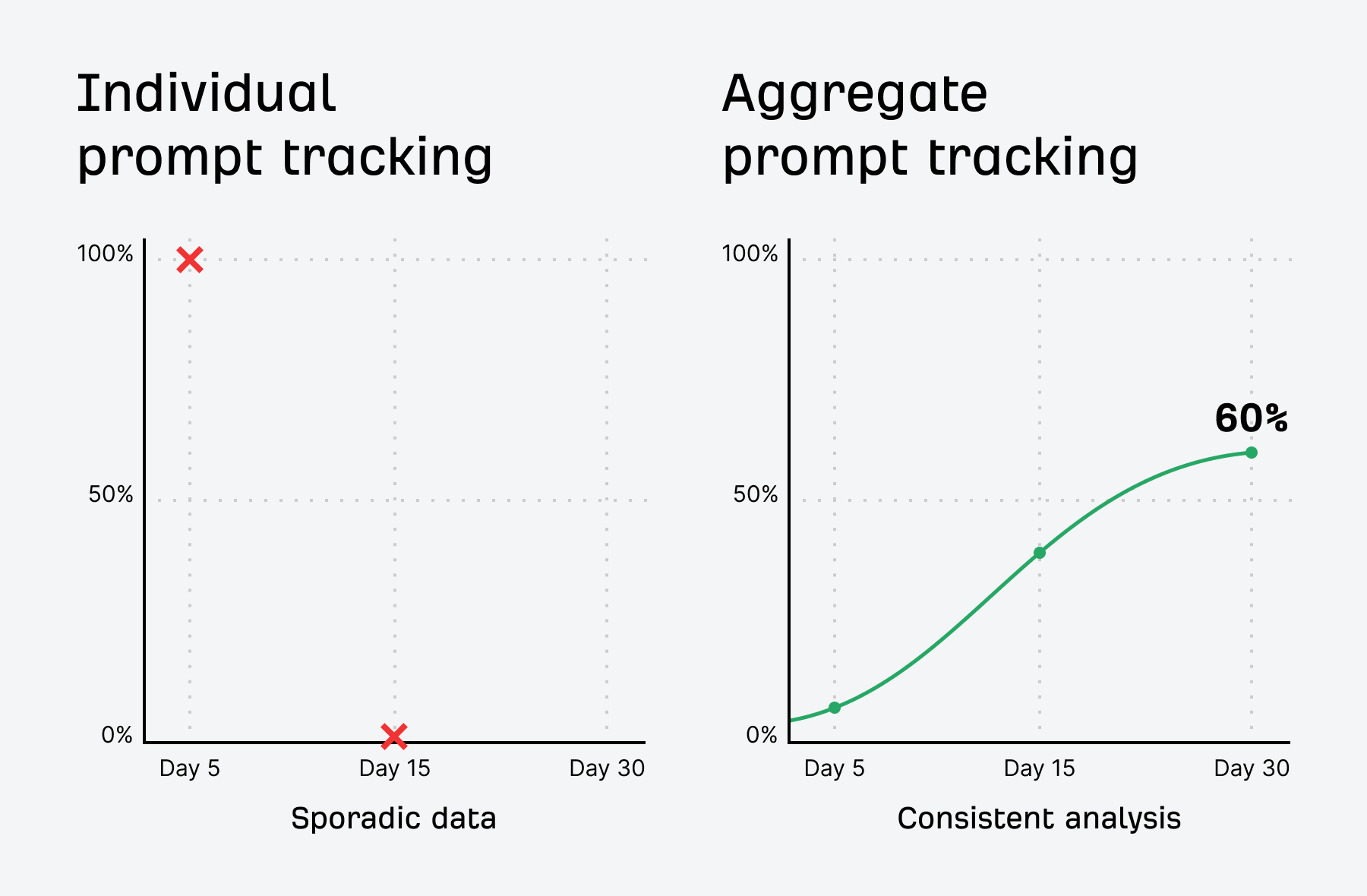
But you can’t easily run a volume of prompts every week manually.
And without scale, you don’t have enough data to spot patterns or measure progress over time.
Manual audits work best for setting an initial benchmark. Run them once to understand where you stand, then use automated tools for scaled, ongoing tracking.
Here’s how to monitor when your brand is mentioned in ChatGPT—and see what’s influencing those mentions.
Monitor your brand’s overall visibility
Start off by assessing your overall performance against the entire Brand Radar database.
Just open Brand Radar, enter your brand name and any competitors you want to benchmark against, then save the report so you can return to it later without rebuilding filters.
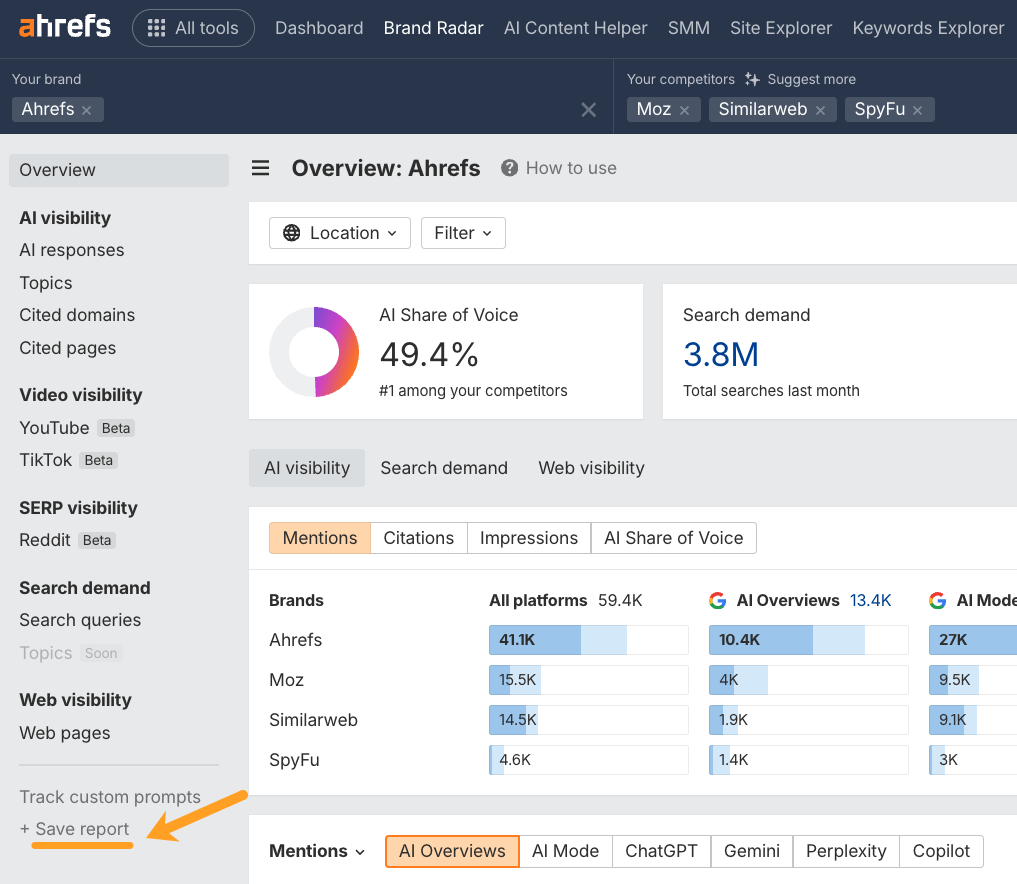
Saving your report means you can check back periodically to measure your mention growth.
Just make sure you’re viewing mentions on the AI visibility chart, then select the ChatGPT index.
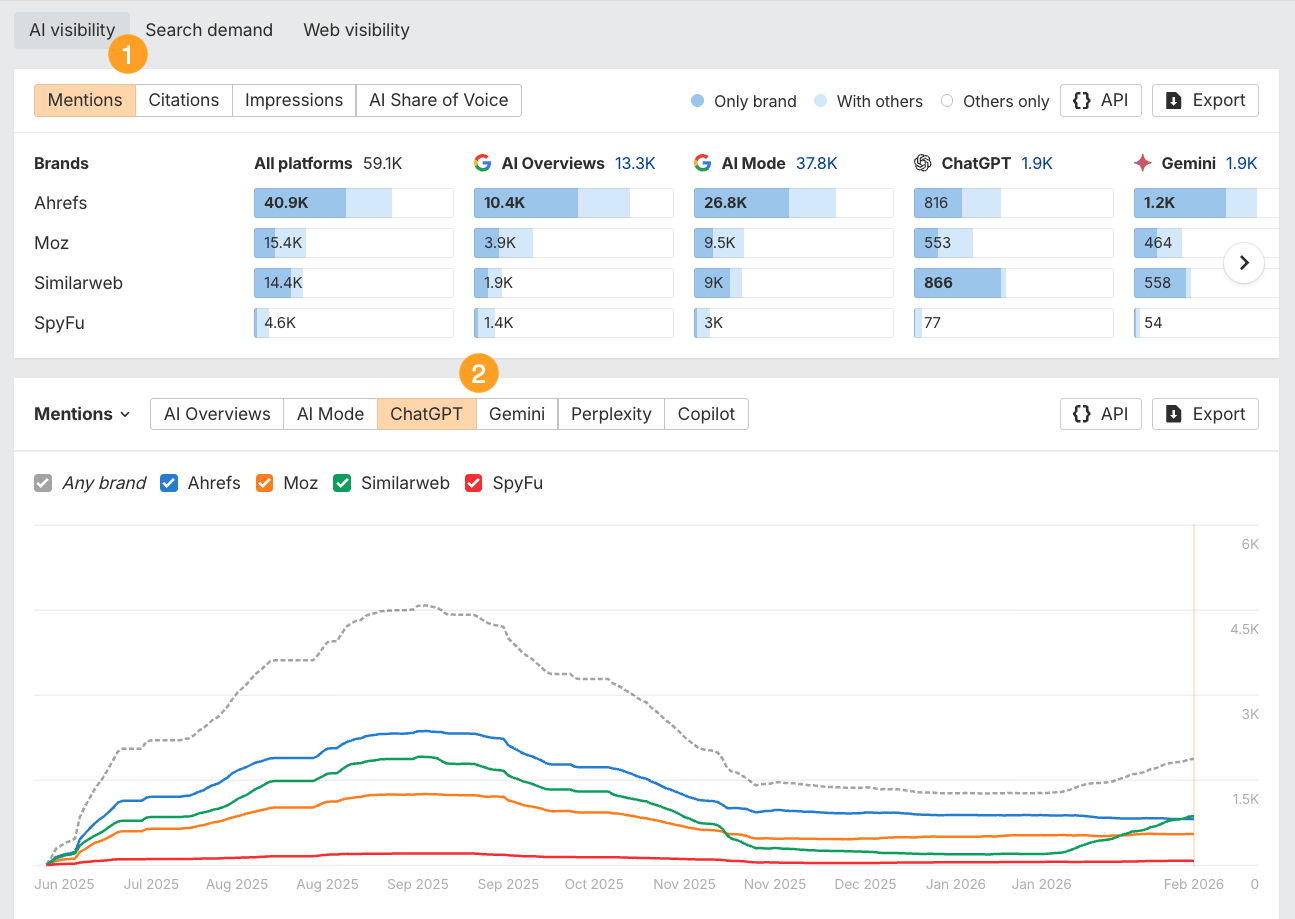
This way, you can see how your performance trends over time versus the competition.
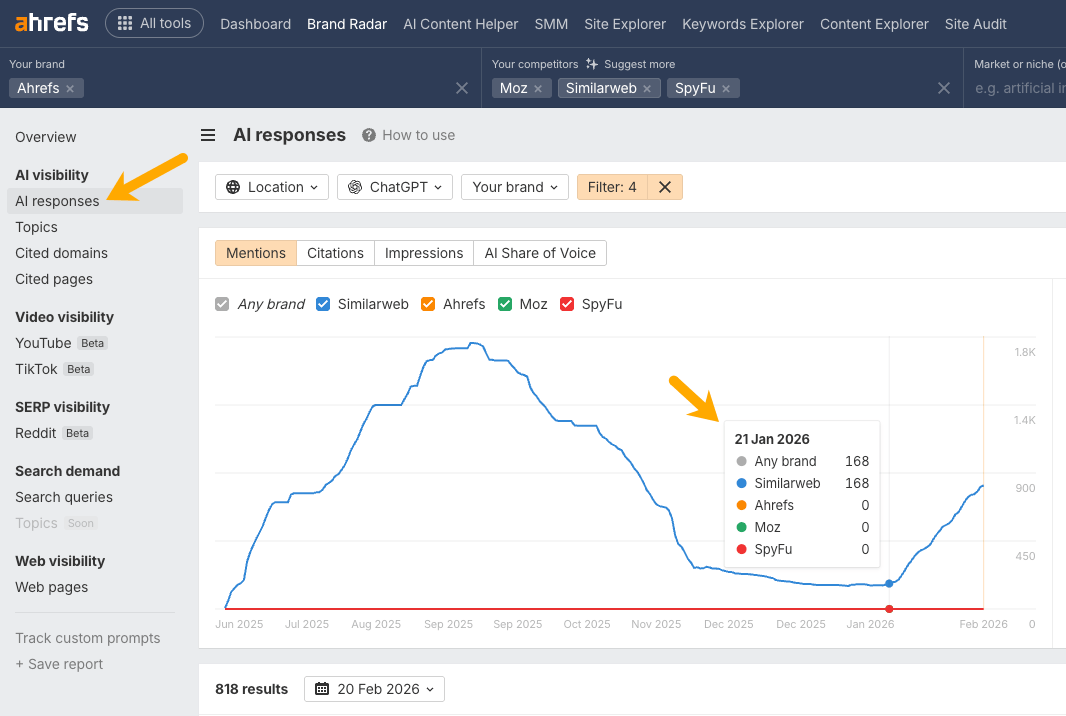
For instance, in the chart above Similarweb (green) are hot on our (blue) heels.
They’ve grown their mention count sharply since the start of the year.
To understand whether this growth was worth replicating, I hovered over Similarweb’s ChatGPT mentions, and hit “Only brand”…
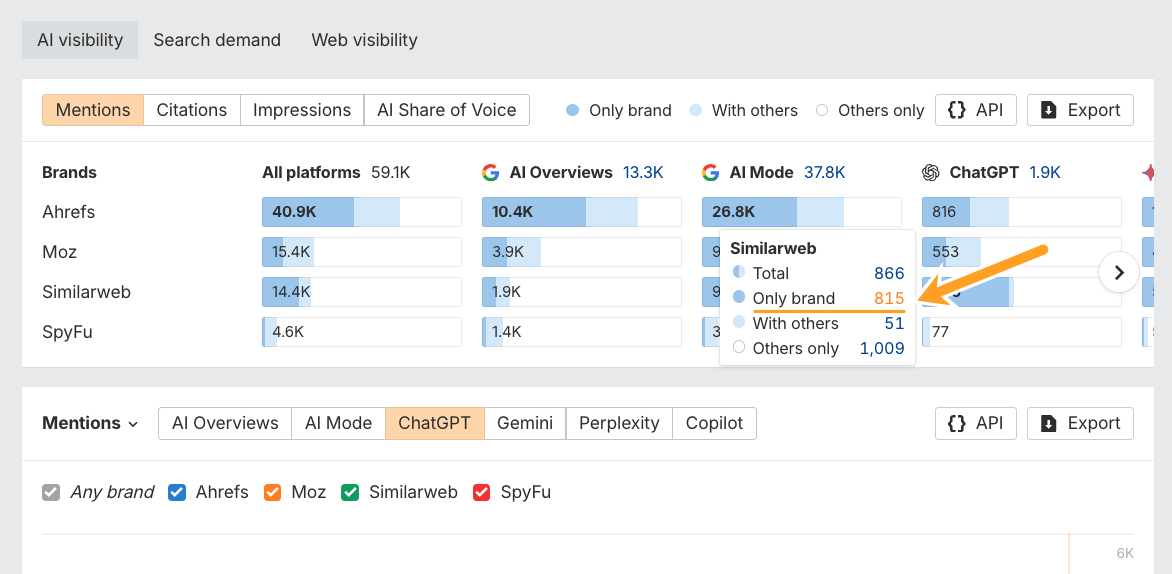
This let me zero-in on Similarweb’s performance in the AI Responses report; their performance had picked up in the last month.
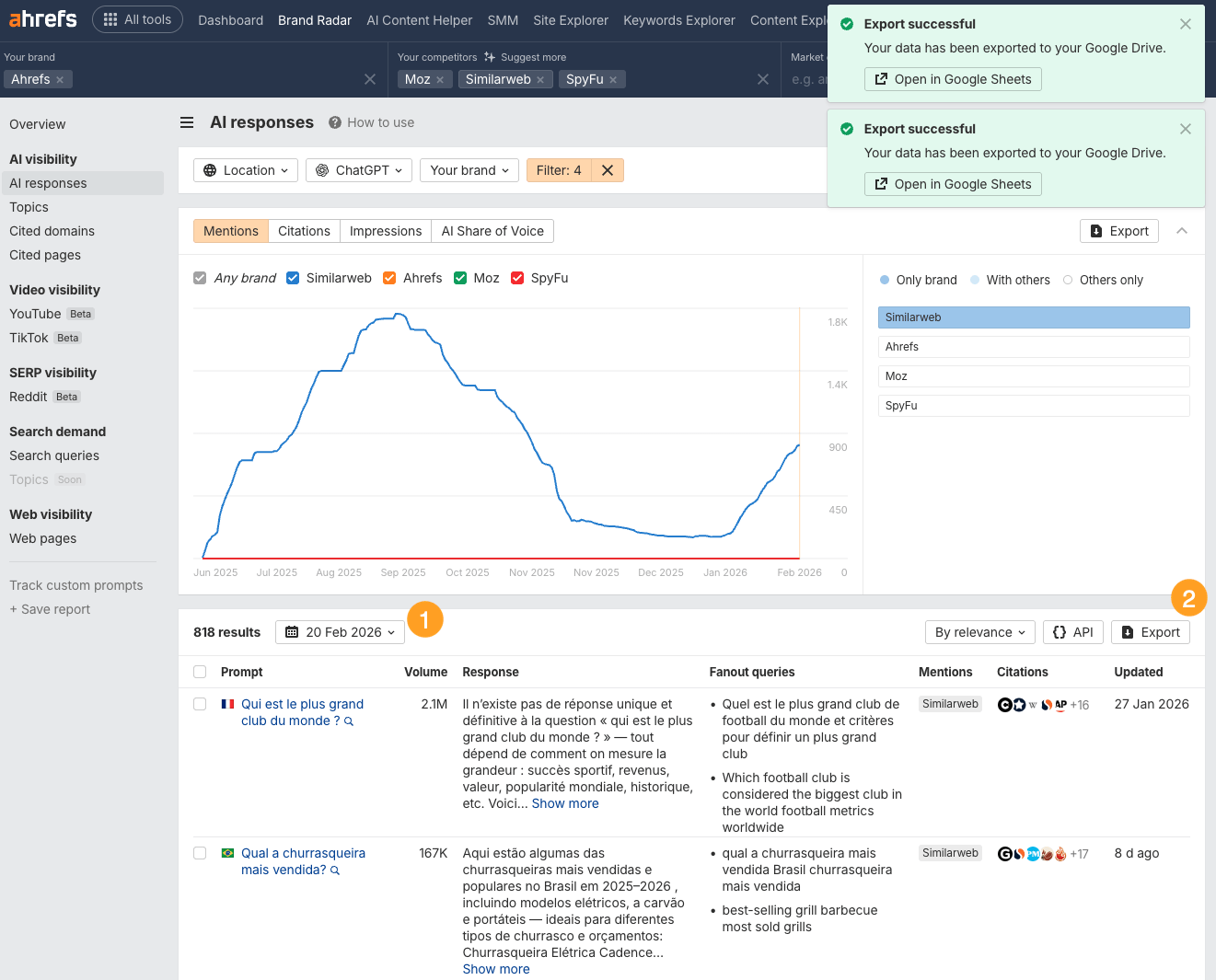
I exported the prompts, responses, fan-out queries, and citations tied to their ChatGPT mentions on the day preceding the mention spike, versus now.
Then, I fed this data to ChatGPT and asked “What kinds of prompts has Similarweb gained visibility for?”
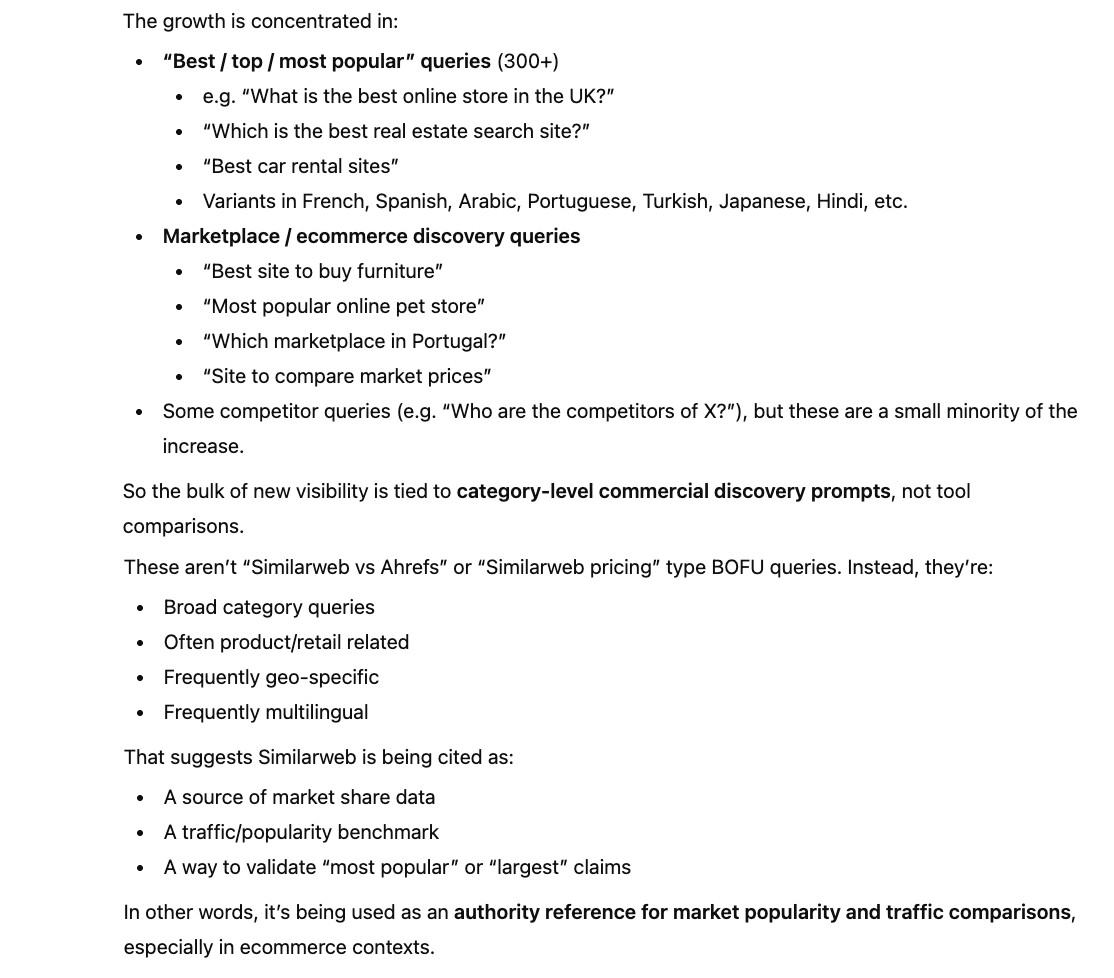
Similarweb has started showing up more often for market share and ecommerce topics.
These aren’t the kind of queries we’re focused on right now, so we wouldn’t look to reverse-engineer this strategy.
Once you’ve analyzed your visibility in context of the entire Brand Radar database, it’s time to home in on the ChatGPT mentions that are most important to you.
Monitor specific ChatGPT mentions with custom prompts
Some mentions matter more than others. Broad analysis is important, but it’s crucial to monitor the conversations that influence real decisions.
With custom prompts, you can track the exact ChatGPT questions and mentions that tie directly to your revenue, positioning, product perception, or campaigns.
Start with a broad category, like “Bottom of funnel” prompts and, within that, define distinct intent angles:
- Comparison query (e.g. “Ahrefs vs Semrush: which is better for keyword research?”)
- Best-of query (e.g. “What’s the best SEO tool for small agencies?”)
- Price/value query (e.g. “Is Ahrefs worth the price in 2026?”)
- Use case query (e.g. “How can I use Ahrefs to find low-competition keywords?”)
- Persona-specific question (e.g. “What’s the best SEO tool for an in-house ecommerce team?”)
- Objection (e.g. “Is Ahrefs too expensive for a small business?”)
Then write 3–5 phrasing variations for each of these angles. A single prompt per angle is too dependent on wording. Three begins to balance out phrasing differences. Five usually indicates strong coverage without overdoing it. This helps to reduce wording bias and account for model randomness.
In Brand Radar, setting up custom prompts is simple. Just choose a project, define your cadence (daily, weekly, monthly), and select the platforms, locations, tags, and competitors you want included.
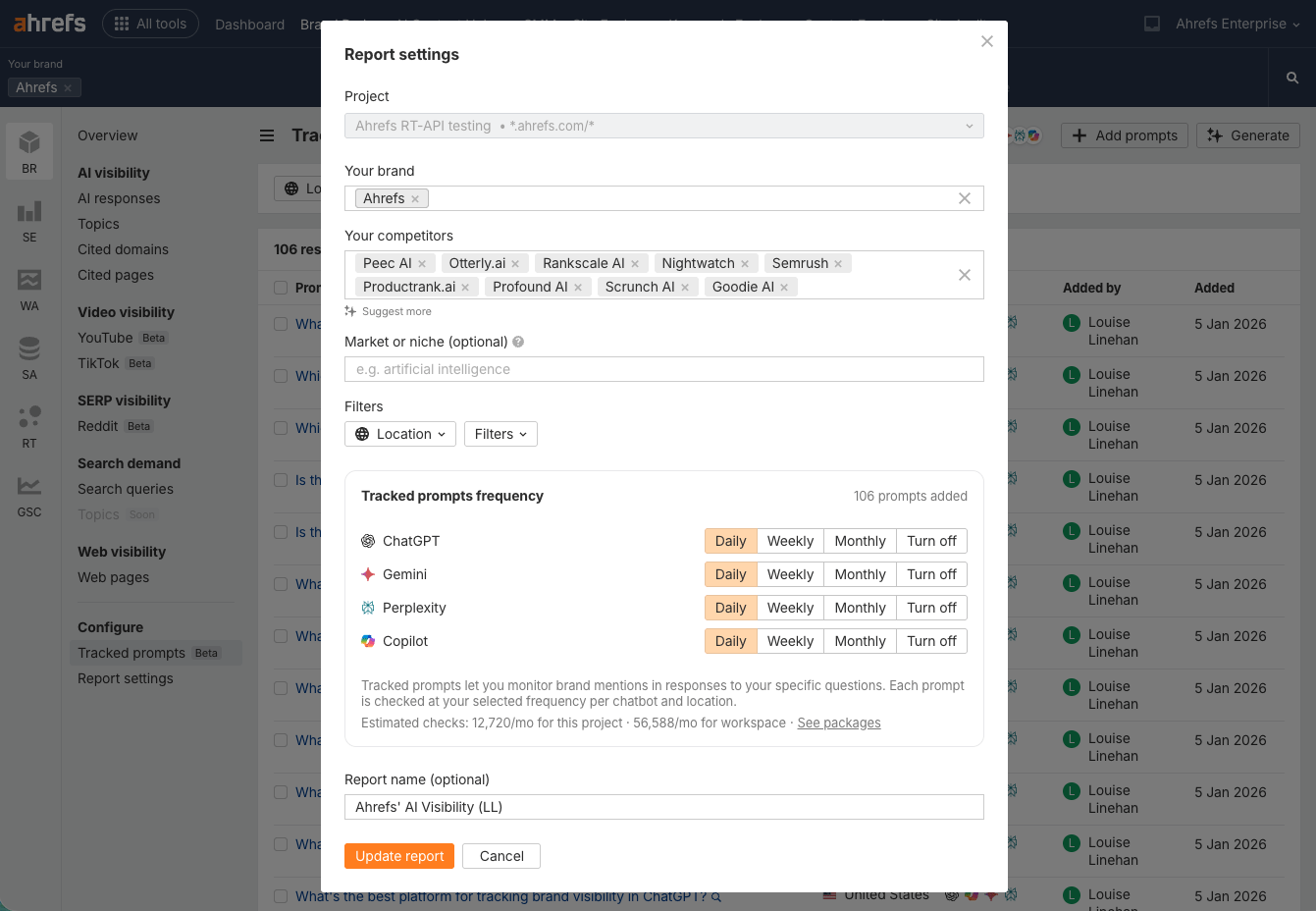
Then allow ~24 hours to populate responses and brand mention data for your tracked ChatGPT prompts.
Once populated, your custom prompt results show up in the native database dashboard.
From there, you can compare your ChatGPT visibility over time and assess the trend direction; looking for growing, flat, or declining mentions.
What you find in monitoring should translate directly into action. The right move depends on your situation.
If you have zero mentions
If your brand isn’t showing up in AI responses, it likely isn’t well-represented in the content sources ChatGPT trusts.
Here’s how to fix that:
- Build content clusters around the questions your audience asks: ChatGPT uses a process called Reciprocal Rank Fusion (RRF) to prioritize the pages that show up repeatedly in search results. Even if those pages are technically lower ranking, if they show up more often, they will win visibility. Clusters help you show up across multiple related queries, which compounds that visibility and strengthens your odds of being cited.
- Outreach to the publications ChatGPT cites: Use Brand Radar’s Cited Domains report to find the most visible publications in your industry, then develop content partnerships with those sites, to build your AI mentions.
- Actively generate reviews: Reviews don’t just influence buyers; they become part of the training and citation layer that informs ChatGPT responses.
- Make your brand information clear: On your brand or about page, spell out what you do, who you’re for, and your core use cases in direct language. LLMs favor content that makes direct, specific claims.
If you have inaccurate mentions
Brand inaccuracies in AI responses mean ChatGPT is probably pulling from outdated content—old pricing pages, discontinued features, or articles written about an earlier version of your product.
Here’s what to do about that:
- Publish updated content that explicitly states the correct information: Be specific: instead of “our pricing has changed,” say “our Starter plan is now $49/month and includes X, Y, Z.”
- Update third-party sources where possible: YouTube, Reddit, Wikipedia (if applicable), industry directories—these are high-signal sources for LLMs and worth keeping current.
- Account for model update cycles: Because ChatGPT has a knowledge cutoff, some inaccuracies will phase out as newer data gets incorporated. Instead of pouring effort into one big correction campaign, prioritize steady content updates that improve accuracy over time.
If competitors are outranking you
To understand why ChatGPT favors a competitor, study the content and context of their mentions in AI responses.
Just head to the ChatGPT “Mentions” bar chart and hover over your brand, then click “Others only”.
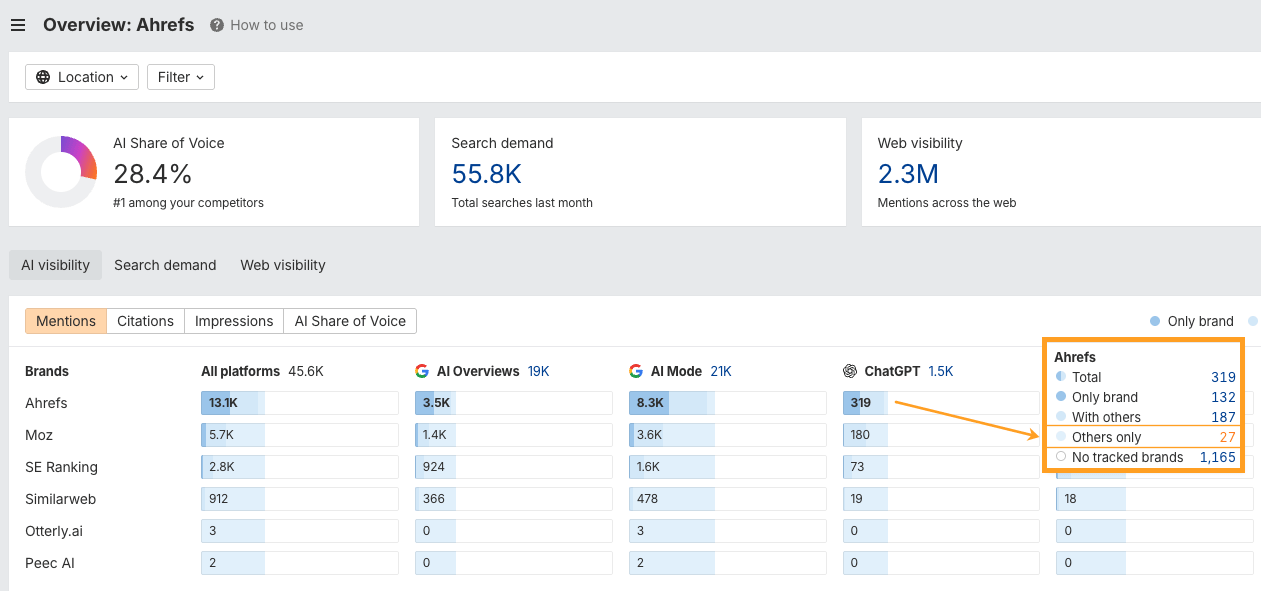
This will instantly generate a selection of filters in the AI responses report, showing you the prompts, responses, and fan-out queries that exclude your brand, but include your competitors.
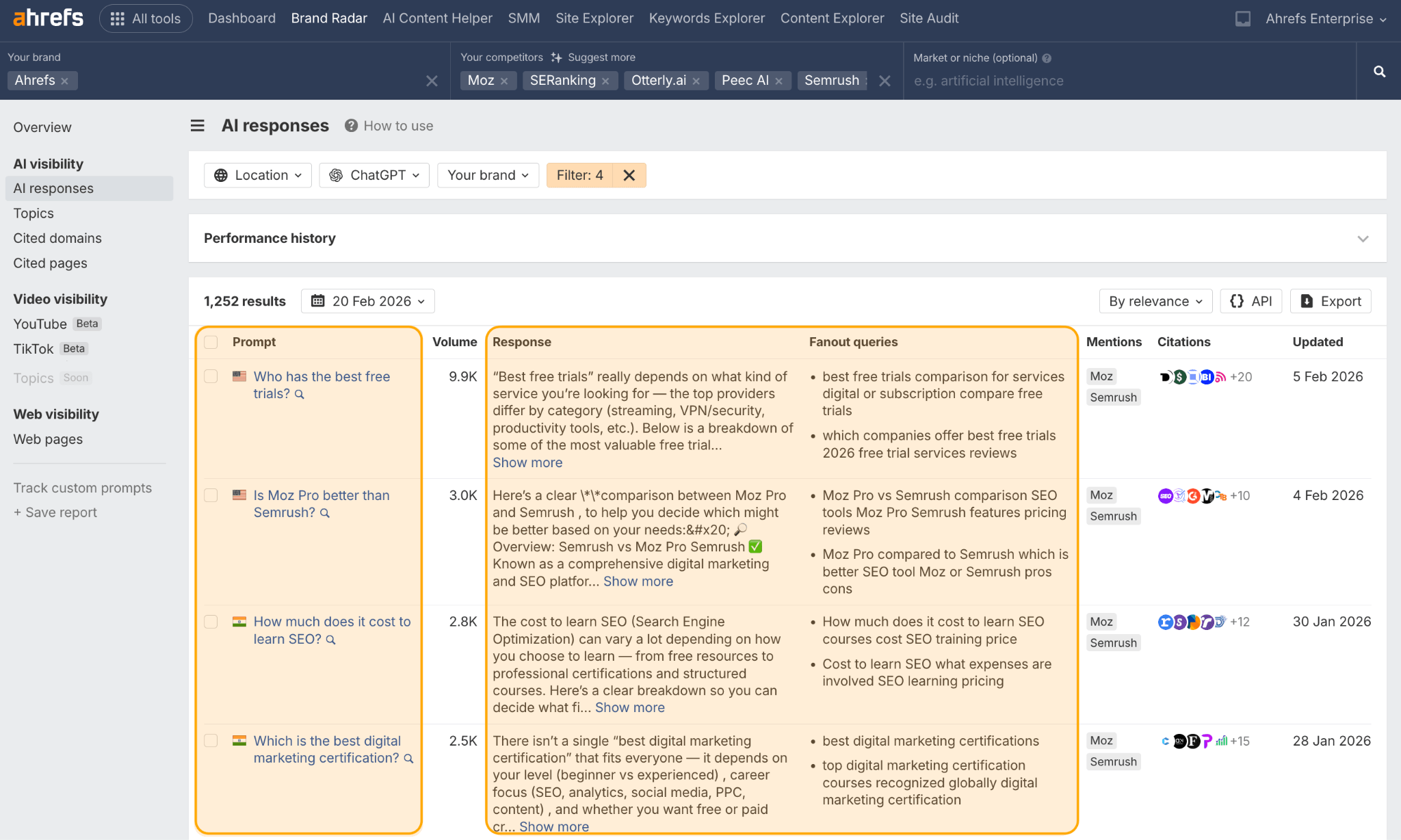
This gives you an understanding of which types of content to create, and who to contact to boost your own mentions.
General ChatGPT visibility improvements
Here are a few things that can help regardless of which scenario you’re in:
- Structure content for extractability: Write in clear, direct prose with explicit definitions, use-case statements, and comparisons. LLMs favor content where claims are easy to isolate.
- Build brand mentions across diverse sources: A brand mentioned in 50 different publications is more reliably surfaced by ChatGPT than one mentioned 500 times in its own blog.
- Set up alerts for your brand name: If you configure an Ahrefs Alert you will get notified every time a new page mentions you online—and that’s a link-building opportunity. Earning proper backlinks to those unlinked mentions strengthens your content authority, which compounds across both search and AI citations over time.
- Track visibility correlations: Note when you publish content, earn press, or push to review sites, then look for corresponding changes in monitoring data 4-8 weeks later. Over time, you’ll develop a sense of which activities actually move the needle.
Final thoughts
Start simple: run the manual prompt audit from the manual method section this week, and document what you find.
That baseline tells you whether your immediate problem is awareness (you’re invisible), accuracy (ChatGPT is describing you wrong), or competitive positioning (you’re present but getting outrun).
The tools and action plans only become meaningful once you know which problem you’re actually solving.
Then you can dive deeper, and monitor your ChatGPT mentions in a dedicated AI tracking tool.
Got questions? Ping me on LinkedIn.